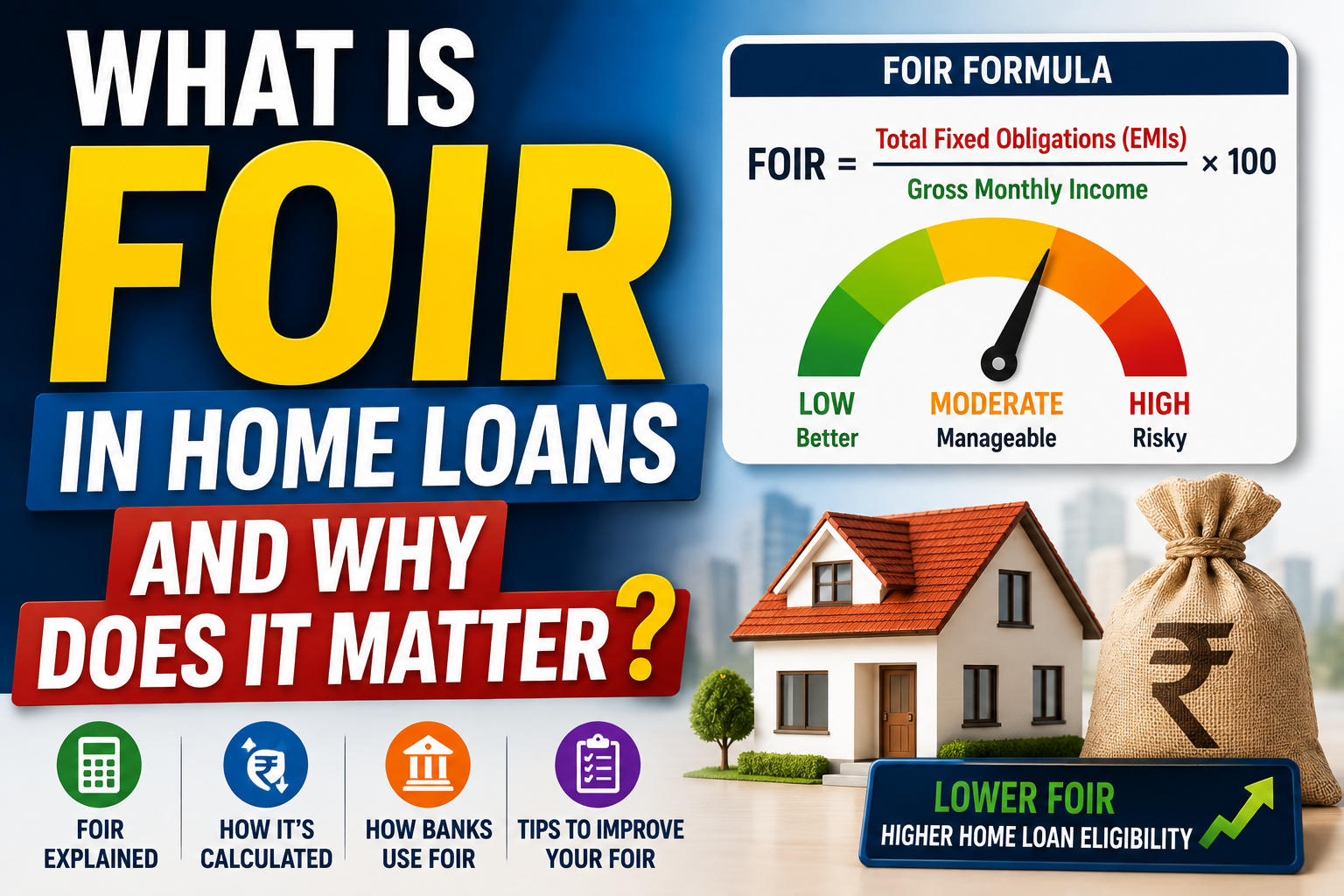
What is FOIR in home loans? Learn how Fixed Obligation to Income Ratio is calculated, why banks use it, ideal FOIR ranges, examples, and how FOIR affects your home loan eligibility.
Table of Contents
Buying a home is one of the biggest financial decisions most people make. Before approving a home loan, banks and housing finance companies don’t simply look at the property’s value or your CIBIL Score. They also want to know whether your monthly income is sufficient to handle the proposed home-loan EMI along with your existing financial commitments.
This is where FOIR, or Fixed Obligation to Income Ratio, becomes important.
FOIR is a financial ratio used by lenders to assess how much of your income is already committed to fixed monthly obligations and how much room remains for a new loan repayment.
For example, if you earn ₹1 lakh per month and your existing loan EMIs plus the proposed home-loan EMI come to ₹45,000, your FOIR would be 45% under that calculation method.
A lower FOIR generally indicates greater repayment capacity, while a higher FOIR suggests that a larger portion of your income is already committed to debt obligations.
However, there is an important point borrowers should understand:
There is no universal FOIR limit that applies to every home-loan applicant in India.
Lenders have their own credit policies and may assess income, liabilities, credit history, employment stability, property details and other factors. The Reserve Bank of India says banks assess home-loan eligibility based on repayment capacity, including monthly disposable or surplus income, income stability, liabilities and other relevant factors.
So, FOIR is best understood as one part of the lender’s overall affordability assessment, rather than a simple pass-or-fail number.
What Does FOIR Mean?
FOIR stands for Fixed Obligation to Income Ratio.
It measures the relationship between a borrower’s fixed monthly financial obligations and their income considered by the lender.
A commonly used simplified formula is:
FOIR = (Existing Monthly Obligations + Proposed Home Loan EMI) ÷ Monthly Income × 100
For example:
- Monthly income: ₹1,00,000
- Existing EMI: ₹15,000
- Proposed home-loan EMI: ₹30,000
Total monthly obligations:
₹15,000 + ₹30,000 = ₹45,000
FOIR:
₹45,000 ÷ ₹1,00,000 × 100 = 45%
Therefore, the FOIR in this example is 45%.
However, the exact calculation can differ between lenders. Some institutions may use gross income, some may use a lender-defined considered income, and the obligations included can also vary.
BankBazaar describes FOIR as a measure of fixed monthly obligations relative to income and notes that lenders can consider existing liabilities and other fixed expenses when assessing loan eligibility.
Why Is FOIR Important for Home Loans?
A home loan is usually a long-term financial commitment.
A borrower may have to make EMI payments for 15, 20 or even 30 years, depending on the loan and lender.
Therefore, the lender wants to determine whether the proposed EMI is realistically affordable.
Imagine two applicants.
Applicant A
Monthly income: ₹1,00,000
Existing EMIs: ₹10,000
Proposed home-loan EMI: ₹30,000
Total obligations: ₹40,000
FOIR: 40%
Applicant B
Monthly income: ₹1,00,000
Existing EMIs: ₹35,000
Proposed home-loan EMI: ₹30,000
Total obligations: ₹65,000
FOIR: 65%
Both applicants earn ₹1 lakh per month.
But Applicant B already has considerably more debt commitments.
The second applicant may therefore have less disposable income available for household expenses, savings and unexpected costs.
This is why lenders consider repayment capacity when determining home-loan eligibility. RBI’s consumer guidance specifically says banks look at monthly disposable or surplus income, liabilities, income stability and other factors when assessing repayment capacity.
How Is FOIR Calculated for a Home Loan?
Let’s understand the calculation with a more detailed example.
Suppose your monthly income is:
₹1,20,000
Your existing obligations are:
- Car loan EMI: ₹12,000
- Personal loan EMI: ₹8,000
- Other eligible monthly obligation: ₹5,000
Existing obligations:
₹25,000
Now suppose the proposed home-loan EMI is:
₹35,000
Total obligations:
₹25,000 + ₹35,000 = ₹60,000
FOIR:
₹60,000 ÷ ₹1,20,000 × 100
= 50%
So, under this simplified calculation, your FOIR would be 50%.
The lender may then combine this information with your CIBIL Score, income stability, employment profile, age, loan tenure, property value and other underwriting factors.
What Is a Good FOIR for a Home Loan?
There is no single FOIR percentage that guarantees home-loan approval.
You will often see figures such as 40%, 50% or 55% mentioned online. These can be useful as general illustrations, but they should not be treated as universal rules.
Different lenders can have different internal policies.
BankBazaar’s home-loan guidance, for example, notes that lenders may commonly assess FOIR within a broad range and that the acceptable level can depend on factors such as income stability and credit profile.
Historical RBI housing-loan guidance has also emphasized repayment capacity rather than establishing one universal FOIR threshold for every borrower. RBI’s consumer FAQ says banks typically assess how much of a borrower’s monthly disposable or surplus income can be used toward repayment, while the actual methodology can differ between institutions.
In simple terms:
- Lower FOIR: Generally gives you more repayment flexibility.
- Moderate FOIR: May be acceptable depending on the lender and your profile.
- High FOIR: Can reduce the loan amount you qualify for or make approval more difficult.
The exact threshold is lender-specific.
Does a High FOIR Mean Your Home Loan Will Be Rejected?
Not necessarily.
A high FOIR can make approval more difficult, but lenders don’t usually make decisions based on a single ratio alone.
They may also consider:
- CIBIL Score
- Monthly income
- Employment stability
- Age
- Existing liabilities
- Loan tenure
- Property value
- Loan-to-value ratio
- Co-applicant income
- Banking history
- Credit history
- Type of employment
- Self-employed business income
For example, someone with a high income and strong financial profile may receive a different assessment from someone with the same FOIR but unstable income.
Axis Bank has publicly discussed FOIR as part of its retail credit risk framework, demonstrating that the ratio is used as a risk-management parameter rather than as an isolated consumer score.
How Existing Loans Affect Your FOIR
Existing loans can significantly affect home-loan eligibility.
Suppose you earn ₹1 lakh per month.
You already have:
- Car loan EMI: ₹15,000
- Personal loan EMI: ₹10,000
Your existing obligations are:
₹25,000 per month
Now assume the lender considers a maximum affordable obligation of ₹50,000 under its internal methodology.
You have approximately:
₹50,000 − ₹25,000 = ₹25,000
available within that assumed obligation limit for the proposed home-loan EMI.
This doesn’t mean the lender will automatically approve a loan whose EMI is ₹25,000. It simply illustrates how existing debt can reduce your borrowing capacity.
This is why paying off or reducing an existing loan before applying for a home loan can sometimes improve eligibility.
Does Credit Card Debt Affect FOIR?
It can.
Credit cards are revolving credit rather than conventional EMI loans, so the exact way a lender treats credit-card obligations can vary.
A lender may consider information relating to your credit-card balances, repayment obligations or other credit commitments when evaluating your overall financial position.
Even if your credit-card payment is relatively small, consistently carrying large outstanding balances can also affect your overall credit profile.
Therefore, don’t assume:
“I don’t have a personal loan, so my FOIR must be low.”
A lender can examine your broader financial obligations rather than looking only at conventional loan EMIs.
Does Rent Count in FOIR?
This depends on the lender’s methodology.
Some lenders may consider rent or housing expenses when assessing affordability, while others may use different calculations.
This is important because FOIR is not a standardized consumer formula with exactly the same inputs across every bank and housing finance company.
For example, a lender may calculate a borrower’s obligations using certain loan EMIs but separately assess rent and household expenses while determining disposable income.
RBI’s home-loan guidance emphasizes monthly disposable or surplus income and overall repayment capacity rather than prescribing one universal formula for every institution.
So, if you’re calculating your own FOIR before applying, treat the result as an estimate—not the exact number your lender will necessarily use.
FOIR vs Debt-to-Income Ratio: What’s the Difference?
FOIR and debt-to-income ratio can look very similar because both compare debt obligations with income.
But the terminology and calculation methods can differ depending on the lender and financial product.
FOIR
Usually focuses on fixed monthly financial obligations relative to income.
Debt-to-Income Ratio
Generally compares total monthly debt payments with gross monthly income.
For example:
Monthly income = ₹1,00,000
Monthly debt obligations = ₹40,000
DTI:
40%
A lender may use FOIR, DTI, or another affordability measure depending on its internal credit policy.
The key idea behind all these ratios is similar:
How much of your income is already committed, and how much repayment capacity remains?
How FOIR Affects Your Home Loan Amount
FOIR can directly influence the maximum home-loan EMI a lender considers affordable.
Suppose:
Monthly income = ₹1,00,000
Assume, purely for illustration, that a lender’s assessment permits total obligations of ₹50,000.
Existing EMI = ₹10,000
Potential room for the new EMI:
₹50,000 − ₹10,000 = ₹40,000
The lender can then use the proposed EMI, interest rate and tenure to estimate a possible loan amount.
This is why two people earning exactly the same salary can qualify for different home-loan amounts.
Applicant A
Income: ₹1,00,000
Existing EMI: ₹5,000
Applicant B
Income: ₹1,00,000
Existing EMI: ₹25,000
Applicant A has more income available after existing debt obligations.
Therefore, Applicant A may potentially qualify for a larger home loan, subject to all other criteria.
How Loan Tenure Can Affect FOIR
Loan tenure can have a significant effect on EMI.
Suppose you borrow ₹50 lakh.
A longer tenure generally results in a lower monthly EMI, all else equal.
A shorter tenure generally produces a higher EMI.
Because FOIR is based on monthly obligations, a lower EMI can reduce the ratio.
However, there’s a major trade-off.
Longer tenure
Advantages:
- Lower monthly EMI
- Lower monthly obligation
- Potentially easier affordability assessment
Disadvantages:
- More interest paid over the life of the loan
- Debt remains outstanding for longer
Shorter tenure
Advantages:
- Faster repayment
- Potentially lower total interest cost
Disadvantages:
- Higher monthly EMI
- Higher monthly obligation
Therefore, don’t choose a 30-year loan solely because it lowers your FOIR.
You should compare the total interest cost as well as the monthly EMI.
Can a Co-Applicant Improve Your FOIR?
A co-applicant with a stable and acceptable income can potentially strengthen a home-loan application.
For example:
Applicant’s monthly income = ₹70,000
Co-applicant’s considered income = ₹50,000
Combined income = ₹1,20,000
If the lender permits clubbing of their incomes and both applicants satisfy its criteria, the additional income can improve overall repayment capacity.
However, a co-applicant does not automatically guarantee approval.
The lender may also examine:
- Co-applicant’s credit history
- Existing liabilities
- Income stability
- Age
- Relationship with the primary applicant
- Property ownership structure
- Other eligibility criteria
The exact treatment varies by lender.
How to Reduce Your FOIR Before Applying for a Home Loan
If your FOIR is high, there are several legitimate ways to improve your financial position.
1. Pay Off Smaller Existing Loans
If you have a small personal or vehicle loan nearing completion, paying it off may eliminate an existing EMI.
However, don’t use all your savings to close debt if doing so leaves you without an emergency fund.
2. Reduce Credit-Card Debt
Large revolving balances can increase your overall financial obligations and may also affect your credit profile.
Paying down expensive credit-card debt can improve your financial position.
3. Increase Your Down Payment
A larger down payment means you may need to borrow less.
For example:
Property price = ₹80 lakh
If you borrow ₹65 lakh, your EMI will be higher than if you borrow ₹55 lakh, assuming the same interest rate and tenure.
A larger down payment can therefore reduce the proposed EMI.
But again, don’t drain your entire savings account.
Homebuyers also need money for:
- Registration and stamp-related costs
- Moving expenses
- Furnishing
- Repairs
- Emergency savings
- Other transaction costs
4. Consider a Longer Tenure Carefully
A longer tenure can reduce your monthly EMI and therefore may improve affordability.
But calculate the total interest before choosing it.
A lower EMI isn’t automatically a cheaper loan.
5. Increase Documented Income
If your income has increased but you haven’t updated your financial documentation, make sure your lender receives accurate and current income information.
For salaried borrowers, this can include relevant salary slips, bank statements and income documents.
For self-employed borrowers, lenders may examine tax returns, financial statements, bank transactions and business income.
RBI’s home-loan guidance lists documents such as salary slips, Form 16, bank statements and financial statements among the documents lenders may request depending on the applicant.
Can a Good CIBIL Score Offset a High FOIR?
Not completely.
This is an important reality check.
A strong CIBIL Score demonstrates a positive credit history, but it doesn’t magically increase your income or reduce your existing EMIs.
Imagine:
CIBIL Score = 800
Monthly income = ₹80,000
Existing EMIs = ₹45,000
Proposed home-loan EMI = ₹30,000
The borrower may have excellent credit history, but the proposed total obligation would be ₹75,000 per month.
That’s a very different risk profile from someone with:
CIBIL Score = 760
Monthly income = ₹1,20,000
Existing EMIs = ₹15,000
Proposed home-loan EMI = ₹35,000
The second applicant has a lower CIBIL Score but potentially much stronger repayment capacity.
This illustrates why credit score and affordability are separate concepts.
Is FOIR the Same for Every Bank?
No.
This is one of the most important things to understand.
Banks and housing finance companies have their own underwriting policies.
One lender may be comfortable with a particular FOIR for a specific applicant profile, while another lender may apply a more conservative assessment.
The lender may also change the calculation based on:
- Income level
- Employment type
- City
- Employer profile
- Credit score
- Existing obligations
- Loan amount
- Property type
- Loan tenure
- Co-applicant income
Therefore, don’t assume that a particular FOIR percentage you found online is a guaranteed eligibility threshold.
FOIR and Property Loan-to-Value Are Different
Another common confusion is between FOIR and LTV.
FOIR evaluates your income and repayment capacity.
LTV, or Loan-to-Value ratio, compares the loan amount with the value of the property.
For example:
Property value = ₹80 lakh
Loan = ₹60 lakh
LTV:
₹60 lakh ÷ ₹80 lakh × 100 = 75%
So:
FOIR = borrower affordability
LTV = loan relative to property value
Both can matter in a home-loan application, but they measure completely different risks.
What Documents Help Lenders Assess FOIR?
The exact documentation depends on the lender and applicant, but borrowers may be asked for documents such as:
Salaried applicants
- Salary slips
- Bank statements
- Form 16
- Identity documents
- Address documents
- Existing loan details
Self-employed applicants
- Income-tax returns
- Financial statements
- Bank statements
- Business-related documents
- Identity and address documents
The lender uses these documents to establish income, existing obligations and overall repayment capacity.
RBI’s consumer home-loan guidance also advises borrowers to understand the documentation and terms required by their bank before proceeding.
Common Mistakes Borrowers Make About FOIR
Mistake 1: Assuming 50% Is a Universal Rule
It isn’t.
Different lenders use different methodologies.
Mistake 2: Ignoring Existing EMIs
A high salary doesn’t guarantee a large loan if most of that salary is already committed.
Mistake 3: Taking a New Personal Loan Before Applying
A new EMI can reduce your home-loan eligibility.
Mistake 4: Choosing a Long Tenure Only to Reduce EMI
It may lower the monthly payment but increase total interest.
Mistake 5: Ignoring Emergency Savings
Don’t use every rupee of savings to reduce your FOIR.
Mistake 6: Thinking CIBIL Is Enough
A strong credit score is useful, but lenders also assess repayment capacity.
Frequently Asked Questions About FOIR
What is FOIR in a home loan?
FOIR stands for Fixed Obligation to Income Ratio. It compares a borrower’s fixed monthly financial obligations with income and helps lenders assess repayment capacity.
What is a good FOIR for a home loan?
There is no universal number. Many lenders use their own internal thresholds, and acceptable FOIR can vary depending on income, credit profile, employment and other factors.
Does FOIR affect home-loan eligibility?
Yes. A higher level of existing monthly obligations can reduce the amount a borrower may be eligible to borrow because less income remains available for the proposed EMI.
Does a personal loan affect FOIR?
Yes, an existing personal-loan EMI can be treated as a financial obligation in the lender’s assessment and can reduce available repayment capacity.
Can I improve FOIR before applying?
Potentially. Reducing existing debt, increasing the down payment, improving documented income or restructuring the proposed loan amount can affect affordability. The best option depends on your financial situation.
Is FOIR more important than CIBIL Score?
Neither should be viewed in isolation. CIBIL reflects credit history, while FOIR focuses on repayment capacity. Lenders can consider both along with several other factors.
Final Takeaway
FOIR, or Fixed Obligation to Income Ratio, is an important concept in home-loan eligibility because it helps lenders assess whether your existing financial commitments and proposed home-loan EMI are manageable relative to your income.
The basic idea is straightforward:
More income + fewer existing obligations = greater potential repayment capacity.
But don’t make the mistake of treating FOIR as a universal pass-or-fail number.
There is no single FOIR percentage that guarantees home-loan approval across all Indian lenders. Banks and housing finance companies can use different underwriting models and may consider income, liabilities, CIBIL Score, employment stability, property value, loan tenure, co-applicant income and other factors. RBI’s own consumer guidance emphasizes overall repayment capacity and disposable/surplus income when discussing home-loan eligibility.
Before applying for a home loan, calculate your existing EMIs, estimate the proposed EMI, review your income and understand how much of your monthly cash flow will remain after debt payments.
Most importantly, don’t optimize only for loan approval.
Optimize for comfortable repayment.
A bank approving a large home loan doesn’t automatically mean that the loan is financially comfortable for you.
Useful Outbound Resources
- Reserve Bank of India – Housing Loans FAQ
- RBI – Housing Loan Guidelines
- ICICI Bank – Loan Eligibility and FOIR Reference
- Axis Bank – Credit Risk and FOIR Framework
- BankBazaar – FOIR Explained
Why is your CIBIL score not increasing despite paying EMIs on time? Learn about credit utilization, loan age, credit mix, enquiries, reporting delays, and errors that may affect your CIBIL score.
