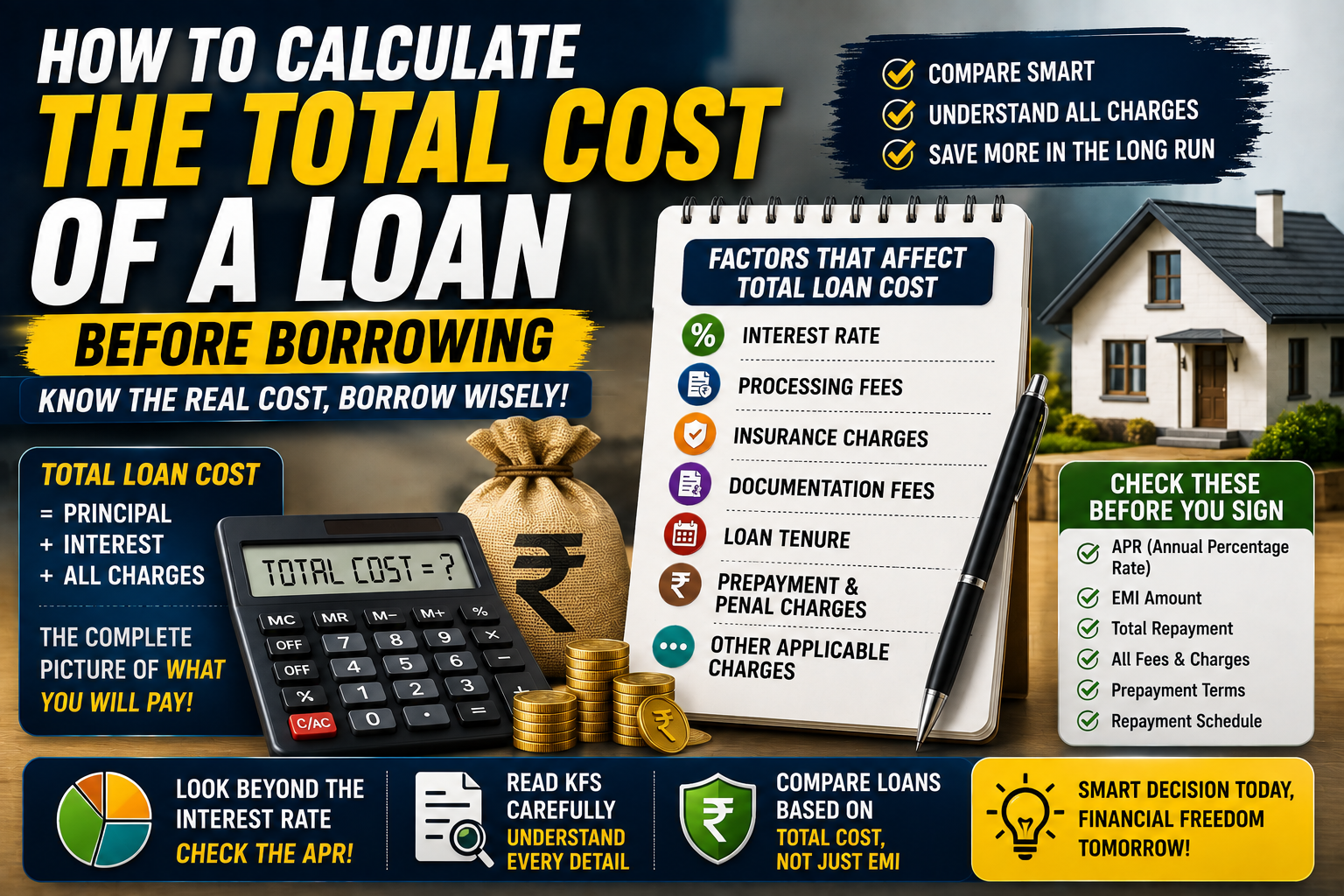
Learn how to calculate the Total Cost of a Loan before borrowing. Understand interest, EMI, processing fees, APR, insurance, penalties and other loan charges.
Table of Contents
Targeted Keyword: Total Cost of a Loan
Secondary Keywords: loan cost calculation, total loan repayment, loan interest calculation, APR on loans, loan charges, EMI calculation, borrowing cost, loan fees
Borrowing money can solve an immediate financial need, but the amount you receive is not the same as the amount you eventually pay back.
If you borrow ₹5 lakh, for example, you may receive ₹5 lakh in your account, but over the life of the loan you could repay considerably more because of interest, processing fees and other applicable charges.
This is why borrowers should calculate the Total Cost of a Loan before accepting any loan offer.
Many people compare loans by looking at just one number:
Interest Rate.
That is a mistake.
A loan with a lower advertised interest rate can sometimes have higher fees, a longer tenure or other costs that make it more expensive overall.
The better approach is to calculate the complete borrowing cost before signing the agreement.
For applicable loans, the Reserve Bank of India (RBI) requires regulated entities to provide a Key Facts Statement (KFS) containing important loan information, including the Annual Percentage Rate (APR) and an amortisation schedule. RBI defines APR as the annual cost of credit to the borrower, including the interest rate and other charges associated with the credit facility.
So, if you are planning to take a personal loan, home loan, vehicle loan, education loan or another form of credit, here’s how to calculate what the loan will actually cost you.
What Is the Total Cost of a Loan?
The Total Cost of a Loan is the complete amount you are financially responsible for paying in connection with the borrowing, considering the principal, interest and applicable charges over the relevant period.
A simplified formula is:
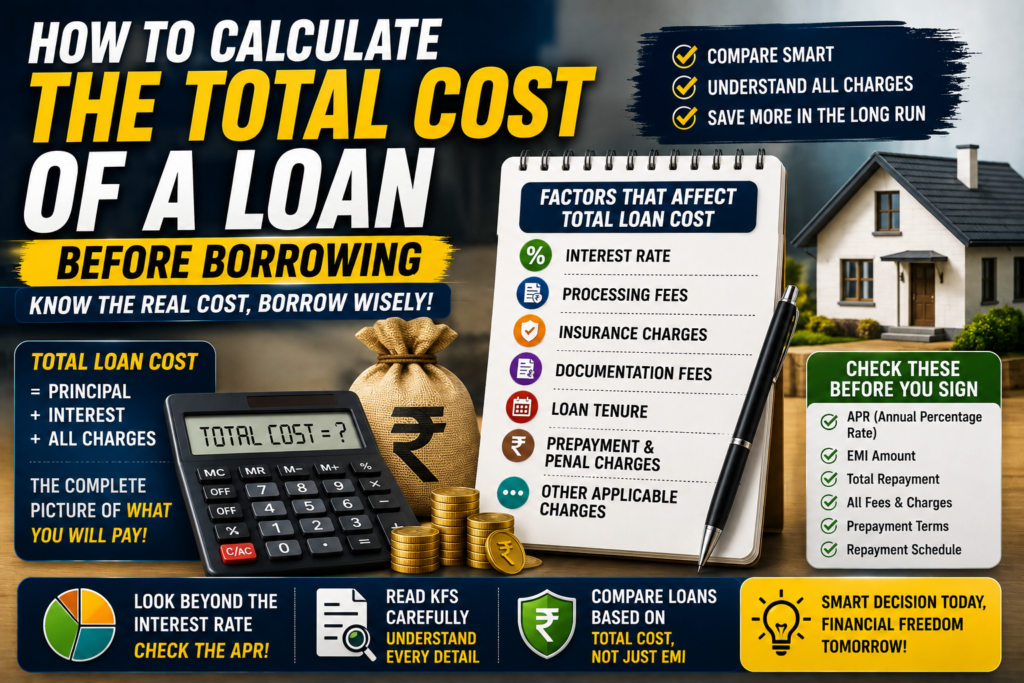
Total Loan Cost = Principal + Total Interest + Applicable Fees and Charges
However, this is only a starting point.
Depending on the loan, you may also need to consider:
- Processing fees
- Documentation charges
- Insurance-related charges
- Legal or technical charges
- Payment-return charges
- Penal charges
- Prepayment or foreclosure charges, where applicable
- Other lender or third-party charges
Therefore, simply calculating:
EMI × Number of EMIs
is not always enough to understand the complete economics of a loan.
You need to know what each payment and fee represents.
Why You Should Calculate the Total Cost Before Borrowing
Suppose two lenders offer you:
Lender A
Interest rate: 11%
Lender B
Interest rate: 12%
Most borrowers would immediately choose Lender A.
But suppose:
Lender A processing fee = ₹20,000
Lender B processing fee = ₹3,000
Now the difference is smaller than it first appeared.
The same problem can occur with:
- Insurance
- Documentation fees
- Longer tenure
- Prepayment charges
- Other applicable fees
This is why the right question isn’t:
“Which loan has the lowest interest rate?”
It is:
“Which loan has the lowest overall cost for my specific borrowing requirement?”
Step 1: Identify the Amount You Actually Need
Before calculating loan cost, determine how much money you actually need.
Suppose you need:
₹5,00,000
Don’t automatically borrow ₹6 lakh just because the lender offers it.
The larger the principal:
- The larger the potential interest cost
- The larger the EMI
- The greater the repayment obligation
Borrow only what you genuinely need and can comfortably repay.
Step 2: Check the Interest Rate
The interest rate is one of the biggest components of loan cost.
Suppose:
Loan amount = ₹5,00,000
Interest rate = 12%
Tenure = 5 years
But don’t stop at the 12%.
Ask:
- Is the rate fixed or floating?
- Is it flat or reducing balance?
- What benchmark is used if it is floating?
- How frequently can the rate reset?
- What is the APR?
- Are there additional charges?
The interest rate tells you the price of borrowing, but not necessarily the entire cost.
Step 3: Calculate the EMI
For a standard reducing-balance loan with a monthly EMI, the formula is:
EMI = P × r × (1+r)^n / [(1+r)^n − 1]
Where:
- P = principal loan amount
- r = monthly interest rate
- n = total number of monthly instalments
For example:
Loan = ₹5,00,000
Annual interest = 12%
Monthly rate = 12% ÷ 12 = 1%
Tenure = 5 years = 60 months
The approximate EMI would be:
₹11,122 per month
The exact amount can vary depending on the lender’s calculation methodology and repayment dates.
Step 4: Calculate Total EMI Payments
Once you know the EMI, calculate:
Total EMI Payments = EMI × Number of EMIs
Using the example:
₹11,122 × 60 ≈ ₹6,67,320
Therefore, you would pay approximately:
₹6.67 lakh
through EMIs over five years.
Since the original loan was:
₹5 lakh
the difference represents approximately:
₹1.67 lakh
in interest, before considering other charges.
This is a much more useful number than simply knowing that the loan has a 12% interest rate.
Step 5: Add the Processing Fee
Now consider the processing fee.
Suppose the lender charges:
Processing fee = ₹5,000
Your borrowing cost becomes approximately:
₹1,67,320 interest
₹5,000 processing fee
=
₹1,72,320
before considering any other applicable charges.
If the processing fee is deducted from the disbursement, you may actually receive less money than the sanctioned loan amount.
For example:
Sanctioned loan = ₹5,00,000
Processing fee = ₹5,000
Net amount received = approximately ₹4,95,000
Yet your repayment obligation may still be based on the contractual ₹5 lakh principal.
That difference matters when assessing the true cost of borrowing.
Step 6: Check Insurance Charges
Some loans may involve insurance or other third-party services.
For example, a lender may offer or require insurance depending on the loan product and applicable terms.
Don’t automatically assume an insurance amount is part of the interest.
Ask:
Is this charge mandatory?
Who receives the money?
Is it included in the APR?
For applicable loans under RBI’s KFS framework, charges recovered from borrowers on behalf of third-party service providers, such as insurance or legal charges, are included in APR where the regulated entity is involved in recovering them, and such charges should be disclosed separately.
This makes it important to examine the KFS rather than relying solely on an advertisement.
Step 7: Check Documentation and Other Fees
Depending on the type of loan, you may encounter:
- Documentation charges
- Legal fees
- Technical valuation fees
- Administrative charges
- Stamp-related costs
- Account-related charges
- Other applicable third-party costs
Not every loan has all of these.
But you should ask the lender for a complete fee schedule.
RBI has emphasized transparency in loan pricing and disclosure of applicable fees and charges so borrowers can compare borrowing costs more effectively.
Step 8: Check the APR
This is one of the most important steps.
The Annual Percentage Rate (APR) provides a broader measure of the annual cost of credit than the headline interest rate.
RBI’s KFS framework defines APR as the annual cost of credit to the borrower, including the interest rate and all other charges associated with the credit facility.
For applicable loans, the KFS includes an APR calculation sheet and amortisation schedule.
This is extremely useful when comparing two loans.
For example:
| Loan A | Loan B | |
|---|---|---|
| Advertised rate | 11% | 12% |
| Processing fee | ₹15,000 | ₹3,000 |
| APR | 14.2% | 13.4% |
Although Loan A has the lower advertised rate, Loan B may have the lower overall annualized cost in this hypothetical example.
That’s why you shouldn’t judge a loan solely by the advertised interest rate.
Step 9: Understand the Loan Tenure
Loan tenure has a major impact on total cost.
Suppose you borrow:
₹5 lakh at 12%
You could choose a shorter or longer repayment period.
Shorter tenure
Higher EMI
Lower total interest
Longer tenure
Lower EMI
Higher total interest
This creates an important trade-off.
A longer tenure can make the loan easier to manage every month, but you may pay significantly more interest over the entire repayment period.
Example: Short vs Long Tenure
Imagine a ₹5 lakh loan at a hypothetical 12% reducing rate.
3-year tenure
EMI will be relatively high.
But total interest will be comparatively lower.
5-year tenure
EMI becomes lower.
But total interest increases.
7-year tenure
EMI becomes even lower.
But you may pay considerably more interest over the life of the loan.
Therefore, don’t choose the longest tenure simply because the EMI looks affordable.
Ask:
“How much extra interest am I paying to reduce my monthly EMI?”
Step 10: Check Whether the Loan Is Flat Rate or Reducing Rate
This is particularly important for personal, vehicle and consumer loans.
A flat interest rate generally calculates interest based on the original principal throughout the stated tenure.
A reducing-balance rate calculates interest based on the outstanding principal.
For example, a lender might advertise:
10% flat
while another offers:
12% reducing
You cannot conclude that 10% is cheaper simply because the percentage is lower.
The calculation methods are different.
Always ask:
“Is this a flat rate or reducing-balance rate?”
Then compare the total repayment and APR.
Step 11: Check Prepayment and Foreclosure Charges
If you plan to repay the loan early, prepayment terms can materially affect your total cost.
Suppose your loan has:
Outstanding principal = ₹3 lakh
You want to repay it early.
If the loan agreement and applicable regulations permit a charge, you need to include that cost in your calculation.
However, the rules are not identical across all loan types and lenders.
For example, RBI has restrictions on foreclosure/prepayment charges for certain floating-rate loans to individual borrowers, while the applicable treatment depends on the loan and lender. Always verify the current rules and your specific agreement before calculating the cost of early repayment.
The important lesson is:
Don’t assume every loan has the same prepayment rules.
Step 12: Consider Penal Charges
A loan’s total cost can also increase if you miss payments.
Depending on the applicable regulatory framework and loan agreement, you may face permitted penal charges or other consequences associated with default.
RBI’s framework for covered regulated entities requires penalties for non-compliance with material loan terms to be treated as penal charges rather than being added to the interest rate, and penal charges should not be capitalised.
This doesn’t mean missing an EMI is harmless.
A missed payment can still result in:
- Applicable penal charges
- Payment-return charges
- Continuing contractual interest
- Potential credit-report consequences
Therefore, when calculating your expected loan cost, also understand what happens if you cannot pay on time.
Step 13: Calculate the Total Amount You Will Repay
Now bring everything together.
A simplified calculation is:
Total Loan Cost = Total Principal Repayment + Total Interest + Applicable Charges
If the principal is ₹5 lakh and total EMI payments are ₹6.67 lakh:
Total interest ≈ ₹1.67 lakh
If processing fees and other applicable charges total ₹8,000:
Estimated total outflow ≈ ₹6.75 lakh
Again, the exact calculation should follow the lender’s repayment schedule and KFS.
Step 14: Calculate the Net Amount You Actually Receive
This is often overlooked.
Suppose:
Loan sanctioned = ₹5,00,000
Processing fee:
₹5,000
Insurance:
₹2,000
Other upfront charges:
₹1,000
Your net disbursement could be approximately:
₹4,92,000
But your contractual repayment may still relate to a ₹5 lakh loan.
Therefore, compare:
Net amount received
with:
Total amount repaid
rather than just comparing the sanctioned amount with the final repayment.
This provides a more realistic picture of your borrowing cost.
A Simple Total Cost Example
Suppose you take:
Loan amount: ₹5,00,000
Interest rate: 12%
Tenure: 5 years
Approximate EMI: ₹11,122
Number of EMIs: 60
Total EMI payments:
₹11,122 × 60 ≈ ₹6,67,320
Suppose additional charges are:
Processing fee = ₹5,000
Documentation/other charges = ₹2,000
Total additional charges:
₹7,000
Then approximate total outflow becomes:
₹6,67,320 + ₹7,000
= ₹6,74,320
So although you borrowed:
₹5,00,000
your approximate total financial outflow is:
₹6.74 lakh
The difference is roughly:
₹1.74 lakh
This is the kind of calculation borrowers should perform before accepting a loan.
Total Cost of a Loan vs EMI
These are not the same thing.
EMI
Shows how much you pay periodically.
Total Cost
Shows how much the loan costs you over its relevant life, after considering interest and applicable charges.
Suppose:
Loan A EMI = ₹10,000
Loan B EMI = ₹12,000
You might choose Loan A.
But if:
Loan A tenure = 7 years
and:
Loan B tenure = 5 years
Loan B could potentially have a lower total interest cost despite the higher EMI.
Therefore:
Never compare EMI without comparing tenure.
Total Cost of a Loan vs Interest Rate
The same principle applies to interest rates.
Suppose:
Loan A = 10%
Loan B = 12%
Loan A appears cheaper.
But what if:
Loan A processing fee = ₹30,000
Loan B processing fee = ₹2,000
And Loan A has a much longer tenure?
The actual difference in total cost could be much smaller than the headline rate suggests.
This is why the Total Cost of a Loan is the more useful metric.
How to Compare Two Loan Offers
Create a simple comparison table.
| Factor | Loan A | Loan B |
|---|---|---|
| Loan amount | ₹5 lakh | ₹5 lakh |
| Interest rate | 11% | 12% |
| Rate type | Reducing | Reducing |
| Tenure | 5 years | 5 years |
| EMI | ₹___ | ₹___ |
| Total interest | ₹___ | ₹___ |
| Processing fee | ₹___ | ₹___ |
| Insurance | ₹___ | ₹___ |
| Other charges | ₹___ | ₹___ |
| APR | ___% | ___% |
| Total repayment | ₹___ | ₹___ |
| Prepayment terms | Check | Check |
The cheapest loan becomes much easier to identify once all these figures are visible.
Use the KFS Before Signing
For applicable regulated loans, the Key Facts Statement is one of the most important documents you should review.
RBI’s framework requires the KFS to be presented in a standardized format and to include the APR calculation and amortisation schedule for applicable loans.
The framework also says that charges not mentioned in the KFS generally cannot be charged during the loan term without the borrower’s explicit consent.
This provides an important practical lesson:
Don’t sign the loan agreement before reading the KFS.
Compare the KFS with what the salesperson or loan app promised you.
If something doesn’t match, ask for clarification before accepting the loan.
How to Calculate Loan Cost Using an Amortisation Schedule
An amortisation schedule shows how each EMI is divided between:
- Principal
- Interest
- Outstanding balance
For example:
| EMI | Principal | Interest | Outstanding |
|---|---|---|---|
| 1 | ₹6,000 | ₹5,000 | ₹4,94,000 |
| 2 | ₹6,060 | ₹4,940 | ₹4,87,940 |
| 3 | ₹6,121 | ₹4,879 | ₹4,81,819 |
These figures are illustrative.
As the outstanding principal declines, the interest component generally declines while the principal component increases.
RBI’s KFS framework includes an amortisation schedule for applicable loans, making it easier for borrowers to understand the repayment structure.
What About Taxes on Loan Charges?
Some loan-related services and charges may have applicable taxes.
Don’t assume that a fee shown by a lender is always the final amount payable.
For example, if a lender quotes a processing fee of:
₹5,000 + applicable tax
your actual cost may be higher than ₹5,000.
Always check whether quoted fees are:
inclusive or exclusive of applicable taxes.
The KFS and lender’s fee schedule should help clarify the applicable charges.
How to Calculate the Cost of a Floating-Rate Loan
Floating-rate loans require additional care because the future interest rate may change.
Suppose:
Initial rate = 8.5%
Your loan is linked to a benchmark.
If the benchmark changes, the loan rate may change according to the applicable terms.
This can affect:
- EMI
- Tenure
- Total interest
RBI’s framework for floating-rate EMI-based personal loans requires lenders to communicate the impact of rate resets and applicable options to borrowers.
Therefore, when calculating the cost of a floating-rate loan, consider scenarios.
Scenario 1
Rate remains unchanged.
Scenario 2
Rate rises by 1%.
Scenario 3
Rate falls by 1%.
This gives you a better understanding of the potential range of repayment costs.
Don’t Forget Opportunity Cost
Loan cost isn’t only about fees.
Consider what the borrowed money is being used for.
Suppose you borrow:
₹3 lakh
to buy something that loses value quickly.
Even if the loan’s interest rate looks reasonable, you are paying interest on an asset that may depreciate.
Therefore, ask:
“Is the benefit I receive from borrowing worth the total cost?”
For a home loan, the answer may be different from a personal loan used for discretionary spending.
The cheapest loan is not necessarily the best financial decision if the borrowing itself isn’t necessary.
How Credit Score Can Affect Loan Cost
Your credit profile can influence the pricing and terms offered by lenders.
A stronger credit history may improve your chances of receiving competitive rates, although approval and pricing depend on the lender’s assessment.
This means maintaining good repayment habits can potentially reduce future borrowing costs.
Before applying for a loan:
- Check your credit report
- Correct inaccurate information
- Avoid unnecessary applications
- Maintain timely repayments
- Keep existing debt manageable
However, don’t assume that a good credit score guarantees the lowest rate.
Lenders consider multiple factors.
How to Reduce the Total Cost of a Loan
There are several ways to reduce borrowing costs.
Compare Multiple Lenders
Don’t accept the first offer.
Negotiate the Interest Rate
A strong credit profile may improve your negotiating position.
Negotiate Fees
Ask whether processing fees or other charges can be reduced.
Choose a Suitable Tenure
Don’t choose a very long tenure solely for a lower EMI.
Make Prepayments When Appropriate
Reducing principal can lower future interest, subject to the loan’s terms and applicable rules.
Avoid Late Payments
Default-related charges and credit consequences can increase your financial burden.
Borrow Only What You Need
A smaller principal means lower potential interest.
Compare APR
Use the KFS and APR to compare applicable loan offers.
A Loan Cost Checklist Before Borrowing
Before signing, ask yourself:
Loan Amount
How much am I actually borrowing?
Net Disbursement
How much money will actually reach my account?
Interest Rate
What is the applicable rate?
Interest Method
Flat or reducing?
Rate Type
Fixed, floating or hybrid?
EMI
How much will I pay each month?
Tenure
How many months or years will I repay?
Total Interest
How much interest will I pay?
Processing Fee
How much does the lender charge?
Other Charges
Are there insurance, documentation, legal or other applicable costs?
APR
What is the disclosed APR?
Prepayment
Can I repay early and under what terms?
Penal Charges
What happens if I miss a payment?
Total Repayment
How much money will leave my pocket overall?
If you don’t have answers to these questions, you probably aren’t ready to accept the loan.
Common Mistakes When Calculating Loan Cost
Mistake 1: Looking Only at the Interest Rate
A low rate doesn’t automatically mean a low total cost.
Mistake 2: Ignoring Processing Fees
Fees can materially increase the cost.
Mistake 3: Comparing EMI Instead of Total Repayment
A longer tenure can reduce EMI but increase total interest.
Mistake 4: Ignoring APR
APR can provide a broader annualized view of the cost of applicable credit.
Mistake 5: Ignoring the Net Amount Received
Upfront charges may reduce the amount you actually receive.
Mistake 6: Ignoring Prepayment Rules
Early repayment can change the economics of the loan.
Mistake 7: Assuming Floating Rates Stay Constant
They can change according to the applicable benchmark and loan terms.
Mistake 8: Taking the Maximum Loan Offered
Your maximum eligibility is not necessarily your ideal borrowing amount.
Frequently Asked Questions
What is the Total Cost of a Loan?
The Total Cost of a Loan is the overall financial outflow associated with borrowing, including principal repayment, interest and applicable fees and charges.
How do I calculate the Total Cost of a Loan?
Start by calculating total EMI payments, then add applicable charges such as processing fees and other disclosed costs. Also account for the amount actually received and any applicable prepayment or default-related costs.
Does EMI include interest?
Yes. In a typical amortising loan, each EMI contains both principal and interest components.
Is a lower EMI always better?
No. A lower EMI can result from a longer tenure, which may increase total interest paid.
What is APR on a loan?
APR is an annualized measure of the cost of credit. RBI’s KFS framework defines it as the annual cost of credit to the borrower, including the interest rate and other charges associated with the credit facility.
What is a KFS?
A Key Facts Statement is a standardized document that provides important information about a loan, including applicable pricing and charges. For applicable loans, it includes the APR calculation and amortisation schedule.
Should I compare interest rate or APR?
For applicable loans, APR can be more useful for comparing the broader cost of credit because it includes interest and applicable charges. However, you should still read the KFS and loan agreement for the complete terms.
Does loan tenure affect total cost?
Yes. A longer tenure can reduce the EMI but usually increases the total amount of interest paid, assuming the same rate and repayment structure.
Can prepayment reduce total loan cost?
Potentially, yes. Reducing the outstanding principal earlier can reduce future interest, but you should check the loan’s prepayment terms and applicable regulations.
Is a flat-rate loan cheaper than a reducing-rate loan?
Not necessarily. The two methods calculate interest differently. Compare total repayment and APR rather than the advertised percentage alone.
What should I check before taking an online loan?
Check the actual lender, loan amount, net disbursement, Interest Rate, APR, KFS, processing fees, repayment schedule, penal charges, prepayment terms and total repayment amount.
Final Takeaway
Knowing how to calculate the Total Cost of a Loan is one of the most important steps you can take before borrowing.
Don’t make your decision based on a single number.
A lender may advertise:
“Low Interest Rate!”
Another may advertise:
“Lowest EMI!”
A third may advertise:
“Instant Approval!”
None of these statements tells you how much the loan will ultimately cost.
Instead, calculate:
Loan Principal
+ Total Interest
+ Processing Fees
+ Applicable Insurance/Third-Party Charges
+ Documentation/Other Charges
+ Applicable Taxes
+ Other Relevant Costs
= Total Loan Cost
Then compare that figure with other lenders.
For applicable regulated loans, use the Key Facts Statement as an important reference point. RBI’s framework requires the KFS to provide standardized information and an APR calculation, while also including an amortisation schedule.
And remember an important distinction:
EMI tells you what you pay each month.
Total repayment tells you what you pay over the loan.
APR helps you compare the annualized cost of credit.
These are different numbers, and you should understand all three.
Before signing any loan agreement, ask yourself:
“If I include every applicable cost, how much money will I actually pay to borrow this amount?”
That is the real question.
A loan is affordable not because the EMI looks small, but because the total cost fits comfortably within your financial plan.
Useful Outbound Resources
- Reserve Bank of India – Key Facts Statement and APR Framework — Official RBI framework for standardized loan disclosures, APR and KFS requirements.
- Reserve Bank of India – Master Directions on KFS and APR — Explains KFS, APR, applicable charges and amortisation schedules.
- RBI – FAQ on Floating Interest Rate and EMI-Based Personal Loans — Useful for understanding how floating-rate changes can affect EMI and tenure.
- RBI – Handbook on Regulations at a Glance — RBI reference covering lending, APR and digital-lending disclosure requirements.
- RBI – Customer Service and Loan Pricing Transparency — RBI material on disclosure of loan fees, charges and APR-related information.
Learn what the Effective Interest Rate on a loan means, how it differs from the advertised rate and APR, how fees affect borrowing costs, and how to compare loan offers.
