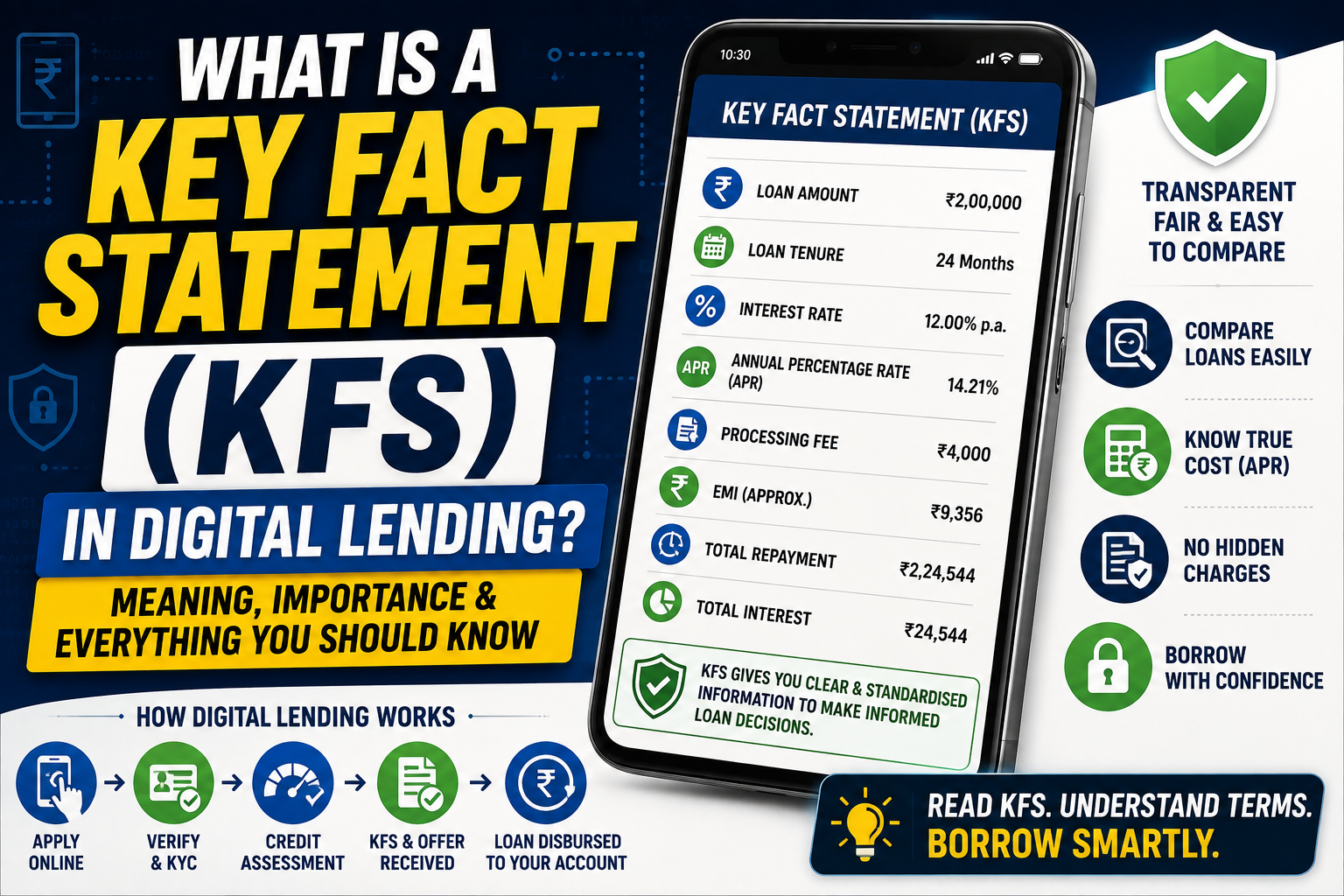
What is a Key Fact Statement (KFS) in digital lending? Learn what a KFS contains, how APR and fees are disclosed, why it matters, and how borrowers can use it to compare digital loans.
Table of Contents
Digital lending has made borrowing faster and more convenient. A borrower can now apply for a personal loan through a smartphone, complete KYC digitally, receive a loan offer and potentially get the money disbursed without visiting a bank branch.
But convenience can create another problem: borrowers may accept a loan without fully understanding its cost and conditions.
This is where the Key Fact Statement (KFS) becomes important.
A KFS is a standardized document that presents the key terms and costs of a loan in a simple format. It is designed to help borrowers understand what they are agreeing to before entering into a loan contract.
The Reserve Bank of India introduced a harmonized KFS framework through its April 15, 2024 circular, covering retail and MSME term loans offered by regulated entities. The framework requires regulated entities to provide prospective borrowers with a KFS before execution of the loan contract.
For digital lending, the importance of KFS is even greater because a loan can sometimes be accepted within minutes.
The basic principle is simple:
Don’t judge a digital loan by the amount offered or the advertised interest rate. Read the KFS first.
What Is a Key Fact Statement?
KFS stands for Key Fact Statement.
It is a standardized statement containing the important facts and financial terms of a loan.
According to the RBI framework, the KFS is intended to provide key information about a loan agreement in a simple and understandable format so that borrowers can make an informed financial decision.
A KFS can help a borrower understand information such as:
- Loan amount
- Loan tenure
- Interest rate
- Interest-rate type
- Annual Percentage Rate (APR)
- Fees and charges
- Repayment schedule
- EMI or periodic instalment
- Other important loan terms
The purpose is not to replace the complete loan agreement.
Instead, think of the KFS as a financial summary that helps you understand the most important parts of the loan before signing the full agreement.
Why Did RBI Introduce the KFS Framework?
Before standardized disclosure, borrowers could encounter loan information presented in different formats by different lenders.
One lender might prominently advertise the interest rate.
Another might highlight the EMI.
Another might emphasize a low processing fee.
The borrower could therefore find it difficult to compare the actual cost of different loans.
The KFS framework aims to make important loan information more standardized and easier to understand.
RBI’s 2024 circular specifically harmonized earlier KFS and APR requirements and expanded the framework to retail and MSME term loans offered by regulated entities.
For consumers, this means the KFS can act as a comparison tool.
Instead of asking:
“Which loan has the lowest interest rate?”
you can ask:
“Which loan has the lower overall cost and better repayment terms?”
That is a much better question.
Who Has to Provide a KFS?
The harmonized RBI framework applies to regulated entities offering covered retail and MSME term loan products.
The framework covers regulated entities including:
- Commercial banks
- Small Finance Banks
- Local Area Banks
- Regional Rural Banks
- Primary Urban Cooperative Banks
- State Cooperative Banks
- Central Cooperative Banks
- Non-Banking Financial Companies, including Housing Finance Companies
The April 15, 2024 RBI circular specifically lists these categories of regulated entities and applies the harmonized KFS requirements to retail and MSME term loan products.
For digital lending, RBI’s Digital Lending Directions also require regulated entities to provide a KFS according to the applicable KFS framework.
Therefore, if you are taking a digital personal loan from a regulated bank or NBFC, the KFS is an important document you should expect to receive.
What Information Is Included in a KFS?
A KFS is designed to provide the borrower with the key financial information needed to understand the loan.
Depending on the loan product, the KFS can include information such as:
1. Loan Amount
This tells you the principal amount being sanctioned.
For example:
Sanctioned loan amount: ₹2,00,000
This is different from the amount you may actually receive in your bank account if permitted fees are deducted from the disbursement.
2. Loan Tenure
The KFS shows how long the loan will remain outstanding.
For example:
Tenure: 24 months
A longer tenure may reduce the EMI but can increase the total interest paid.
3. Interest Rate
The KFS identifies the applicable interest rate and relevant rate structure.
Depending on the product, the rate may be fixed or floating.
Borrowers should understand whether the rate can change during the loan tenure.
4. Annual Percentage Rate
The APR, or Annual Percentage Rate, is one of the most important figures in the KFS.
It is intended to represent the annualized cost of credit, including the interest and applicable charges associated with the loan.
RBI requires the KFS to include an APR computation sheet for covered loans.
This is extremely useful because the advertised interest rate alone may not tell you the complete cost.
Interest Rate vs APR: What’s the Difference?
Suppose a digital lender advertises:
Interest rate: 12%
That sounds straightforward.
But suppose the loan also has:
- Processing fee
- Documentation charge
- Other applicable charges
The actual cost of borrowing can therefore be higher than simply looking at the 12% interest rate.
APR attempts to provide a more comprehensive annualized view of the cost.
For this reason, borrowers should compare APR rather than only the headline interest rate when evaluating digital loans.
RBI’s financial-awareness material specifically advises borrowers to assess the total cost of a digital loan through the APR and related terms displayed in the KFS.
4. Fees and Charges
The KFS should disclose applicable fees and charges.
These can include charges such as:
- Processing fees
- Documentation-related charges
- Certain service charges
- Applicable third-party charges
- Other permitted costs
The exact charges depend on the loan and lender.
This section is important because a loan with a slightly higher interest rate may sometimes have lower fees, while another loan with a lower advertised rate may have significantly higher charges.
Therefore, don’t compare loans based on the interest rate alone.
5. Repayment Schedule
A KFS can also include an amortization or repayment schedule showing how the loan is expected to be repaid over its tenure.
The schedule can show:
- Instalment number
- Principal component
- Interest component
- Outstanding principal
- Instalment amount
- Payment timing
RBI’s KFS framework requires the APR computation and amortization schedule to be included for covered loans.
This allows borrowers to see how the loan balance changes over time.
What Is an Amortization Schedule?
An amortization schedule breaks down each repayment into its components.
For example, imagine a hypothetical EMI of ₹10,000.
One instalment might contain:
Principal: ₹6,500
Interest: ₹3,500
Later in the loan:
Principal: ₹8,000
Interest: ₹2,000
The exact amounts depend on the loan structure.
The total EMI may remain similar for an equated repayment structure, while the proportion going toward principal and interest changes over time.
The KFS’s repayment schedule can help borrowers understand this process.
Does the KFS Show the Total Cost of the Loan?
Yes, the KFS is intended to make the important cost components easier to understand.
Consider a hypothetical loan:
Loan amount: ₹2,00,000
Interest over the tenure: ₹30,000
Other disclosed charges: ₹5,000
The borrower therefore needs to look beyond the ₹2 lakh amount and understand the total repayment obligation.
The KFS can help reveal:
- How much is borrowed
- How much interest is charged
- What fees apply
- How much must ultimately be repaid
This makes the KFS particularly useful when comparing multiple loan offers.
What Is the Validity Period of a KFS?
The RBI framework gives borrowers a period to consider the terms before accepting the loan.
For loans with a tenor of seven days or more, the KFS must have a validity period of at least three working days.
For loans with a tenor of less than seven days, the validity period is at least one working day.
This is important because borrowers should not feel pressured into accepting a loan immediately.
If a lender provides a KFS and you agree to the terms within the applicable validity period, the regulated entity is bound by the terms stated in the KFS, subject to the regulatory framework.
Can a Lender Charge a Fee Not Mentioned in the KFS?
This is one of the most important consumer-protection aspects of the KFS.
Under the RBI framework, fees and charges that are not disclosed in the KFS generally cannot subsequently be charged during the loan term without the borrower’s explicit consent, subject to the applicable regulatory requirements.
This gives borrowers an important reason to read the document carefully.
If you see an unexpected charge later, the first question should be:
“Was this charge disclosed in the KFS or loan agreement?”
Keep a copy of your KFS for your records.
Why Is KFS Especially Important in Digital Lending?
Digital lending apps make borrowing extremely convenient.
You might see:
“Instant Personal Loan – Apply Now”
You enter a few details, complete verification and receive an offer.
The entire process can feel more like making an online purchase than taking on a multi-year financial obligation.
But a personal loan can create months or years of repayment commitments.
That’s why the KFS is important.
It forces attention toward the actual financial terms.
Instead of focusing on:
“You are eligible for ₹3 lakh!”
you should focus on:
- What is the APR?
- What is the EMI?
- What is the total repayment?
- What are the fees?
- What is the tenure?
- What happens if I miss a payment?
- What are the prepayment conditions?
The KFS helps answer these questions.
KFS and Digital Lending Apps
A digital lending app may be operated by a bank or NBFC or may be associated with a Lending Service Provider (LSP).
The important point is to identify the actual regulated lender.
RBI’s Digital Lending Directions require regulated entities to provide KFS in accordance with the applicable KFS framework. They also require important digitally signed documents, including the KFS, loan summary, sanction letter, terms and conditions and account statements, to be sent to the borrower’s registered and verified email or SMS.
This provides borrowers with a record of the documents associated with their loan.
What Should You Check in a Digital Loan KFS?
Before accepting a loan, go through the KFS line by line.
Check 1: Sanctioned Loan Amount
Is it the amount you actually need?
Don’t borrow more simply because the app offers a higher amount.
Check 2: Net Disbursed Amount
Check how much money will actually reach your bank account after permitted deductions.
Check 3: Interest Rate
Understand whether the rate is fixed or floating.
Check 4: APR
This is one of the most important figures for comparing the cost of different offers.
Check 5: Processing Fee
Understand how much will be deducted or charged.
Check 6: EMI
Make sure you can comfortably afford it every month.
Check 7: Tenure
A longer tenure may reduce the EMI but increase total interest.
Check 8: Total Repayment
Understand how much you will pay over the entire loan period.
Check 9: Penal Charges
Understand what happens if you miss or delay a payment.
Check 10: Prepayment Conditions
Check whether there are applicable charges or conditions for early repayment.
Example: How KFS Can Help You Compare Two Loans
Suppose you need ₹2 lakh.
You receive two digital loan offers.
Loan A
Interest rate: 12%
Processing fee: ₹4,000
APR: 14%
Tenure: 24 months
Loan B
Interest rate: 13%
Processing fee: ₹1,000
APR: 13.8%
Tenure: 24 months
At first glance, Loan A looks better because its interest rate is only 12%.
But the APR comparison tells a different story.
Loan B’s APR is lower in this hypothetical example.
This demonstrates why the borrower should examine the complete cost rather than selecting the loan with the lowest advertised interest rate.
The actual comparison must always use the KFS supplied for the specific loan.
Is KFS the Same as a Loan Agreement?
No.
The two documents serve different purposes.
KFS
A concise, standardized summary of key loan terms and costs.
Loan Agreement
The full legal document containing detailed terms and conditions governing the lending relationship.
The KFS helps you understand the major financial terms before entering the agreement.
It does not mean you can ignore the full loan agreement.
Read both.
What If the KFS Is Difficult to Understand?
The KFS is supposed to be written in a language understood by the borrower.
RBI’s framework requires the KFS to be provided in a language understood by the borrower, and the contents are to be explained with acknowledgement that the borrower has understood them.
If you don’t understand:
- APR
- Fees
- EMI
- Penalty
- Tenure
- Prepayment terms
don’t simply accept the loan.
Ask the lender for clarification.
If the lender cannot clearly explain the terms, that itself should make you reconsider the loan.
KFS and Third-Party Charges
Some loans may involve third-party services, such as insurance or legal services, depending on the product.
Under the applicable KFS framework, third-party charges recovered from the borrower through the regulated entity can also form part of the APR and should be separately disclosed.
This is important because borrowers sometimes assume:
“It’s a third-party fee, so it doesn’t count toward the cost of my loan.”
That isn’t necessarily correct.
The KFS is designed to provide a more complete picture of applicable borrowing costs.
Can KFS Protect You From Fraudulent Loan Apps?
KFS is an important protection, but it is not a guarantee that an app is legitimate.
A fraudulent app could potentially show borrowers fake documents.
Therefore, you should first verify the actual lender.
RBI advises consumers to check whether a digital lending app is associated with an RBI-regulated bank or NBFC through the lender’s official website. RBI has also established a public repository of digital lending apps associated with regulated entities to help consumers verify such claims.
So your process should be:
Verify lender → Check app → Receive KFS → Read terms → Compare APR → Decide
Not:
Download app → See approval → Accept immediately
Red Flags to Watch for in Digital Lending
Be cautious if a loan app:
- Does not clearly identify the actual lender.
- Avoids providing a KFS.
- Doesn’t disclose APR.
- Demands unexplained upfront payments.
- Pressures you to accept immediately.
- Requests excessive phone permissions.
- Provides unclear fee information.
- Sends loan documents from suspicious email addresses.
- Asks you to send repayment to a personal bank account.
- Uses threatening or misleading advertising.
RBI’s consumer-awareness material specifically advises borrowers to carefully read the KFS, sanction letter and privacy policies and to verify the lender behind a digital lending app.
What Happens After You Accept the KFS?
Once you agree to the loan terms and complete the required process, the loan can proceed toward execution and disbursement.
For digital lending, RBI requires the regulated entity to ensure that digitally signed important documents, including the KFS and sanction-related documents, are delivered to the borrower’s registered and verified email or SMS.
Keep these documents.
You may need them later if:
- You want to verify a charge.
- You want to make a prepayment.
- There is a dispute.
- You need to check your repayment schedule.
- You want to file a complaint.
KFS vs Advertisement: Which One Should You Trust?
A loan advertisement is designed to attract attention.
A KFS is designed to disclose important loan information.
These are very different purposes.
An advertisement might say:
“Personal Loan at 10.99%!”
But the KFS can tell you:
- Actual applicable rate
- APR
- Fees
- EMI
- Tenure
- Total repayment
- Other applicable terms
Therefore, don’t make a borrowing decision based solely on an advertisement.
The KFS is much more important for your final decision.
How to Use KFS When Comparing Multiple Digital Loans
If you have multiple offers, create a simple comparison table.
| Factor | Loan A | Loan B | Loan C |
|---|---|---|---|
| Loan Amount | ₹2 lakh | ₹2 lakh | ₹2 lakh |
| Interest Rate | 12% | 13% | 11.9% |
| APR | Check KFS | Check KFS | Check KFS |
| Processing Fee | Check KFS | Check KFS | Check KFS |
| Tenure | 24 months | 24 months | 18 months |
| EMI | Check KFS | Check KFS | Check KFS |
| Total Repayment | Check KFS | Check KFS | Check KFS |
Then compare the overall cost.
This is much better than choosing based on the first number you see on a loan app.
Common Mistakes Borrowers Make With KFS
Mistake 1: Ignoring the KFS
Some borrowers accept the loan immediately after seeing the approved amount.
Don’t.
Mistake 2: Looking Only at Interest Rate
APR and total repayment are also important.
Mistake 3: Ignoring Processing Fees
A low rate can be offset by substantial fees.
Mistake 4: Not Checking Net Disbursement
You may receive less than the sanctioned amount if permitted charges are deducted.
Mistake 5: Ignoring Tenure
A lower EMI doesn’t necessarily mean a cheaper loan.
Mistake 6: Not Saving the KFS
Keep a copy for your records.
Mistake 7: Assuming the App Is the Lender
Always identify the actual regulated entity.
Frequently Asked Questions About KFS
What does KFS stand for?
KFS stands for Key Facts Statement. It is a standardized document summarizing important terms and costs of a loan.
Is KFS mandatory for digital loans?
Regulated entities engaged in digital lending must provide KFS in accordance with RBI’s applicable KFS framework. The harmonized KFS framework also covers retail and MSME term loans offered by regulated entities.
What is included in a KFS?
It can include the loan amount, tenure, interest rate, APR, fees and charges, repayment schedule and other important terms.
What is APR in KFS?
APR is the annualized cost of credit and incorporates interest and applicable charges according to RBI’s framework.
Can a lender charge a fee that isn’t in the KFS?
Generally, charges not disclosed in the KFS cannot subsequently be charged during the loan term without the borrower’s explicit consent, subject to applicable RBI requirements.
How long is a KFS valid?
For loans with a tenor of seven days or more, the KFS validity period must be at least three working days. For loans with a tenor below seven days, it must be at least one working day.
Is KFS the same as a sanction letter?
No. A KFS is a standardized summary of key loan terms and costs, while a sanction letter and loan agreement serve different purposes and can contain additional details.
Should I read the KFS before accepting a digital loan?
Absolutely. It is one of the most important documents to review before accepting a digital loan.
Final Takeaway
A Key Fact Statement (KFS) is one of the most important consumer-protection tools in India’s modern lending ecosystem.
It gives borrowers a standardized view of important loan information before they enter into a credit agreement.
For digital lending, this is especially valuable because technology has made borrowing incredibly fast.
The speed of the application can sometimes encourage borrowers to focus on:
“How quickly can I get the money?”
instead of:
“How much will this loan actually cost me?”
The KFS helps shift the focus toward the second question.
Before accepting a digital loan, check:
Loan amount → Interest rate → APR → Fees → EMI → Tenure → Total repayment → Penal charges → Prepayment terms
Also verify the actual regulated lender behind the digital lending app.
RBI’s framework requires regulated entities to provide KFS for covered loans and has strengthened disclosure requirements around digital lending, including the transmission of important loan documents to borrowers.
Most importantly, don’t treat the KFS as just another document to click through.
Read it. Compare it. Save it. Understand it.
A digital loan can take only a few minutes to apply for, but the financial commitment may last for years.
The KFS helps make sure you understand that commitment before you say yes.
Useful Outbound Resources
- RBI – Key Facts Statement (KFS) for Loans & Advances
- RBI – Digital Lending Directions and Regulatory Information
- RBI – Financial Awareness Messages: Digital Lending
- RBI – Handbook on Regulations at a Glance
- RBI – KFS Format and Loan Disclosure Framework
What is a digital lending app and how does it work? Learn how online loan apps process applications, verify borrowers, assess credit, disburse loans, calculate APR, and protect customer data.
