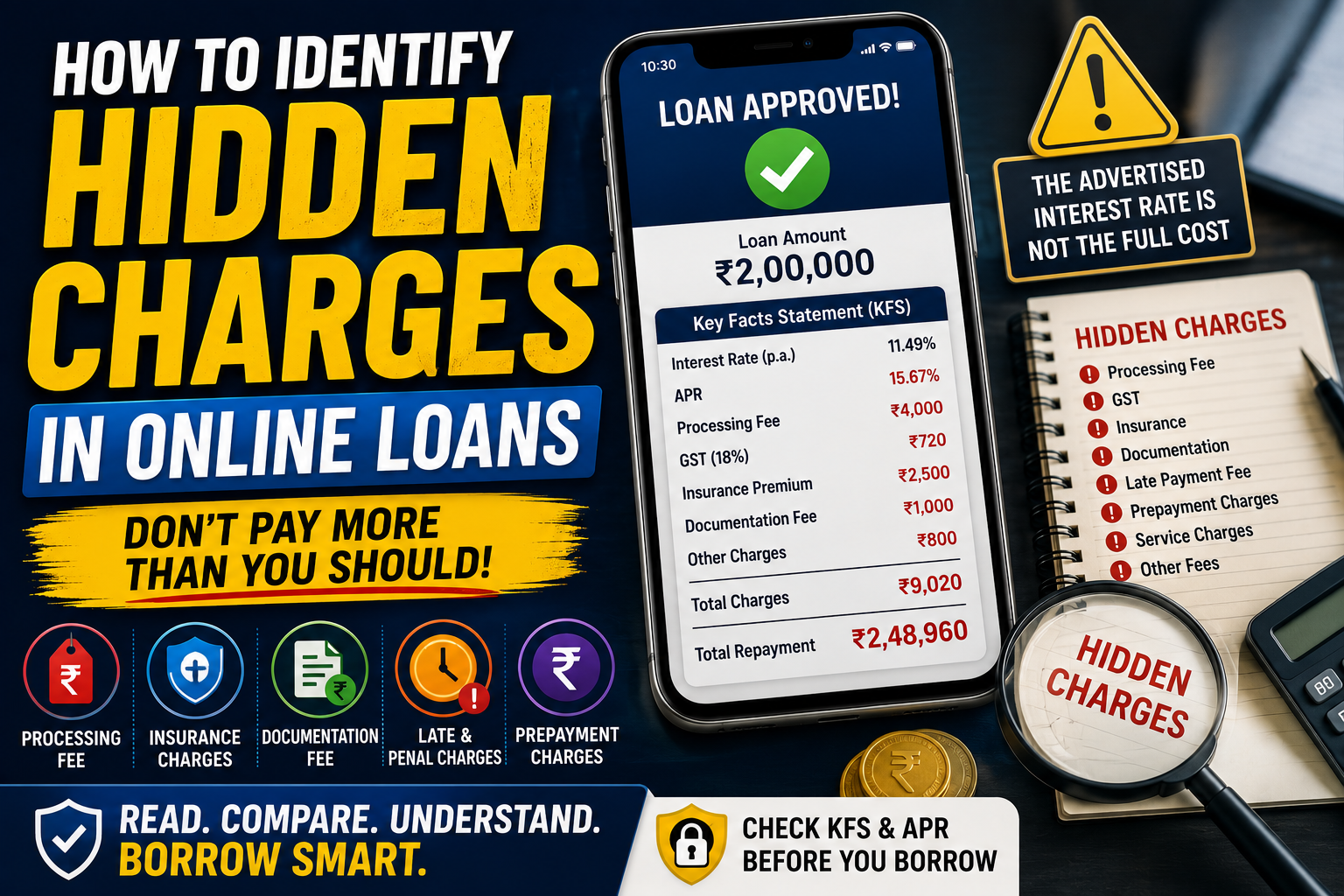
Learn how to identify Hidden Charges in online loans. Understand processing fees, APR, insurance, GST, late fees, prepayment charges and how to check your KFS before borrowing.
Table of Contents
Online loans have made borrowing money remarkably convenient. A borrower can compare loan offers, complete KYC, submit documents and receive funds digitally without visiting a bank branch.
But convenience can also make it easier to overlook the Hidden Charges associated with a loan.
An online loan advertisement might prominently display:
“Personal Loan at 10.99% Interest!”
But the actual cost of borrowing may also include processing fees, taxes, insurance, documentation charges, penal charges, prepayment-related costs or other applicable fees.
This doesn’t necessarily mean the lender is doing something illegal.
The real problem occurs when borrowers don’t notice or understand these costs before accepting the loan.
The Reserve Bank of India (RBI) has introduced standardized disclosure requirements through the Key Facts Statement (KFS) and Annual Percentage Rate (APR) framework to improve transparency and help borrowers make informed decisions. For covered retail and MSME term loans, regulated entities must provide a KFS before the loan contract is executed. The KFS includes important information about the loan and an APR calculation.
So, how can you identify Hidden Charges before taking an online loan?
Let’s break it down.
What Are Hidden Charges in Online Loans?
Hidden Charges are loan-related costs that a borrower may not notice when looking only at the advertised interest rate or EMI.
The word “hidden” does not necessarily mean that the lender has deliberately concealed the charge.
A fee can be disclosed somewhere in the loan documentation but still be easy for a borrower to miss.
For example, an online loan advertisement may say:
Loan Amount: ₹2,00,000
Interest Rate: 12%
But the final cost could also include:
- Processing fee
- GST on applicable charges
- Insurance premium
- Documentation charges
- Late-payment or penal charges
- Prepayment-related charges where permitted
- Other disclosed service charges
Therefore, borrowers should not evaluate an online loan using the interest rate alone.
The better question is:
“What is the total cost of this loan?”
Why Do Online Loans Have So Many Charges?
Lenders incur costs when processing and servicing loans.
Some charges may cover:
- Application processing
- Verification
- Documentation
- Technology infrastructure
- Credit assessment
- Certain third-party services
- Loan servicing
Different lenders use different pricing structures.
One lender may charge a relatively low interest rate but a higher processing fee.
Another may charge a slightly higher interest rate but lower upfront fees.
Therefore, comparing only the headline interest rate can produce the wrong conclusion.
This is exactly why the RBI’s KFS framework is important.
The RBI says APR should include charges levied by the regulated entity, and applicable third-party charges recovered through the regulated entity can also form part of APR and must be separately disclosed.
The Most Important Document: Key Facts Statement
If you want to identify Hidden Charges, start with the Key Facts Statement (KFS).
The RBI requires regulated entities covered by the KFS framework to provide prospective borrowers with a standardized KFS before execution of the loan contract.
The document is intended to help borrowers make an informed decision.
The KFS can contain information such as:
- Loan amount
- Loan tenure
- Interest rate
- Interest-rate type
- APR
- Fees and charges
- Repayment schedule
- Other important loan terms
For digital loans, RBI’s Digital Lending Directions, 2025 specifically require regulated entities to provide the KFS in accordance with the applicable RBI KFS framework.
Never accept an online loan before reading the KFS.
What Is APR and Why Does It Matter?
APR stands for Annual Percentage Rate.
It is designed to show the annualized cost of credit, taking relevant interest and charges into account under the applicable framework.
This makes APR extremely useful when comparing online loans.
Imagine two lenders advertise:
Loan A
Interest rate: 11.5%
Loan B
Interest rate: 12%
At first glance, Loan A appears cheaper.
But suppose:
Loan A APR: 14%
Loan B APR: 13.5%
In this hypothetical example, Loan B may actually have the lower overall annualized cost because the fee structure differs.
Therefore:
Don’t compare only interest rates.
Compare:
APR + total repayment + fees + loan terms.
The RBI’s KFS framework specifically requires an APR computation sheet as part of the KFS.
1. Processing Fee
The processing fee is one of the most common costs associated with online loans.
Suppose you borrow:
₹5,00,000
and the lender charges:
2% processing fee
The fee would be:
₹5,00,000 × 2% = ₹10,000
Depending on the lender’s terms, applicable taxes may also apply.
This means the amount you receive could be lower than the sanctioned amount if the fee is deducted from disbursement.
For example:
Sanctioned loan: ₹5,00,000
Processing fee: ₹10,000
Net amount received: potentially ₹4,90,000 before considering applicable taxes or other deductions.
This is why you should check both:
Sanctioned amount
and
Net disbursed amount
2. GST on Charges
Borrowers sometimes focus on the processing fee and forget about applicable taxes.
For example:
Processing fee = ₹10,000
If GST is applicable to that service charge, the actual amount payable can be higher.
The important point is that GST is not the same thing as the lender’s interest rate.
Check your KFS, fee schedule and invoice/receipt to understand which charges include applicable taxes and which do not.
Don’t assume:
“2% processing fee”
means your total upfront cost is exactly 2%.
3. Insurance Charges
Some loans may involve insurance or other third-party products.
For example, a lender may offer or arrange an insurance product connected with the loan.
This can increase the overall cost.
RBI’s KFS framework says charges recovered from borrowers through the regulated entity on behalf of third-party service providers—such as insurance or legal charges—should also form part of APR and be separately disclosed.
Therefore, if you see:
Loan amount: ₹3,00,000
but the amount actually credited is lower, ask:
“What deductions were made, and why?”
Never assume the difference is automatically a processing fee.
4. Documentation Charges
Some lenders may apply documentation-related fees.
These could be associated with:
- Agreement processing
- Documentation
- Verification
- Administrative services
The important issue isn’t simply whether a documentation fee exists.
The important question is:
Was it clearly disclosed before you accepted the loan?
Check the KFS and loan agreement.
If a charge appears after disbursement that wasn’t disclosed in the applicable loan documentation, ask the lender to explain it.
5. Verification Charges
Some lending processes involve verification costs.
These may relate to:
- Address verification
- Employment verification
- Other permissible verification activities
Again, don’t automatically assume that every fee is illegitimate.
Instead, check:
What is the fee?
Why is it charged?
Was it disclosed?
Is it included in the loan’s cost disclosure?
Transparency is the key.
6. Late Payment Charges
Late-payment charges can become expensive if you miss an EMI.
For example, you may have:
EMI: ₹12,000
and a separate penal charge for delayed payment.
Borrowers should understand the consequences of missing a payment before accepting the loan.
RBI has separate rules concerning penal charges in loan accounts, and regulated entities are required to follow the applicable framework rather than treating penal charges as a disguised form of interest.
Don’t wait until you miss an EMI to discover what the lender charges.
Check the KFS and loan agreement beforehand.
7. Prepayment and Foreclosure Charges
Suppose you receive a bonus and decide to repay your online loan early.
You might assume:
“I’m paying the lender early, so there shouldn’t be any extra cost.”
Not necessarily.
Whether a prepayment or foreclosure charge can be imposed depends on the loan type, lender category, applicable RBI rules and terms of the loan.
For example, RBI has specific restrictions on prepayment penalties for certain floating-rate loans to individual borrowers.
Therefore, don’t assume that all online loans have identical prepayment rules.
Check:
- Part-prepayment rules
- Full foreclosure rules
- Applicable charges
- Minimum prepayment amount
- Lock-in conditions, if any
8. Convenience or Service Charges
Some online lending platforms may present additional service-related charges.
These may be described using terms such as:
- Convenience fee
- Service fee
- Platform fee
- Administration fee
- Technology fee
The name of the fee is less important than its actual purpose and disclosure.
If a digital lending platform is acting as a Lending Service Provider (LSP), RBI’s Digital Lending Directions state that fees and charges payable to LSPs for credit intermediation are to be paid by the regulated entity and not directly by the borrower.
So if someone tells you:
“Pay our LSP fee directly to this personal UPI account.”
be extremely cautious.
Verify the charge through the actual regulated lender.
9. Hidden Charges in “Zero Processing Fee” Loans
This is a classic marketing trap—not necessarily a regulatory violation.
An advertisement may say:
“ZERO PROCESSING FEE!”
That sounds attractive.
But don’t stop reading.
The loan could still have:
- Higher interest rate
- Insurance cost
- Other applicable charges
- Late-payment charges
- Other disclosed fees
Therefore, zero processing fee does not mean zero-cost loan.
Always compare the total cost.
10. Charges Deducted Before Disbursement
This is one of the easiest things to overlook.
Suppose:
Approved loan: ₹1,00,000
You receive:
₹96,000
You need to know exactly why ₹4,000 was deducted.
It could include:
- Processing fee
- Applicable tax
- Insurance
- Other disclosed charges
Never accept a difference between sanctioned and received amount without understanding it.
Ask for a disbursement statement.
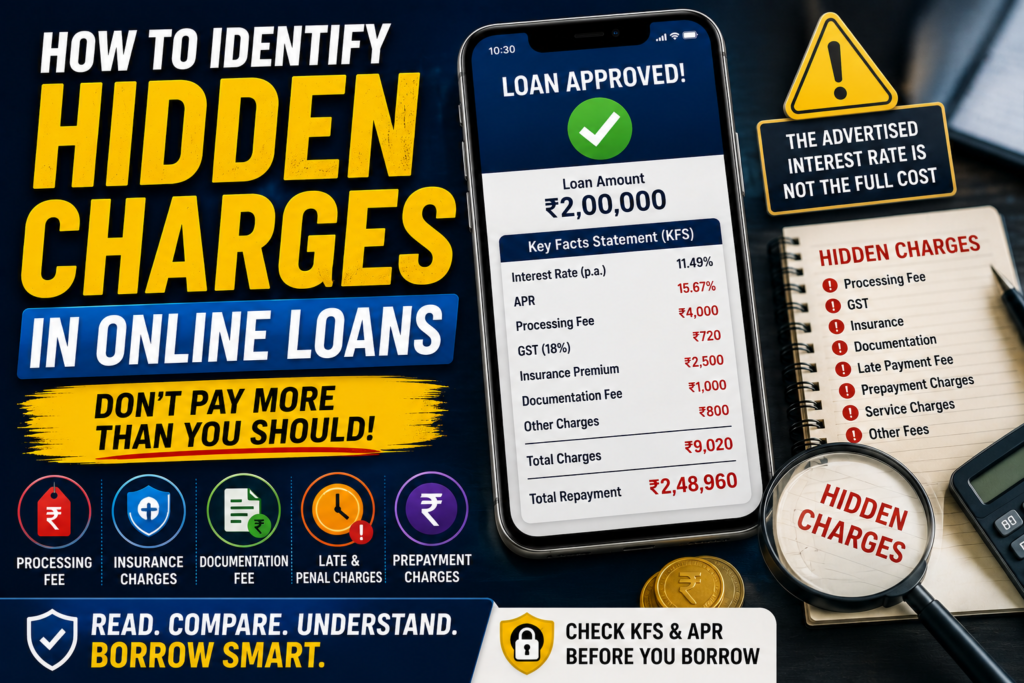
Example: How Hidden Charges Increase the Cost
Suppose you take an online loan of:
₹2,00,000
Advertised interest rate:
12%
Processing fee:
2% = ₹4,000
Suppose an applicable tax on that fee adds another amount.
You might initially think:
“I’m borrowing ₹2 lakh at 12%.”
But your actual economics could be different because:
- You may receive less than ₹2 lakh after permitted deductions.
- You still repay the contractual principal.
- You pay interest according to the loan terms.
- You may pay applicable fees and taxes.
This is why the net amount received and total repayment should both be checked.
How to Identify Hidden Charges Before Applying
Don’t wait until after approval.
Use this process.
Step 1: Ignore the Advertisement
Treat the advertisement as an introduction, not the final loan offer.
An advertisement may highlight only the most attractive feature.
Step 2: Ask for the KFS
For covered loans from regulated entities, the KFS should provide standardized information about the loan.
Step 3: Check the APR
Don’t look only at the interest rate.
Step 4: Check Every Fee
Write down every charge.
Step 5: Check Net Disbursement
Compare:
Sanctioned amount vs actual amount credited
Step 6: Check Total Repayment
Find out how much you will repay over the full tenure.
Step 7: Check Penalties
Understand the consequences of missing an EMI.
Step 8: Check Prepayment Rules
Understand what happens if you repay early.
Step 9: Read the Loan Agreement
The KFS is important, but it doesn’t replace the full agreement.
Step 10: Save All Documents
Keep:
- KFS
- Loan agreement
- Sanction letter
- Repayment schedule
- Fee receipts
- Payment confirmations
How to Compare Two Online Loans
Suppose you need:
₹3 lakh
You receive two offers.
| Factor | Loan A | Loan B |
|---|---|---|
| Interest Rate | 11.5% | 12% |
| Processing Fee | 2% | 0.5% |
| APR | Check KFS | Check KFS |
| Tenure | 36 months | 36 months |
| EMI | Check KFS | Check KFS |
| Total Repayment | Check KFS | Check KFS |
| Prepayment Terms | Check | Check |
| Penal Charges | Check | Check |
Which loan is cheaper?
You cannot answer that from the interest rate alone.
You need to compare the APR and total repayment.
This is precisely why standardized disclosures matter.
Why APR Is Better Than Interest Rate Alone
Imagine two online lenders.
Lender A
Interest rate = 10.99%
Lender B
Interest rate = 11.49%
You might immediately choose Lender A.
But suppose:
Lender A APR = 15%
Lender B APR = 13.5%
In this hypothetical example, Lender B could be the cheaper loan despite having a higher advertised interest rate.
The lesson is simple:
The lowest interest rate is not necessarily the lowest-cost loan.
Look at the complete cost.
Are All Charges Outside the Interest Rate “Hidden Charges”?
No.
This distinction is important.
A processing fee that is clearly disclosed in the KFS is not really a hidden charge.
Likewise, an applicable insurance premium or third-party fee that is properly disclosed isn’t necessarily a hidden charge.
The problem arises when:
- The borrower doesn’t receive clear information.
- A fee is buried in unclear documentation.
- The advertisement creates a misleading impression.
- The borrower discovers an unexpected charge after accepting the loan.
- A third party demands an unexplained payment.
Therefore, a better term for borrowers is:
“Undisclosed or poorly understood charges.”
That is what you should actively protect yourself against.
Can a Lender Add New Charges After the Loan Starts?
Under the RBI KFS framework, fees and charges not mentioned in the KFS generally cannot be charged during the loan term without the borrower’s explicit consent, subject to the applicable regulatory framework.
This makes the KFS an important reference document.
If a new charge appears, compare it with:
KFS → Loan Agreement → Subsequent communication
If you cannot identify the basis of the charge, contact the lender and ask for a written explanation.
Hidden Charges and Digital Lending Apps
Digital lending deserves additional caution because borrowers can move through the application process very quickly.
A digital lending app may involve:
Borrower → Digital Lending App → LSP → Bank/NBFC
The app or LSP may provide technology and other services, but the actual lender should be clearly identifiable.
RBI’s Digital Lending Directions require regulated entities to provide borrowers with digitally signed documents including the KFS, loan summary, sanction letter, terms and conditions and account statements through registered and verified email/SMS after execution of the relevant transaction.
Keep these documents.
They can help you verify what you actually agreed to.
Be Careful With Upfront Payment Requests
One of the biggest warning signs is an unexplained upfront payment.
For example:
“Your loan is approved. Pay ₹5,000 first to release the money.”
Don’t transfer money immediately.
First determine:
- Who is the actual lender?
- What is the charge?
- Is it included in the KFS?
- Is the payment being requested through an official lender channel?
- Is the recipient actually authorized?
A legitimate lending relationship should be transparent about charges and payment channels.
If an unknown person asks you to send money to a personal UPI ID, bank account or wallet, treat it as a serious warning sign.
How to Check Whether an Online Loan App Is Genuine
Before applying:
1. Identify the actual lender
Find the legal name of the bank or NBFC.
2. Visit the lender’s official website
Verify the relationship with the app or platform.
3. Check RBI information
RBI has published consumer guidance and digital-lending information to help borrowers verify legitimate lending arrangements.
4. Read the privacy policy
Understand what personal data the app wants to collect.
5. Check the KFS
Never skip the KFS.
6. Compare APR
Don’t compare advertisements.
Compare actual offers.
What Should You Do If You Discover an Unexpected Charge?
Suppose you already took the loan and discover a fee you weren’t expecting.
Don’t immediately assume it is fraudulent.
First:
Step 1: Check Your KFS
Search for the fee.
Step 2: Check the Loan Agreement
Look for the relevant clause.
Step 3: Check Your Disbursement Statement
See whether the amount was deducted upfront.
Step 4: Contact the Lender
Ask for a written explanation.
Step 5: Preserve Evidence
Save:
- Screenshots
- Emails
- KFS
- Agreement
- Payment receipts
- Statements
Step 6: Escalate if Necessary
If the regulated lender does not resolve your complaint within the applicable grievance-redressal process, RBI’s complaint mechanisms may be available depending on the lender and circumstances.
RBI materials note that regulated entities remain responsible for grievance redressal even where digital lending involves LSPs.
A Simple Hidden Charges Checklist
Before accepting an online loan, ask these questions:
Loan Cost
- What is the interest rate?
- What is the APR?
- What is the total repayment?
Fees
- What is the processing fee?
- Is GST applicable?
- Is there an insurance charge?
- Are there documentation charges?
- Are there service/platform fees?
Repayment
- What is the EMI?
- When is the first EMI due?
- What are late-payment charges?
- What are penal charges?
Early Repayment
- Can I prepay?
- Are there prepayment charges?
- Are there foreclosure conditions?
Disbursement
- How much will actually reach my bank account?
- What deductions will be made?
Digital Lending
- Who is the actual lender?
- Is there an LSP?
- Where should I make repayments?
- What data will the app collect?
If you cannot get clear answers, don’t accept the loan yet.
Common Mistakes Borrowers Make
Mistake 1: Choosing the Lowest Advertised Rate
The lowest rate doesn’t necessarily mean the lowest total cost.
Mistake 2: Ignoring the KFS
This is perhaps the biggest mistake.
Mistake 3: Looking Only at EMI
A lower EMI can simply mean a longer tenure and higher total interest.
Mistake 4: Ignoring the Net Disbursement
You may receive less money than the sanctioned amount because of permitted deductions.
Mistake 5: Forgetting Taxes
Applicable taxes can increase the cost of certain fees.
Mistake 6: Ignoring Prepayment Terms
You may want to repay early later.
Understand the rules before borrowing.
Mistake 7: Paying Unknown Intermediaries
Never make unexplained payments simply because someone claims to be a loan agent.
Mistake 8: Taking the Maximum Eligible Amount
Just because an app offers ₹5 lakh doesn’t mean you should borrow ₹5 lakh.
Frequently Asked Questions About Hidden Charges
What are Hidden Charges in online loans?
Hidden Charges are loan-related costs that borrowers may not notice when looking only at the advertised interest rate or EMI. A charge isn’t necessarily illegal simply because it is additional; the key issue is whether it is properly disclosed and permitted.
How can I identify Hidden Charges?
Check the KFS, APR, loan agreement, fee schedule, net disbursement amount, total repayment, penal charges and prepayment conditions.
Is the processing fee a Hidden Charge?
Not if it is clearly disclosed before you accept the loan. It becomes a concern when the borrower is not clearly informed about it.
Does APR include Hidden Charges?
APR is intended to capture the annualized cost of credit, including applicable charges under the RBI framework. The KFS provides the APR calculation and relevant disclosures.
Can a lender charge a fee not mentioned in the KFS?
Under the RBI KFS framework, fees or charges not mentioned in the KFS generally cannot subsequently be charged during the loan term without the borrower’s explicit consent, subject to applicable requirements.
Can online loans have insurance charges?
Some loan arrangements may involve insurance or other third-party services. Applicable third-party charges recovered through the regulated entity must be disclosed and form part of APR under the relevant KFS framework.
How can I avoid Hidden Charges?
Don’t accept a loan based only on an advertisement. Read the KFS, compare APR and total repayment, understand every fee, and verify the actual lender.
Final Takeaway
Online loans can be useful when you need quick access to money, but the speed of the application should never prevent you from understanding the cost.
The biggest mistake borrowers make is focusing on one attractive number:
“Interest rate: 10.99%”
That number doesn’t tell the entire story.
Before accepting an online loan, check:
Interest rate → APR → Processing fee → Taxes → Insurance → Other fees → EMI → Total repayment → Penal charges → Prepayment terms → Net disbursement
The Key Facts Statement should be your starting point.
RBI’s KFS framework is designed to reduce information asymmetry by giving prospective borrowers standardized information before they enter into covered loan contracts. APR is also intended to provide a more complete picture of the annualized cost of credit.
For digital loans, RBI’s Digital Lending Directions, 2025 require regulated entities to provide KFS and important loan documents to borrowers, while also establishing requirements around digital lending platforms, LSPs, data and borrower protection.
The most important lesson is:
A loan with the lowest advertised interest rate is not necessarily the cheapest loan.
And another important distinction:
A disclosed fee is not necessarily a hidden charge. An unexpected or poorly disclosed cost is what you need to investigate.
So before clicking “Accept Loan”, take a few extra minutes.
Read the KFS.
Check the APR.
Calculate the total repayment.
Find out exactly how much money you will receive.
Understand every fee.
And verify who is actually lending you the money.
Borrowing online should be convenient—but understanding the cost should never be optional.
Useful Outbound Resources
- Reserve Bank of India – Key Facts Statement (KFS) for Loans & Advances — Official RBI framework for standardized loan disclosures and APR.
- RBI – Digital Lending Directions, 2025 — Regulatory framework covering digital lending, borrower disclosures, KFS and Lending Service Providers.
- RBI – Handbook on Regulations at a Glance — Overview of RBI requirements relating to digital lending and borrower protection.
- RBI – Financial Awareness Resources — Consumer-focused information on responsible borrowing and financial services.
What is the cooling-off period in digital lending? Learn how borrowers can exit a digital loan, what charges apply, RBI rules, KFS requirements and how the process works.
