Understand Loan Sanction vs Disbursement in home loans. Learn what sanction means, when disbursement happens, required documents, delays, conditions and key differences.
Table of Contents
Buying a home is one of the biggest financial decisions most people make. For many buyers, the process involves applying for a home loan and going through several stages before the lender actually releases the money.
Two terms that frequently create confusion are loan sanction and loan disbursement.
A borrower may receive a message saying:
“Congratulations! Your home loan has been sanctioned.”
Naturally, the next question is:
“When will I get the money?”
This is where the difference between Loan Sanction vs Disbursement becomes important.
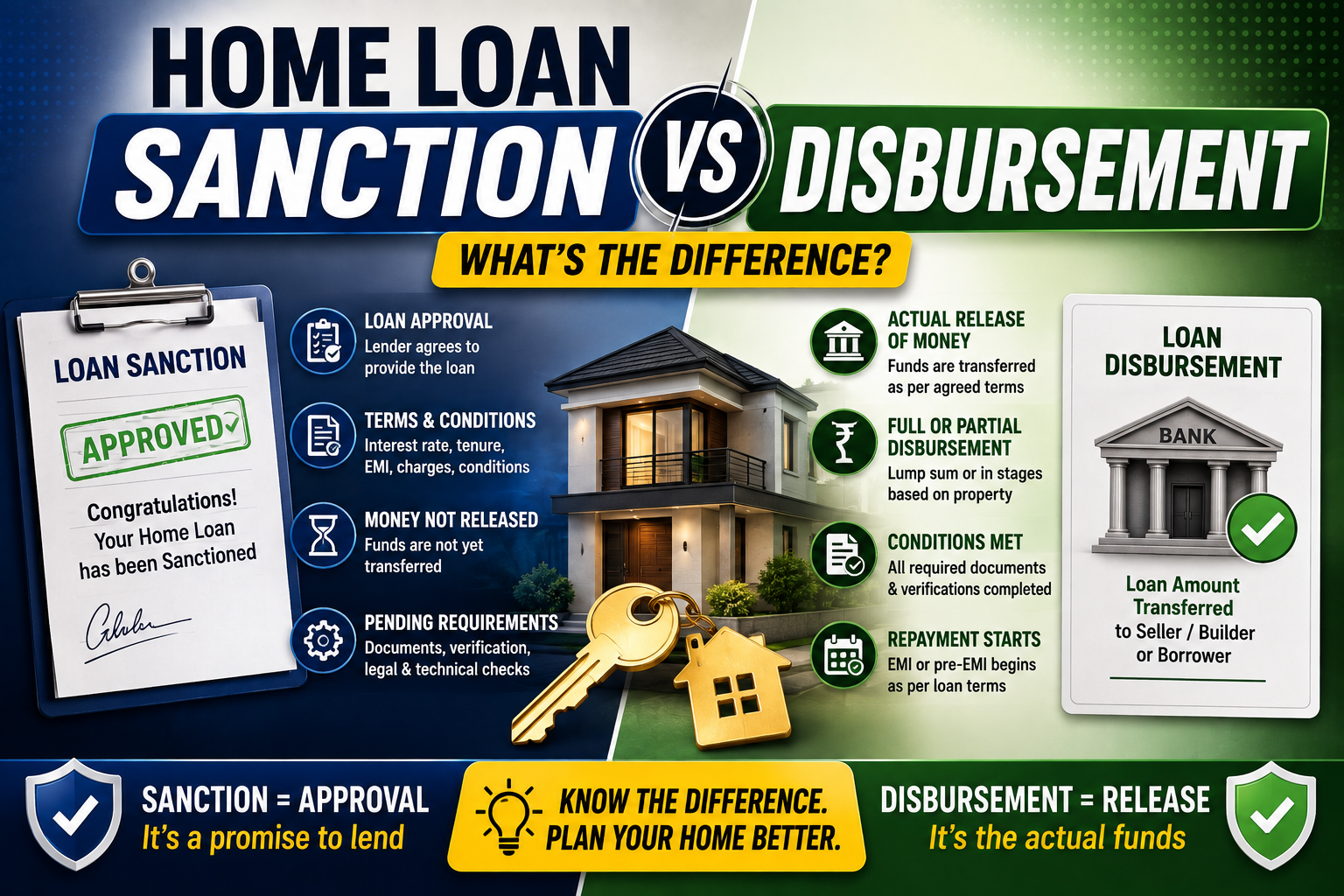
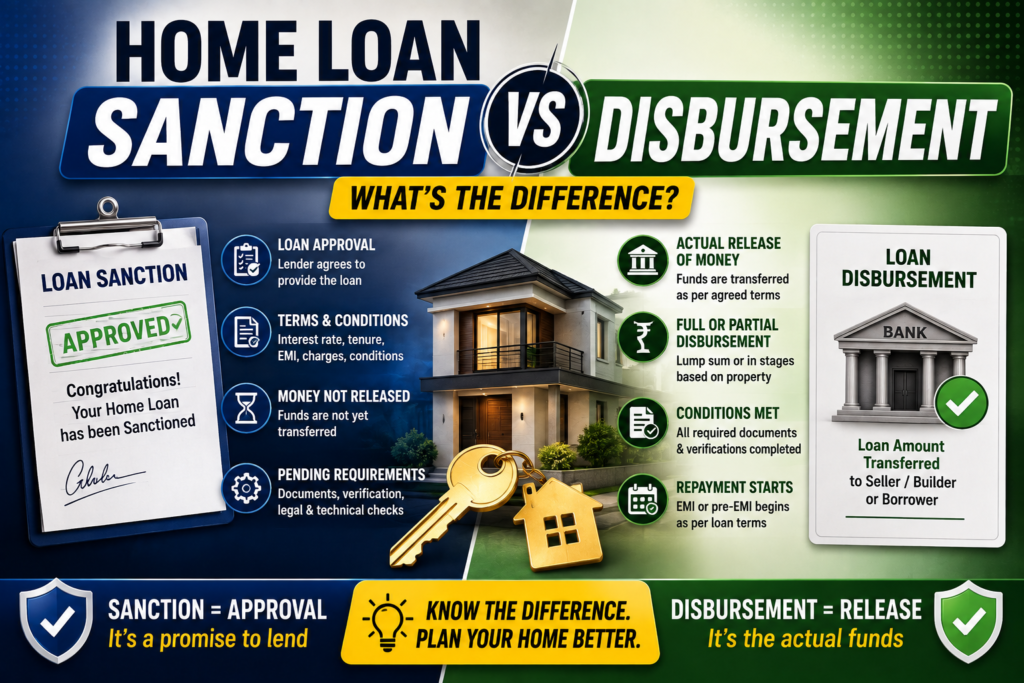
A loan sanction means the lender has approved the loan subject to the terms and conditions mentioned in the sanction letter.
A loan disbursement means the lender actually releases the approved loan amount, either fully or in stages, after the required conditions have been satisfied.
In other words:
Sanction = Approval
Disbursement = Release of Money
Receiving a sanction letter does not necessarily mean that the entire loan amount has already been transferred to you or the property seller.
Understanding this distinction can help homebuyers plan their finances, property payments and documentation more effectively.
What Is Home Loan Sanction?
A home loan sanction is the stage at which a lender evaluates your application and decides how much credit it is willing to provide and under what conditions.
During the loan assessment, the lender may examine factors such as:
- Income
- Employment or business stability
- Existing loans
- Credit history
- Credit score
- Repayment capacity
- Age
- Property details
- Property valuation
- Legal status of the property
- Down payment
- Loan-to-value ratio
- Loan tenure
The lender uses this information to determine whether the proposed loan is acceptable within its credit policy.
If the application is approved, the lender issues a sanction letter or equivalent written communication containing the important terms.
RBI’s fair-practices framework requires lenders to communicate the credit limit along with the applicable terms and conditions and retain the borrower’s acceptance of those terms.
What Is Included in a Home Loan Sanction Letter?
The exact format varies between lenders, but a sanction letter can contain important information such as:
- Sanctioned loan amount
- Interest rate
- Type of interest rate
- Loan tenure
- EMI structure
- Processing fees
- Prepayment conditions
- Penal charges, where applicable
- Security or mortgage requirements
- Conditions before disbursement
- Disbursement schedule
- Other applicable terms
For housing finance companies, RBI’s regulatory framework specifically requires the sanctioned amount and relevant terms and conditions—including annualized interest rate, EMI structure, prepayment charges and penal charges, where applicable—to be communicated in writing.
This is why you should read the sanction letter carefully instead of treating it as just an approval message.
What Does Loan Sanction Actually Mean?
Suppose you apply for:
Home loan requested: ₹50 lakh
After assessing your application, the lender approves:
Sanctioned amount: ₹45 lakh
This means the lender has agreed to provide up to ₹45 lakh, subject to the applicable conditions.
It does not necessarily mean ₹45 lakh will immediately be transferred to your account.
The lender may still require:
- Property documents
- Legal verification
- Technical valuation
- Sale agreement
- Registration-related documentation
- Insurance, where applicable
- Margin/down-payment contribution
- Execution of loan documents
- Mortgage creation
- Completion of other pre-disbursement conditions
Only after the required conditions are satisfied does the lender proceed with disbursement.
What Is Home Loan Disbursement?
Disbursement is the actual release of the sanctioned loan amount.
Once the lender has completed the required checks and the borrower has fulfilled the conditions of the sanction, the lender releases the funds according to the agreed disbursement terms.
Depending on the property and loan structure, the money may be:
- Paid directly to the seller
- Paid to the builder/developer
- Released to another eligible party
- Released to the borrower in permitted circumstances
The exact process depends on the transaction and lender.
RBI’s fair-practices framework requires lenders to ensure timely disbursement of loans in conformity with the disbursement schedule and applicable terms and conditions.
Loan Sanction vs Disbursement: Simple Example
Let’s make the difference easy to understand.
Imagine you are purchasing a home worth:
₹60 lakh
You arrange:
Down payment: ₹15 lakh
You apply for:
Home loan: ₹45 lakh
The lender evaluates your application and approves the loan.
Stage 1 — Sanction
The bank issues a sanction letter stating:
Loan sanctioned: ₹45 lakh
At this point:
Money may not yet have been released.
Stage 2 — Property Verification
The lender completes the required legal and technical checks.
Stage 3 — Documentation
You complete the required loan documentation and other conditions.
Stage 4 — Disbursement
The lender releases the applicable amount according to the agreed schedule.
So:
₹45 lakh sanctioned ≠ ₹45 lakh immediately disbursed
This is the central difference between Loan Sanction vs Disbursement.
Loan Sanction vs Disbursement: Key Differences
| Feature | Loan Sanction | Loan Disbursement |
|---|---|---|
| Meaning | Loan approval | Actual release of funds |
| Stage | Approval stage | Funding stage |
| Money transferred? | Not necessarily | Yes |
| Property checks | May still be pending | Usually required conditions completed |
| Loan agreement | May be pending/executed depending on lender | Normally completed as required |
| Down payment | Usually needs to be arranged | Relevant contribution may need to be paid |
| Legal verification | May still be underway | Generally completed as required |
| Technical valuation | May still be pending | Generally completed as required |
| EMI implications | Depends on lender and disbursement structure | Repayment generally begins according to loan terms |
| Can amount change? | Sanction may be subject to conditions | Amount released according to approved terms/schedule |
Why Is a Home Loan Sanction Not the Final Step?
Many first-time homebuyers assume that once they receive a sanction letter, the home loan process is finished.
That is a mistake.
A sanction is generally an approval subject to conditions.
The lender may still need to verify whether:
- The property is legally acceptable
- The title is clear
- The property valuation supports the loan
- The required margin has been contributed
- Required documents have been submitted
- Construction has reached the appropriate stage
- The sale agreement is satisfactory
- Loan documentation is complete
This is why a borrower can have a sanctioned loan and still experience a delay in receiving the funds.
What Happens Between Sanction and Disbursement?
The period between sanction and disbursement can involve several steps.
1. Property Legal Verification
The lender may examine the property’s legal documents.
This can involve reviewing:
- Title documents
- Sale documents
- Approved plans
- Encumbrance-related information
- Previous ownership documents
- Applicable permissions
The exact documents depend on the property and lender.
2. Technical Verification
The lender may arrange a technical assessment of the property.
The purpose can include determining:
- Property value
- Construction quality
- Property condition
- Compliance with approved plans
- Construction progress
For certain housing loans, property-related conditions may need to be satisfied before funds are released.
3. Property Valuation
The lender needs to determine whether the property’s value supports the proposed loan.
This matters because a home loan is generally secured against the property.
For example:
Property value: ₹70 lakh
Loan requested: ₹65 lakh
The lender may determine that the proposed loan does not fit its applicable lending and risk parameters.
You may therefore receive a sanction for a lower amount than originally requested.
4. Down Payment or Margin Requirement
Suppose:
Property price = ₹50 lakh
and the lender agrees to finance:
₹40 lakh
You may need to arrange the remaining:
₹10 lakh
from your own funds, subject to the lender’s applicable margin requirements.
The lender may require evidence that your contribution has been paid or arranged before disbursing its portion.
RBI has issued housing-loan guidance around loan-to-value (LTV) requirements, including restrictions designed to prevent excessive leveraging.
This means:
Sanctioned loan amount ≠ automatically the full property cost.
You still need your own contribution.
5. Execution of Loan Documents
Before disbursement, you may need to complete documents such as:
- Loan agreement
- Mortgage-related documents
- Undertakings
- Property-related declarations
- Other lender-specific documentation
RBI’s fair-practices guidance says borrowers should be furnished a copy of the loan agreement along with the enclosures referred to in it.
Don’t sign documents without understanding the key financial terms.
6. Mortgage Creation
Because a home loan is generally secured against the property, the lender may require creation of the applicable security or mortgage.
The precise process varies according to the property, state, lender and transaction structure.
The lender may not release funds until the required security-related conditions are satisfied.
7. Disbursement Request
Once the relevant conditions are satisfied, the borrower may need to submit a disbursement request.
For example, the lender may ask for:
- Seller’s details
- Sale agreement
- Payment demand letter
- Builder demand letter
- Registration documents
- Proof of margin contribution
- Other required documentation
The lender then processes the request according to the sanction terms.
Full vs Partial Home Loan Disbursement
This is another important part of understanding Loan Sanction vs Disbursement.
A home loan can sometimes be disbursed in one lump sum.
But in many under-construction properties, the loan may be released in multiple stages.
For example:
Total sanctioned loan: ₹50 lakh
The lender might disburse:
Stage 1: ₹10 lakh
Stage 2: ₹12 lakh
Stage 3: ₹15 lakh
Stage 4: ₹13 lakh
The exact schedule depends on the lender, property and construction progress.
This is known as partial or tranche-based disbursement.
Why Are Home Loans Disbursed in Stages?
For under-construction properties, lenders may link disbursement to construction progress.
This helps ensure that funds are released in accordance with the project’s progress and the terms agreed with the lender.
For example:
Foundation stage
₹10 lakh
Structure stage
₹12 lakh
Slab/advanced construction
₹15 lakh
Final stage
₹13 lakh
The actual stages and amounts vary.
This is why borrowers purchasing under-construction property should understand the disbursement schedule before signing the loan documents.
Does EMI Start After Sanction or Disbursement?
This is one of the most common questions.
The answer depends on the loan structure and lender’s terms.
In a standard fully disbursed home loan, repayment generally begins according to the terms after disbursement.
For partially disbursed under-construction loans, borrowers may initially pay pre-EMI interest on the amount actually disbursed, depending on the loan structure.
Later, once the full loan is disbursed, regular EMI repayment may begin according to the agreed terms.
RBI’s consumer FAQ explains that EMI repayment for a home loan starts from the month following the month in which full disbursement occurs in the context described there.
However, borrowers should not assume that every home loan follows exactly the same schedule.
Check your sanction letter and loan agreement.
What Is Pre-EMI?
Pre-EMI is generally the interest payable on the amount of the loan that has actually been disbursed before the regular EMI structure begins.
Suppose:
Total sanctioned loan = ₹40 lakh
but only:
₹10 lakh
has been disbursed.
Under a structure involving pre-EMI, you may initially pay interest on the ₹10 lakh actually disbursed rather than paying a full EMI calculated on ₹40 lakh.
As additional amounts are disbursed, the interest obligation can increase.
The exact arrangement depends on the loan contract.
Can a Home Loan Be Sanctioned but Never Disbursed?
Yes.
A sanction does not necessarily guarantee that funds will be released immediately.
Disbursement can be delayed or withheld if applicable conditions are not satisfied.
Examples include:
- Property documentation problems
- Legal-title issues
- Valuation concerns
- Missing documents
- Incomplete loan documentation
- Failure to meet margin requirements
- Construction-stage issues
- Changes in the borrower’s financial circumstances
- Expiry of the sanction period
- Other conditions stated in the sanction letter
This is why borrowers should carefully read the conditions attached to the sanction.
Can the Sanctioned Amount Change Before Disbursement?
Potentially, yes, depending on the lender’s terms and circumstances.
A sanction may be subject to conditions and validity requirements.
For example, if the lender discovers a significant issue during property verification, it may require additional documentation or reassess the proposed financing.
Likewise, if there is a major change in the borrower’s financial situation or material information that was not previously disclosed, the lender may take action according to the loan agreement and applicable policy.
This is another reason why:
Sanction is not the same as unconditional cash in hand.
What Can Delay Home Loan Disbursement?
Several factors can cause delays.
1. Incomplete Property Documents
Missing title or approval documents can slow the process.
2. Legal Verification Issues
A property may require additional legal clarification.
3. Technical Valuation
Differences between the expected and assessed property value can create complications.
4. Incomplete Borrower Documents
Missing income, identity or financial documents can delay processing.
5. Margin Money Not Paid
The lender may require the borrower’s own contribution before releasing funds.
6. Builder Documentation
For under-construction projects, required builder documents may not be complete.
7. Construction Progress
A tranche may not be released until the required construction stage is achieved.
8. Registration or Mortgage Formalities
Certain legal or security-related steps may still be pending.
What Should You Do If Your Home Loan Disbursement Is Delayed?
Don’t rely only on verbal assurances.
Ask the lender:
“What exact condition is pending before disbursement?”
Request the answer in writing if possible.
Then create a checklist.
Borrower-side issues
- Income documents
- KYC
- Margin contribution
- Loan agreement
- Required undertakings
Property-side issues
- Title documents
- Approved plan
- Valuation
- Legal clearance
- Sale agreement
Builder-side issues
- Demand letter
- Construction stage
- Project documentation
- Required approvals
Lender-side process
- Final approval
- Disbursement request
- Mortgage/security formalities
- Payment processing
This can make it much easier to identify the actual bottleneck.
Can a Bank Refuse Disbursement After Sanction?
A sanction is a formal credit decision, but it is generally subject to the terms and conditions specified by the lender.
If the borrower fails to satisfy required conditions, the lender may not proceed with disbursement according to the applicable sanction terms.
RBI’s fair-practices framework requires lenders to clearly communicate loan terms and ensure disbursement in conformity with the applicable schedule and conditions.
So borrowers should distinguish between:
“My loan has been sanctioned.”
and
“All conditions have been satisfied and my disbursement is scheduled.”
The second statement is much closer to actual funding.
Sanction Letter vs Loan Agreement
These documents should not be confused.
Sanction Letter
Usually communicates the lender’s approval and important conditions.
Loan Agreement
Contains the detailed legal terms governing the loan relationship.
You should carefully review both.
RBI’s fair-practices framework says lenders should provide borrowers with a copy of the loan agreement and the enclosures referred to in it.
Sanctioned Amount vs Disbursed Amount
These figures can be different.
Suppose:
Sanctioned amount = ₹50 lakh
But the lender has initially released:
₹20 lakh
Then:
Sanctioned = ₹50 lakh
Disbursed = ₹20 lakh
The remaining amount may be released later according to the applicable conditions and schedule.
This is especially common in construction-linked financing.
Does Interest Apply to the Entire Sanctioned Amount?
Generally, interest is calculated based on the amount actually outstanding/disbursed according to the loan structure—not simply the maximum amount sanctioned.
For example:
Sanctioned: ₹50 lakh
Currently disbursed: ₹20 lakh
The applicable interest obligation is generally based on the amount outstanding under the loan terms.
This is one reason partial disbursement can be useful for under-construction properties.
However, the exact calculation should always be checked in the loan agreement.
Home Loan Sanction vs Disbursement for Ready-to-Move Property
For a ready-to-move property, the process may be relatively straightforward.
A typical sequence could be:
Loan application
↓
Credit assessment
↓
Sanction
↓
Property legal & technical verification
↓
Documentation
↓
Borrower’s margin contribution
↓
Registration/security formalities
↓
Disbursement
The lender may release the loan amount according to the sale transaction and applicable conditions.
Home Loan Sanction vs Disbursement for Under-Construction Property
For an under-construction property, the process can look different:
Loan application
↓
Sanction
↓
Property/project verification
↓
Loan documentation
↓
Construction progress
↓
Disbursement request
↓
Partial disbursement
↓
Further construction
↓
Additional disbursement
↓
Final disbursement
This process can take much longer.
Therefore, buyers should understand the builder’s payment schedule and coordinate it with the lender’s disbursement schedule.
What If the Property Price Is Higher Than the Loan Sanction?
Suppose:
Property price = ₹80 lakh
Loan sanctioned = ₹55 lakh
You must arrange the remaining amount from your own resources, subject to the lender’s applicable requirements.
Don’t assume:
“The bank sanctioned ₹55 lakh, so the rest will automatically be arranged.”
Your own contribution is an important part of the home-buying plan.
Also remember that certain transaction costs such as stamp duty and registration expenses may need to be paid separately and should not automatically be assumed to be financed as part of the home loan. RBI has specifically cautioned banks against including stamp duty, registration and certain documentation charges in the property cost for LTV purposes in a way that dilutes LTV requirements.
7 Things to Check After Home Loan Sanction
Once you receive your sanction letter, check:
1. Sanctioned Amount
Is it the amount you expected?
2. Interest Rate
Is it fixed or floating?
3. EMI
Does the EMI fit your budget?
4. Loan Tenure
How long will you repay?
5. Disbursement Conditions
What must you complete before funds are released?
6. Disbursement Schedule
Will the loan be released fully or in stages?
7. Fees and Charges
Check processing fees, applicable charges and other costs.
7 Things to Check Before Disbursement
Before requesting the funds, confirm:
- Property documents are complete
- Legal verification is completed
- Technical valuation is completed
- Your margin contribution is ready
- Loan documentation is signed
- Mortgage/security formalities are satisfied
- Seller/builder payment details are correct
This can significantly reduce avoidable delays.
Common Mistakes Borrowers Make
Mistake 1: Assuming Sanction Means Money Is Available
It doesn’t necessarily.
Mistake 2: Ignoring Conditions in the Sanction Letter
These conditions can determine whether and when the loan is disbursed.
Mistake 3: Not Planning the Down Payment
Your own contribution needs to be ready.
Mistake 4: Ignoring Property Documents
Even if your income and credit profile are strong, property-related problems can delay disbursement.
Mistake 5: Not Coordinating With the Seller
The seller or builder may have a payment deadline.
Your lender’s disbursement schedule needs to align with it.
Mistake 6: Assuming Full Disbursement
Under-construction properties may receive funds in stages.
Mistake 7: Not Keeping Copies of Documents
Keep your:
- Sanction letter
- Loan agreement
- Disbursement requests
- Payment receipts
- Repayment schedule
for future reference.
Frequently Asked Questions
What is the difference between loan sanction and disbursement?
Loan sanction means the lender has approved the loan subject to specified terms and conditions. Loan disbursement means the lender actually releases the approved funds.
Does sanction mean my home loan is guaranteed?
A sanction is an approval subject to the conditions specified by the lender. Disbursement can depend on completion of property, documentation and other requirements.
How long does home loan disbursement take after sanction?
There is no universal timeline. It depends on whether the required documentation, legal verification, technical assessment, margin contribution and other conditions have been completed.
Can a home loan be disbursed in parts?
Yes. Under-construction properties commonly involve stage-wise or tranche-based disbursement according to construction progress and the lender’s terms.
When does EMI start after home loan disbursement?
It depends on the loan structure and lender’s terms. Fully disbursed loans generally move into scheduled EMI repayment according to the agreement, while partially disbursed loans may involve pre-EMI interest before full EMI repayment begins.
Can my loan be sanctioned but not disbursed?
Yes. If required conditions have not been satisfied, disbursement may be delayed or not proceed according to the applicable sanction terms.
What documents are needed before disbursement?
Requirements vary, but can include property documents, sale agreement, valuation/legal reports, proof of margin contribution, loan documentation, registration-related documents and other lender-specific requirements.
Can the sanctioned amount be different from the requested amount?
Yes. A lender may sanction an amount lower than what you requested based on repayment capacity, property value, LTV, credit assessment and its lending policy.
Final Takeaway
Understanding Loan Sanction vs Disbursement is essential for anyone taking a home loan.
The simplest way to remember the difference is:
Loan Sanction
“The lender agrees to provide the loan, subject to the stated conditions.”
Loan Disbursement
“The lender actually releases the approved funds.”
A sanction letter is therefore not the same as receiving the money.
After sanction, the lender may still need to complete property verification, technical assessment, documentation, mortgage/security formalities and other conditions before releasing the funds.
For an under-construction property, the loan may also be disbursed in multiple stages rather than as one lump sum.
RBI’s fair-practices framework requires lenders to communicate loan terms and conditions clearly and to ensure timely disbursement in conformity with the applicable terms and schedule.
For borrowers, the most important lesson is:
Don’t plan your property purchase around the sanctioned amount alone. Plan around the actual disbursement schedule.
Before signing your property agreement or committing to a payment deadline, understand:
How much is sanctioned?
How much will be disbursed initially?
When will the next tranche be released?
What conditions must be completed?
How much of your own money must you contribute?
When will EMI or pre-EMI payments begin?
These questions can prevent unpleasant surprises during the home-buying process.
Ultimately:
Sanction gives you approval.
Disbursement gives you the funds.
And between the two lies an important process of documentation, verification and compliance.
Understanding that process can make your home-loan journey significantly smoother.
Useful Outbound Resources
- Reserve Bank of India – Fair Practices Code for Lenders — RBI guidance on communicating loan terms, loan agreements and timely disbursement.
- RBI – Handbook on Regulations at a Glance — Overview of RBI lending-related requirements, including communication of terms and disbursement practices.
- RBI – Housing Loans FAQ — RBI consumer information covering home-loan eligibility, EMI, documents, rates and repayment.
- RBI – Housing Loan and LTV Guidelines — RBI information on LTV and housing-loan financing.
- RBI – Housing Finance Directions — Regulatory information concerning housing-finance terms and communication of sanction conditions.
Online Loan vs Bank Loan: compare safety, interest rates, hidden charges, data privacy, RBI regulation, repayment, fraud risks and borrower protection to choose wisely.
