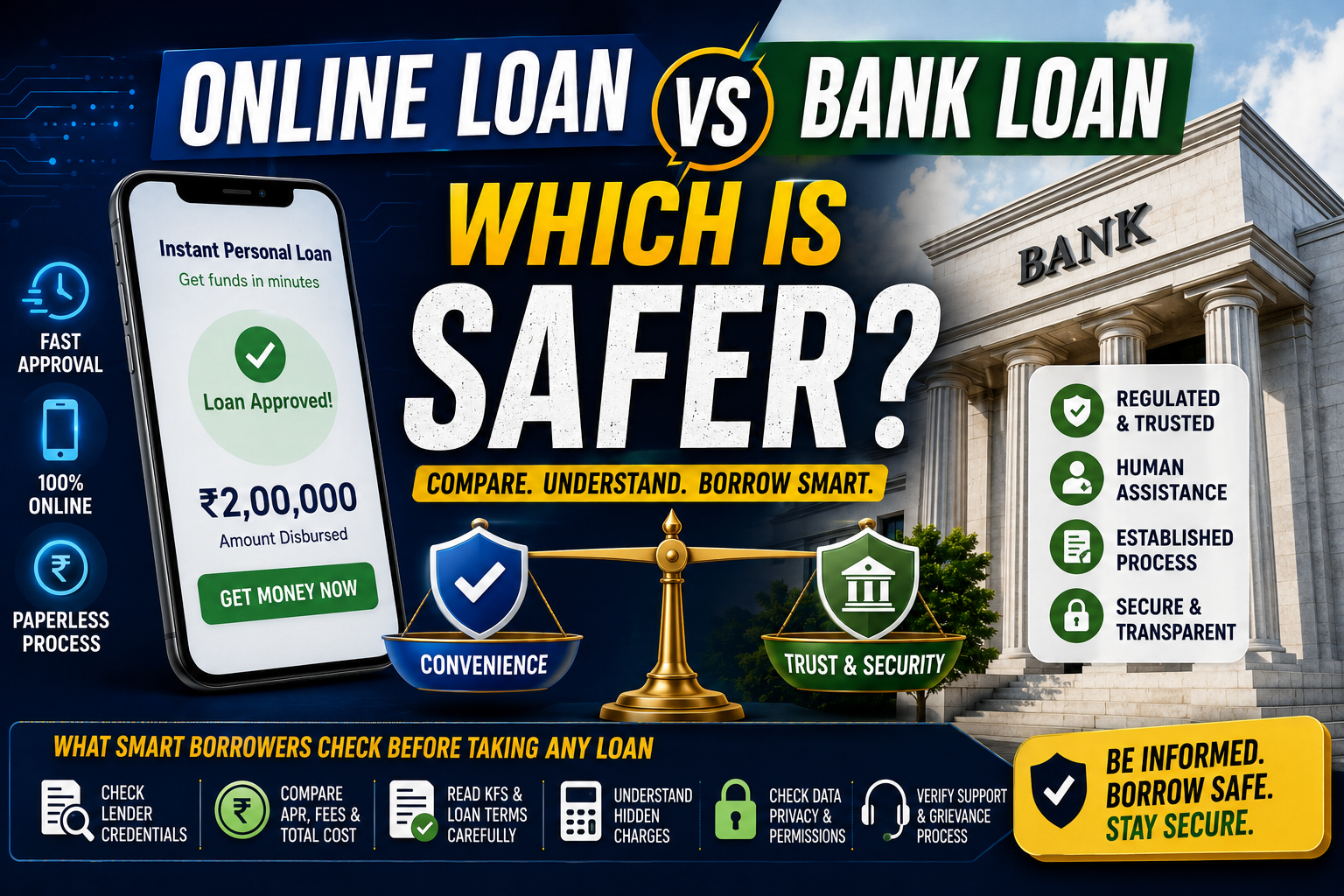
Online Loan vs Bank Loan: compare safety, interest rates, hidden charges, data privacy, RBI regulation, repayment, fraud risks and borrower protection to choose wisely.
Table of Contents
The way people borrow money has changed dramatically.
Earlier, getting a personal loan usually meant visiting a bank branch, submitting documents, speaking with a loan officer and waiting for approval. Today, borrowers can apply for loans from their smartphones and receive decisions digitally.
This has created a common question:
Online Loan vs Bank Loan: Which Is Safer?
At first glance, the answer might seem obvious.
A traditional bank loan feels safer because you know the bank, its branches and its reputation. An online loan, on the other hand, may involve an unfamiliar app, fintech company or digital platform.
But that comparison is incomplete.
An online loan is a method of delivering credit, not necessarily a different type of lender.
A bank can offer a loan completely online through its own website or mobile app. Similarly, an online lending platform may facilitate a loan provided by an RBI-regulated bank or NBFC.
The Reserve Bank of India’s Digital Lending Directions, 2025 regulate digital lending activities of entities including commercial banks, specified cooperative banks, NBFCs and All-India Financial Institutions. The framework also covers arrangements involving Lending Service Providers (LSPs) and Digital Lending Apps (DLAs).
So the better question isn’t:
“Online loan or bank loan?”
It is:
“Who is actually lending the money, and how well protected am I?”
Let’s compare both options in detail.
What Is an Online Loan?
An online loan is a loan for which much or all of the borrowing process is completed digitally.
The borrower may:
- Apply through a website or mobile app
- Submit documents electronically
- Complete digital KYC
- Receive a loan decision online
- Sign documents electronically
- Receive the money in a bank account
- Make repayments digitally
Online lending platforms can be operated by banks and NBFCs themselves or can involve Lending Service Providers working with regulated entities.
RBI’s consumer-awareness material explains that Digital Lending Apps can belong to regulated entities such as banks and NBFCs or can be operated by LSPs engaged by regulated entities. RBI advises borrowers to verify the association through the bank or NBFC’s website.
Therefore, an online loan isn’t automatically unsafe.
What Is a Traditional Bank Loan?
A traditional bank loan is generally a loan obtained directly from a bank, often through a physical branch.
The process may involve:
- Visiting a branch
- Speaking with a loan officer
- Submitting documents
- Completing verification
- Credit assessment
- Loan approval
- Signing the agreement
- Disbursement
- EMI repayment
However, the distinction between traditional and online banking is becoming less significant.
Many banks now allow customers to complete substantial portions of the loan process digitally.
So you could have:
Traditional branch loan
or
Digital loan from the same bank
The underlying lender can be exactly the same.
Online Loan vs Bank Loan: The Most Important Difference
The biggest misconception is:
Online loan = fintech company
That isn’t necessarily true.
Imagine you apply through a mobile application called XYZ Finance.
The app may actually be operated by a Lending Service Provider, while the loan is provided by an RBI-regulated NBFC.
In that situation:
XYZ Finance = Digital platform/LSP
NBFC = Actual lender
You = Borrower
RBI’s 2025 framework defines an LSP as an agent of a regulated entity that performs specified digital lending functions such as customer acquisition, services related to underwriting and pricing, servicing, monitoring or recovery.
This distinction matters enormously when evaluating safety.
Is an Online Loan Safer Than a Bank Loan?
There is no universal answer.
A legitimate online loan from a regulated bank or NBFC can be safer than an informal loan obtained through an unverified intermediary.
At the same time, an online loan from an unknown or fraudulent app can be extremely risky.
So safety depends on several factors:
- Identity of the lender
- RBI regulatory status
- Transparency of loan terms
- Data privacy
- Fee disclosure
- Repayment mechanism
- Customer support
- Grievance redressal
- Security of the digital platform
Therefore:
A regulated online loan can be safe.
An unverified online loan can be dangerous.
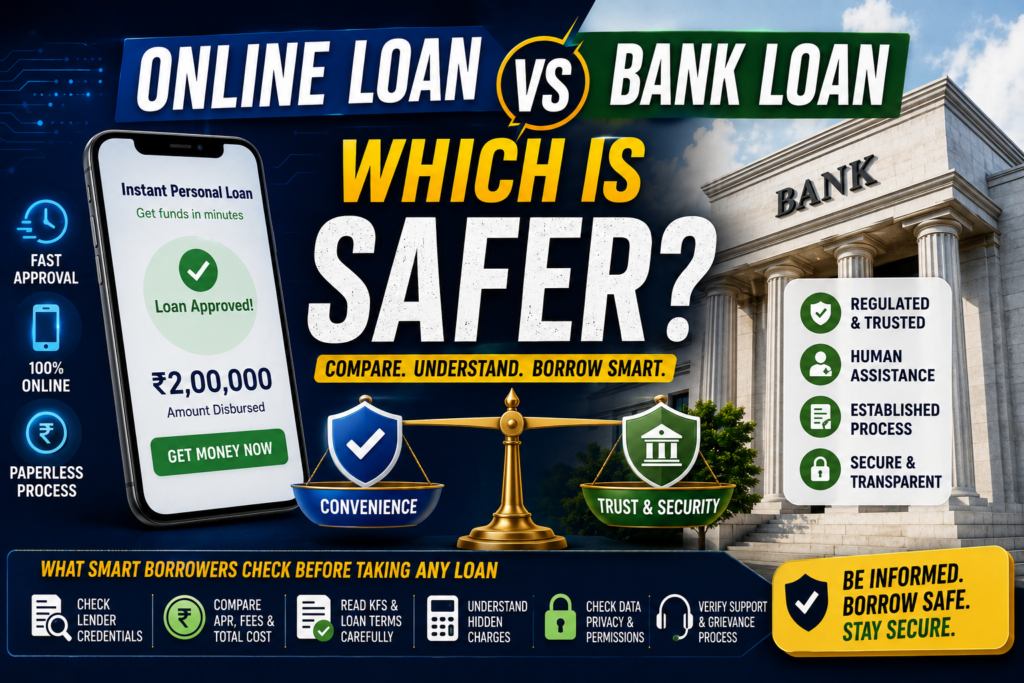
Online Loan vs Bank Loan: Safety Comparison
| Factor | Online Loan | Traditional Bank Loan |
|---|---|---|
| Application | Digital | Usually branch-based |
| Convenience | Very high | Moderate |
| Processing speed | Often faster | Can be slower |
| Physical interaction | Usually limited | Usually available |
| Fraud risk | Higher if app is unverified | Generally lower with direct bank interaction |
| Data privacy concerns | Important | Important |
| RBI regulation | Depends on actual lender | Bank is RBI-regulated |
| KFS | Required for covered loans | Required for covered loans |
| Digital documentation | Common | Increasingly common |
| Customer support | Digital/phone | Branch + digital |
| Transparency | Depends on platform | Usually clearer with direct bank |
| Best safety indicator | Verified regulated lender | Direct relationship with regulated bank |
The table shows something important:
The lender matters more than the channel.
1. Safety of the Lender
This should be your first consideration.
Before taking an online loan, ask:
Who is actually lending me the money?
Don’t stop at the name of the app.
Look for the legal name of the bank or NBFC.
RBI’s consumer guidance specifically recommends checking whether a Digital Lending App is associated with an RBI-regulated bank or NBFC through the lender’s website. RBI also advises consumers to avoid downloading loan apps received through SMS or social-media links.
This is one of the strongest safety checks you can perform.
Traditional bank loan
If you walk into an established bank branch and apply directly through the bank, the identity of the lender is generally obvious.
Online loan
You may need to investigate the relationship between the app, LSP and actual lender.
Winner for simplicity: Traditional bank loan.
But a verified online loan from the same regulated bank can offer comparable regulatory protection.
2. Risk of Fraud
Online lending has created opportunities for fraudulent loan apps.
A fake app can advertise:
“Instant Personal Loan – No CIBIL Required!”
The borrower may submit:
- PAN
- Aadhaar-related information
- Bank details
- Salary information
- Contact details
- Photos
- Other personal data
A fraudulent operator could misuse this information.
RBI has specifically warned consumers about unscrupulous digital lending apps and advises them to verify the association between the app and an RBI-regulated entity.
Bank branch
Fraud risk isn’t zero, but the physical presence and direct relationship with the bank can make verification easier.
Online platform
The borrower has to be more careful about:
- App authenticity
- Website domain
- Lender identity
- Permissions
- Payment instructions
- Customer-care details
Winner: Traditional bank loan, particularly for borrowers who are less comfortable verifying digital platforms.
3. Data Privacy
This is one area where online loans deserve special attention.
A digital lending platform may process significant amounts of personal information.
RBI’s Digital Lending framework requires data collection to be need-based and based on prior explicit consent. It also requires Digital Lending Apps/LSPs to maintain clear privacy policies and places restrictions on the storage of borrowers’ personal information.
This means you should be suspicious if an app demands unnecessary access to:
- Contacts
- Call logs
- Photos
- Messages
- Files
- Location
A loan application should not automatically mean giving an unknown application unlimited access to your phone.
Bank loan
Banks also process sensitive financial information, but borrowers generally have a clearer understanding of the institution handling their data.
Online loan
The platform, LSP and lender relationship may require additional scrutiny.
Winner: Bank loan for transparency, although regulated digital lenders also have data-protection obligations.
4. Interest Rates and APR
This is where many borrowers make a mistake.
They assume:
Online loan = high interest
and
Bank loan = low interest
That isn’t always true.
The actual interest rate depends on:
- Borrower’s credit profile
- Income
- Existing debt
- Loan amount
- Tenure
- Secured vs unsecured borrowing
- Lender’s pricing policy
- Market conditions
A bank may offer an expensive unsecured personal loan to one borrower while an NBFC or digital lender may offer a competitive rate to another.
So don’t judge the cost based on the channel.
Instead, compare:
Interest rate + APR + fees + total repayment
The RBI’s KFS framework is designed to make important loan costs easier to compare.
5. Hidden Charges
This is another major issue.
An online loan advertisement may prominently display:
“Loan at 11.99%!”
But you should also check:
- Processing fee
- Applicable taxes
- Insurance charges
- Documentation fees
- Other service charges
- Penal charges
- Prepayment terms
The RBI’s KFS framework requires covered loans to disclose the APR and relevant charges. Charges not included in the KFS generally cannot subsequently be charged during the loan term without the borrower’s explicit consent, subject to the applicable framework.
This means the KFS should become your primary reference document before accepting a loan.
6. Key Facts Statement: A Major Safety Tool
The Key Facts Statement (KFS) is important whether you’re borrowing digitally or through a regulated lender’s other channels.
It provides important information such as:
- Loan amount
- Tenure
- Interest rate
- APR
- Charges
- Repayment schedule
- Other key terms
RBI’s framework requires the KFS to be provided before the loan agreement is executed for covered loans.
For digital lending, the 2025 Directions specifically require regulated entities to provide the KFS according to the applicable KFS framework.
Reality check
If you’re choosing between:
Online Loan A: 11% advertised rate
and
Bank Loan B: 12% advertised rate
don’t immediately choose A.
Compare the KFS and APR.
Loan A could have higher fees.
7. Speed of Approval
This is where online loans clearly have an advantage.
A digital application can potentially be processed much faster because:
- Documents are submitted electronically
- Data can be verified digitally
- Credit assessment can be automated
- Communication happens instantly
- Physical paperwork can be reduced
A traditional bank branch may require:
- Appointment or visit
- Physical document submission
- Manual verification
- Additional processing time
Winner: Online loan.
But here’s the catch:
Fast approval isn’t the same as good borrowing.
A five-minute approval can create a five-year financial obligation.
8. Convenience
Online lending wins easily on convenience.
You can often:
- Apply from home
- Upload documents from your phone
- Track application status
- Receive notifications
- Make digital repayments
- Access statements online
For people who already use digital banking comfortably, this can be extremely useful.
Traditional bank loans may require more physical interaction.
Winner: Online loan.
9. Human Assistance
Traditional bank loans have one major advantage:
Human interaction.
If you don’t understand:
- Interest calculation
- EMI
- Loan tenure
- Prepayment
- Documentation
- Charges
you can speak to a bank representative.
Digital lending may instead rely on:
- Chat support
- Phone support
- In-app help
That can be sufficient for straightforward loans but frustrating when a complicated problem occurs.
Winner: Traditional bank loan.
10. Customer Complaints and Grievance Redressal
A safe lender should provide a clear way to raise complaints.
Under the Digital Lending Directions, regulated entities and LSPs that have an interface with borrowers must designate nodal grievance-redressal officers for digital-lending complaints, with contact details made available through relevant channels including the DLA and KFS.
This is important because borrowers should know:
Who do I contact if something goes wrong?
Before borrowing online, look for:
- Customer-care number
- Grievance officer
- Lender’s official website
- Complaint process
- Escalation mechanism
If you can’t find any legitimate customer-support information, that’s a red flag.
11. Loan Disbursement and Repayment Safety
This is another area where digital borrowers should be careful.
Under RBI’s Digital Lending Directions, loan disbursal should generally be made directly to the borrower’s bank account, subject to specified exceptions.
Similarly, repayments should generally flow directly between the borrower and the regulated entity rather than through a third-party pass-through or pool account.
This means you should be suspicious if someone says:
“Send the repayment to my personal UPI ID.”
or:
“Pay the processing fee to my personal bank account.”
Verify the payment instructions through the actual lender.
12. Cooling-Off Period
Digital loans have another useful consumer-protection feature.
Under the RBI’s Digital Lending Directions, 2025, borrowers must receive an explicit option to exit a digital loan during an initial cooling-off period by paying the principal and proportionate APR without a penalty.
The minimum cooling-off period is one day, although the regulated entity can provide a longer period under its Board-approved policy. A reasonable one-time processing fee may be retained if it was disclosed upfront in the KFS.
This can be useful if you realize shortly after taking the loan that:
- You don’t need the money.
- The loan is more expensive than expected.
- You accepted the loan too quickly.
- You found a more suitable option.
However, don’t interpret this as unlimited free cancellation.
The borrower must follow the lender’s exit process and pay the required amount.
13. Credit Score Impact
Don’t assume that an online loan doesn’t affect your credit history.
A digital loan provided by a regulated lender can be reported to Credit Information Companies under applicable RBI requirements. The 2025 Digital Lending Directions specifically include reporting of digital lending activity to CICs.
This means:
Online loan = real loan
Your repayment behavior matters.
If you consistently pay EMIs on time, that can contribute to a positive credit history.
If you repeatedly miss payments, the consequences can be negative.
So don’t take multiple online loans simply because the application process is easy.
14. Risk of Taking Multiple Loans
This is one of the biggest disadvantages of easy digital credit.
Suppose you already have:
Home Loan EMI: ₹20,000
Credit Card EMI: ₹8,000
Personal Loan EMI: ₹10,000
Then you see an online offer:
“Instant ₹2 lakh loan.”
The application takes five minutes.
That’s precisely where you need discipline.
Easy access to credit can make borrowing feel painless.
But your bank account experiences the opposite.
It sees every EMI.
The danger isn’t necessarily the online platform itself.
The danger is easy borrowing without adequate repayment capacity.
15. Online Loan vs Bank Loan for Emergency Situations
Suppose you suddenly need ₹1 lakh for an urgent expense.
An online loan may provide faster access.
But speed should not override cost.
Before accepting the loan, ask:
- How much do I actually need?
- How much will I repay?
- What is the APR?
- Can I comfortably pay the EMI?
- Is there a cheaper alternative?
- Is the lender regulated?
- What happens if I miss an EMI?
If you can answer all seven questions, you’re making a much more informed decision.
16. Which Is Safer for First-Time Borrowers?
For a first-time borrower who isn’t comfortable with digital finance, a direct bank loan may be easier to understand.
Why?
- Clear lender identity
- Physical branch
- Human assistance
- Established customer-service channels
- Familiar documentation
But that doesn’t mean an online loan is automatically unsafe.
A first-time borrower can safely use a digital loan if they:
- Verify the lender
- Check the app
- Read the KFS
- Compare APR
- Understand fees
- Avoid unnecessary permissions
- Use official payment channels
The issue is not technology.
The issue is verification.
17. Which Is Safer for Tech-Savvy Borrowers?
A financially disciplined borrower who understands digital finance may prefer online lending because of:
- Faster processing
- Easier comparison
- Digital documentation
- Convenience
- Faster communication
But even experienced borrowers should verify the lender.
Being comfortable with smartphones doesn’t automatically protect you from sophisticated financial scams.
Online Loan vs Bank Loan: Pros and Cons
Online Loans
Advantages
- Fast application
- Convenient
- Less paperwork
- Digital documentation
- Quick status updates
- Easy repayment
- Potentially faster disbursement
Disadvantages
- Fake-app risk
- Data privacy concerns
- Less human interaction
- Easy access can encourage over-borrowing
- Some platforms may have complicated fee structures
- Borrower must verify the actual lender
Bank Loans
Advantages
- Clear lender identity
- Established institutions
- Branch support
- Human assistance
- Established grievance mechanisms
- Often easier for borrowers to understand
Disadvantages
- May require more documentation
- Can take longer
- Branch visits may be required for some products
- Less convenient than fully digital lending
Which Is Actually Safer?
Here’s the more accurate answer:
Safest Option
A loan from a verified RBI-regulated bank or NBFC with transparent terms, a clear KFS, reasonable pricing, secure data practices and proper grievance support.
It doesn’t matter whether you applied:
Online
or
At a branch.
The underlying lender and terms are what matter most.
How to Safely Take an Online Loan
Follow this checklist.
Step 1: Identify the Lender
Find the legal name of the bank or NBFC.
Step 2: Verify the App
RBI advises consumers to check the association between a digital lending app and the regulated lender through the lender’s website.
Step 3: Check the KFS
Don’t accept the loan before reviewing it.
Step 4: Compare APR
Don’t compare only interest rates.
Step 5: Check Fees
Look for:
- Processing fees
- Taxes
- Insurance
- Other charges
- Penal charges
Step 6: Check the EMI
Make sure it fits your budget.
Step 7: Check Total Repayment
Know how much you’ll ultimately pay.
Step 8: Check Privacy Permissions
Don’t provide unnecessary access to your phone.
Step 9: Use Official Payment Channels
Never send repayments to an unknown person’s account.
Step 10: Save Documents
Keep:
- KFS
- Loan agreement
- Sanction letter
- Repayment schedule
- Payment receipts
Red Flags That Mean You Should Walk Away
Be extremely cautious if an online loan app:
- Refuses to identify the actual lender
- Claims “RBI approved” without clear evidence
- Arrives through an unsolicited SMS or social-media link
- Demands an unexplained upfront payment
- Requests excessive phone permissions
- Refuses to provide a KFS
- Hides the APR
- Doesn’t clearly disclose fees
- Asks you to repay through a personal UPI ID
- Pressures you to accept immediately
- Uses threats or abusive recovery practices
RBI specifically advises consumers to avoid downloading loan apps received through SMS or social-media links and to verify their association with regulated banks or NBFCs.
A Simple Decision Framework
Before choosing between an online loan and bank loan, score each option on five factors:
| Factor | Question |
|---|---|
| Lender | Is the actual lender regulated? |
| Cost | What is the APR and total repayment? |
| Transparency | Are all fees clearly disclosed? |
| Data | Is my personal information handled appropriately? |
| Support | Can I contact the lender if something goes wrong? |
If an online loan scores well on all five, there is no reason to reject it simply because it is digital.
If a bank loan scores poorly on cost or terms, being a bank doesn’t automatically make it the better financial decision.
Frequently Asked Questions
Is an online loan safe?
It can be, provided it is offered through a legitimate arrangement involving an RBI-regulated lender and complies with applicable digital-lending requirements. You should verify the actual lender before borrowing.
Is a bank loan safer than an online loan?
Not automatically. A bank loan may offer easier lender identification and physical support, but a regulated online loan can also have strong borrower protections.
Are online loans regulated by RBI?
Digital lending activities conducted by RBI-regulated entities are subject to RBI’s digital-lending framework. The 2025 Directions cover digital lending activities of commercial banks, specified cooperative banks, NBFCs and All-India Financial Institutions.
Can an online loan affect my CIBIL score?
Yes. Digital loans from regulated lenders can be reported to Credit Information Companies under applicable requirements.
What should I check before taking an online loan?
Check the actual lender, KFS, APR, interest rate, processing fees, total repayment, EMI, privacy policy, repayment method and grievance-redressal details.
Is an online loan always more expensive?
No. Pricing depends on the lender, borrower and loan product. Compare APR and total repayment instead of assuming online loans are automatically expensive.
Can I cancel a digital loan after receiving it?
Covered digital loans must have an initial cooling-off option under RBI’s 2025 Digital Lending Directions. The minimum period is one day, and exiting generally involves paying the principal and proportionate APR without a penalty, subject to the applicable disclosed terms.
Final Verdict: Online Loan vs Bank Loan — Which Is Safer?
The answer is more nuanced than:
“Bank loans are safe and online loans are risky.”
That’s outdated thinking.
The modern lending ecosystem has blurred the line between the two.
Banks themselves offer fully digital loans.
Fintech platforms may facilitate loans provided by regulated banks or NBFCs.
Therefore, the most important factor is not whether you applied online or offline.
It is:
Who is the actual lender?
Is the lender regulated?
Are the loan costs transparent?
Have you read the KFS?
Is your data being handled responsibly?
Can you access proper customer support?
RBI’s Digital Lending Directions, 2025 have strengthened the digital-lending framework around borrower disclosures, LSP arrangements, data collection, repayment channels, grievance redressal and cooling-off rights.
For example, regulated entities must provide a KFS for digital loans, ensure appropriate disclosure of loan terms, and generally ensure that loan disbursal and repayment flows do not pass through third-party accounts such as those of LSPs.
That means a verified online loan from a regulated lender can be a perfectly legitimate and safe borrowing option.
But an unknown loan app that refuses to disclose its lender is a completely different situation.
The safest approach is:
Verify the lender → Check the KFS → Compare APR → Understand all fees → Check repayment terms → Review data permissions → Use official payment channels → Borrow only what you can repay.
If you want convenience, an online loan can be attractive.
If you want face-to-face assistance, a traditional bank branch may be preferable.
But when it comes to safety, don’t choose based on the word “online” or “bank.”
Choose based on the regulated lender, transparency, cost and consumer protection behind the loan.
The safest loan isn’t necessarily the one that is approved fastest.
It’s the one you fully understand before accepting.
Useful Outbound Resources
- Reserve Bank of India – Digital Lending Directions, 2025 — Official RBI framework covering digital lending, Digital Lending Apps, LSPs, disclosures, data protection, repayment and borrower safeguards.
- RBI – Financial Awareness Messages: Digital Lending Apps — Consumer guidance on verifying digital lending apps and their association with regulated banks/NBFCs.
- RBI – Key Facts Statement (KFS) for Loans & Advances — Official RBI framework covering standardized loan disclosures and APR.
- RBI – Handbook on Regulations at a Glance — RBI overview of regulatory requirements relating to digital lending, data, APR and borrower protection.
- RBI – Fair Practices Code for Lenders — RBI guidance emphasizing fairness and transparency in charging interest and other loan-related amounts.
Learn how to identify Hidden Charges in online loans. Understand processing fees, APR, insurance, GST, late fees, prepayment charges and how to check your KFS before borrowing.
