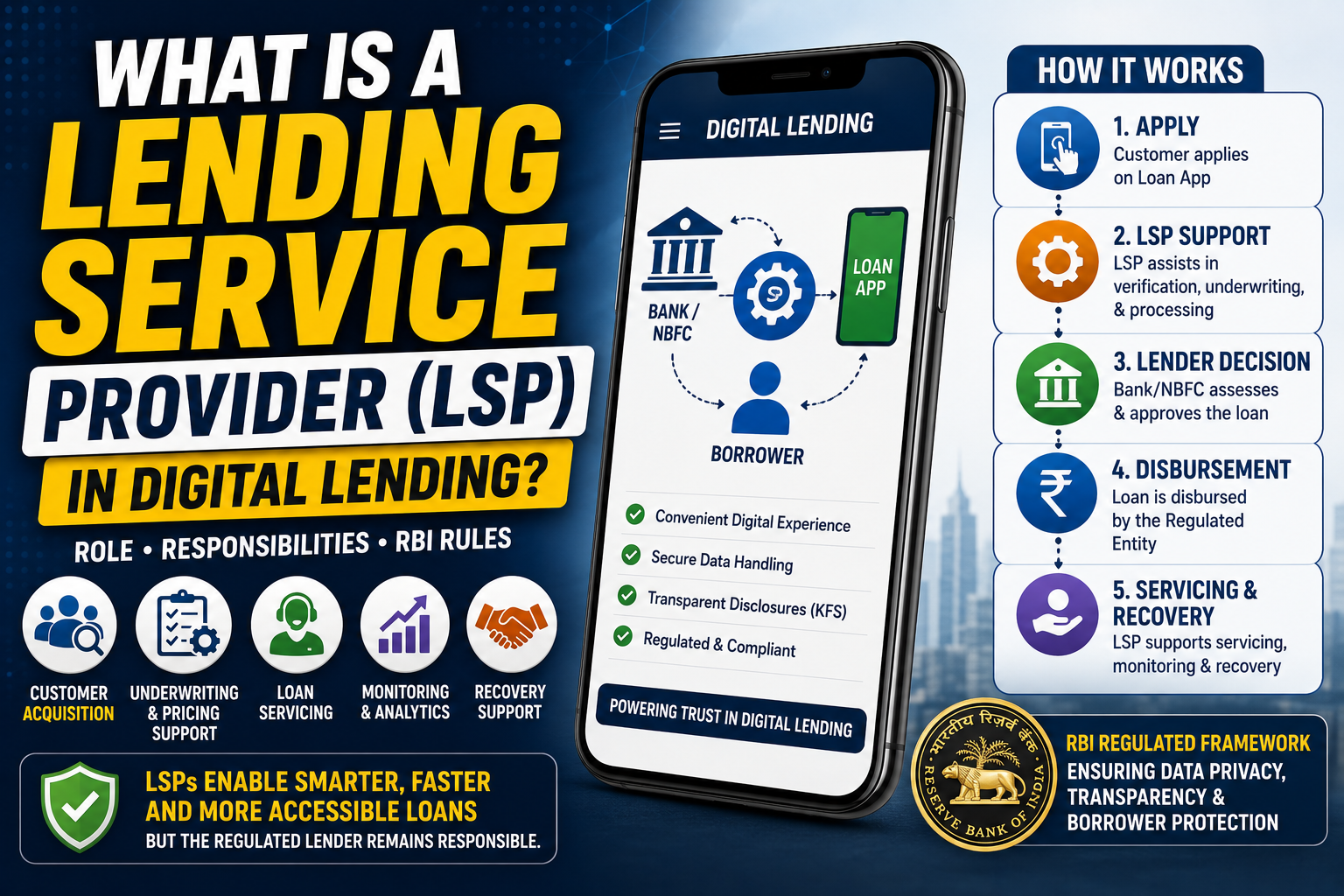
What is a Lending Service Provider (LSP) in digital lending? Learn how LSPs work with banks and NBFCs, their responsibilities, role in loan apps, data privacy, borrower protection, and RBI rules.
Table of Contents
Digital lending has transformed the way people apply for loans in India. Instead of visiting a bank branch, borrowers can now complete applications, submit documents, undergo verification and receive loan-related services through websites and mobile applications.
But behind many digital lending platforms, there may be several different companies performing different roles.
One of these is a Lending Service Provider (LSP).
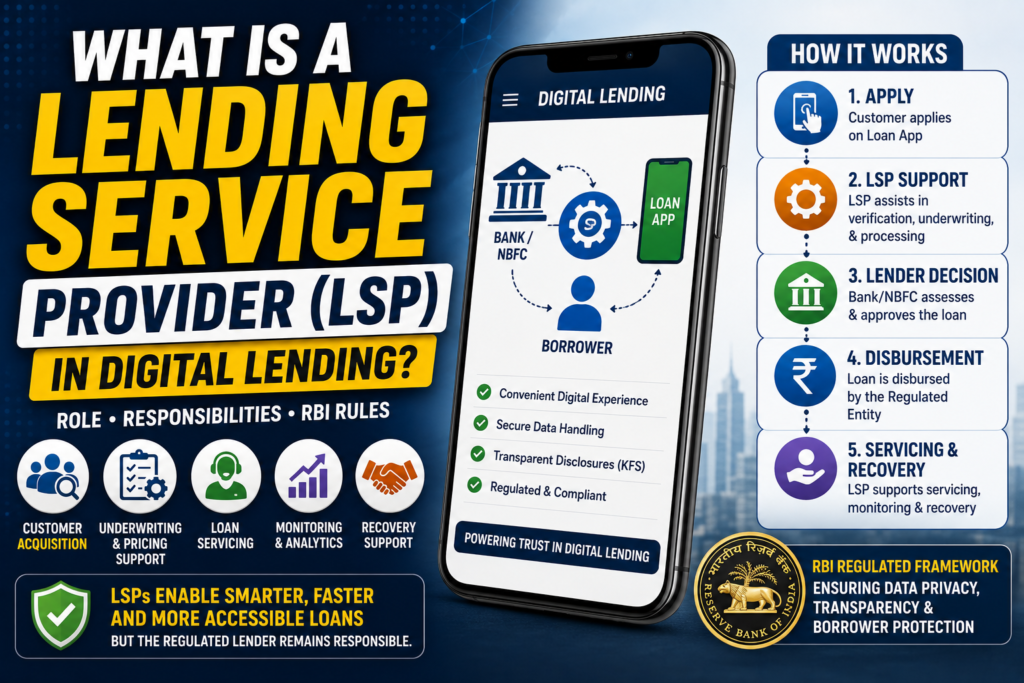
An LSP can help a bank or NBFC with activities such as customer acquisition, services connected with underwriting and pricing, loan servicing, monitoring and recovery. Under the Reserve Bank of India’s Digital Lending Directions, 2025, an LSP is an agent of a regulated entity that carries out one or more of the regulated entity’s digital lending functions, or part of them, on its behalf.
This distinction matters because borrowers often assume that the company operating a loan app is automatically the company providing the loan.
That is not necessarily true.
A typical digital lending arrangement may involve:
Borrower → Digital Lending App → LSP → Bank/NBFC
In some cases, the regulated lender itself operates the app and there may be no separate LSP.
Understanding the role of an LSP can help borrowers identify who is actually lending the money, who is providing the technology, who is handling customer service and who is responsible for different parts of the lending process.
What Is an LSP?
LSP stands for Lending Service Provider.
Under RBI’s Digital Lending Directions, 2025, an LSP is an agent of a Regulated Entity (RE), including another regulated entity, that performs one or more digital lending functions—or part of those functions—on behalf of the RE. These functions can include customer acquisition, services incidental to underwriting and pricing, servicing, monitoring and recovery of a specific loan or loan portfolio.
In simple language:
An LSP is a third-party service provider that helps a regulated lender perform certain parts of the digital lending process.
The LSP generally does not become the lender simply because it operates the technology platform or interacts with the borrower.
The actual lending relationship remains with the regulated entity.
Who Is the Regulated Entity?
In RBI’s digital lending framework, the Regulated Entity (RE) can include institutions such as banks, cooperative banks, NBFCs and certain All-India Financial Institutions covered by the Directions.
For a borrower, this is a critical distinction.
Imagine you apply for a personal loan through an app called XYZ Loans.
The app might be operated by Company A.
Company A could be an LSP.
But the actual loan could be provided by:
ABC Bank
In that case:
- XYZ Loans = LSP/platform
- ABC Bank = regulated lender
- You = borrower
The loan agreement should identify the actual lender.
Therefore, don’t assume:
App name = lender name
Always check the loan documents.
What Does an LSP Do?
The role of an LSP can vary depending on the contractual arrangement with the regulated entity.
RBI’s 2025 Directions specifically identify several functions that an LSP may perform.
These include:
- Customer acquisition
- Services incidental to underwriting and pricing
- Loan servicing
- Loan monitoring
- Recovery of specific loans or loan portfolios
The LSP must perform these activities in accordance with the applicable RBI outsourcing framework.
Let’s understand each function.
1. Customer Acquisition
One of the most common roles of an LSP is helping lenders find potential borrowers.
For example, a fintech platform may operate:
- A mobile app
- A website
- Digital advertising campaigns
- Online application forms
- Financial comparison tools
A customer may discover the platform through an online advertisement and submit a loan application.
The LSP can then facilitate the customer’s application with one or more regulated lenders.
This can make the process much more convenient for borrowers.
But there is an important issue:
The borrower should know who the actual lender is.
An attractive fintech brand does not necessarily mean that the fintech itself is providing the loan.
2. Underwriting and Pricing Support
An LSP can also provide services that are incidental to underwriting and pricing.
For example, technology may help collect and organize information used by the lender for credit assessment.
An LSP might facilitate:
- Digital document collection
- Data processing
- Application verification
- Fraud checks
- Financial information analysis
- Technology-based credit assessment support
However, this does not mean the LSP automatically becomes the final decision-maker for the loan.
The regulated entity remains responsible for the lending activity and must comply with RBI requirements.
This is particularly important because credit decisions affect consumers directly.
3. Loan Servicing
After a loan is disbursed, the borrower may still interact with an LSP.
For example, an LSP may provide technology for:
- EMI reminders
- Account information
- Repayment schedules
- Customer support
- Loan statements
- Digital communication
The exact responsibilities depend on the arrangement between the LSP and regulated entity.
The borrower should nevertheless be able to identify the actual lender and understand where repayments should be made.
4. Loan Monitoring
An LSP may also assist the regulated entity in monitoring specific loans or loan portfolios.
This can involve technology that helps identify:
- Missed payments
- Delinquency
- Changes in account status
- Portfolio-level trends
- Fraud indicators
The purpose is to help the lender manage the loan portfolio.
However, monitoring does not eliminate the regulated entity’s responsibility for the lending relationship.
5. Recovery Services
An LSP can also perform recovery-related activities on behalf of a regulated entity when engaged for that purpose.
This is one area where consumer protection is particularly important.
Borrowers should know who is contacting them about repayment and whether the person or organization is authorized to act on behalf of the lender.
RBI’s digital lending framework requires disclosure of the details of recovery agents in applicable circumstances, and regulated entities are expected to guide LSPs acting as recovery agents and ensure compliance with applicable instructions.
So, if someone suddenly contacts you demanding repayment, don’t simply transfer money because they claim to represent a loan app.
Verify the request through the lender’s official channels.
How Does an LSP Work With a Bank or NBFC?
An LSP doesn’t simply start offering loans on behalf of a bank without an arrangement.
RBI’s Digital Lending Directions require digital lending involving an LSP to operate under a contractual agreement between the regulated entity and the LSP.
The agreement should clearly define:
- Roles
- Rights
- Responsibilities
- Obligations
- Scope of services
- Applicable compliance requirements
The regulated entity is also required to conduct enhanced due diligence before entering into an LSP arrangement.
This means the bank or NBFC should evaluate the LSP rather than blindly outsourcing important activities.
What Does RBI Require Banks and NBFCs to Check Before Hiring an LSP?
The RBI’s 2025 Directions require regulated entities to conduct enhanced due diligence on LSPs.
The assessment can consider factors such as:
- Technical capabilities
- Data privacy policies
- Data storage systems
- Fairness in dealing with borrowers
- Past conduct
- Ability to comply with applicable laws and regulations
The regulated entity must also periodically review the conduct of the LSP against the contractual arrangement.
This is important because outsourcing a function doesn’t mean outsourcing responsibility.
Is the LSP Responsible for the Loan?
This is one of the biggest misconceptions.
Suppose:
Bank A provides ₹2 lakh to a borrower.
Fintech B operates the app and provides digital services.
If Fintech B is acting as an LSP for Bank A, the borrower should not assume that Fintech B has become the lender.
The regulated entity remains responsible for the lending activity and applicable regulatory obligations.
RBI’s earlier Digital Lending Guidelines explicitly stated that outsourcing arrangements with LSPs or Digital Lending Apps do not diminish the regulated entity’s obligations.
The 2025 Directions continue this principle and make the regulated entity responsible for the acts and omissions of the LSP in the relevant digital-lending arrangement.
Therefore:
LSP = service provider
RE = regulated lender
These roles should not be confused.
Can an LSP Charge the Borrower Directly?
Generally, borrowers should be careful about any claim that an LSP needs to be paid separately for facilitating the loan.
RBI’s digital-lending framework states that fees and charges payable to LSPs for credit intermediation are to be paid by the regulated entity and not directly by the borrower.
This is an important consumer-protection principle.
For example, if someone says:
“Pay us ₹2,000 directly because we are the LSP and then your loan will be approved.”
That deserves serious scrutiny.
A borrower should instead check the official loan documents and the lender’s disclosed charges.
How Does an LSP Make Money?
An LSP is a service provider, so its business model can involve receiving compensation from the regulated entity for the services it provides.
The exact commercial arrangement depends on the contract.
For example, an LSP could provide:
- Technology infrastructure
- Customer acquisition
- Loan servicing
- Underwriting-related technology
- Portfolio monitoring
- Recovery support
The key regulatory principle is that the borrower should not be improperly burdened with separate LSP fees for credit intermediation.
RBI’s framework specifically requires applicable LSP fees and charges for credit intermediation to be paid by the regulated entity rather than directly by the borrower.
LSP vs Digital Lending App: What’s the Difference?
These two terms are often confused.
Digital Lending App
A DLA is the mobile or web-based application that provides the user interface for digital lending services.
LSP
An LSP is an agent of a regulated entity that performs one or more digital lending functions on behalf of that entity.
A DLA can be:
- An app operated by the regulated entity
- An app operated by an LSP
RBI’s 2025 Directions explicitly include applications of the regulated entity as well as applications operated by LSPs for extending credit facilitation services.
Therefore:
DLA = technology/interface
LSP = service provider/agent
RE = regulated lender
One company can sometimes perform multiple roles, but the roles should still be understood separately.
Example: How an LSP Can Fit Into a Digital Loan
Imagine a borrower wants a ₹3 lakh personal loan.
Step 1: Application
The borrower downloads a fintech app.
Step 2: LSP Platform
The app is operated by an LSP that has arrangements with regulated lenders.
Step 3: Information Collection
The platform facilitates the collection of information required for the loan application.
Step 4: Lender Assessment
The regulated lender assesses the borrower’s creditworthiness and determines the applicable loan terms under its processes.
Step 5: KFS
The borrower receives the applicable Key Facts Statement showing important loan terms and costs.
Step 6: Loan Agreement
The borrower accepts the agreement with the actual lender.
Step 7: Disbursement
The loan is disbursed according to the applicable RBI framework.
Step 8: Servicing
The borrower may continue interacting with the app or LSP for certain servicing functions.
This creates a digital experience without necessarily requiring the fintech platform itself to be the lender.
LSP and Multiple Lenders
One of the more important developments in RBI’s 2025 Digital Lending Directions concerns LSP arrangements involving multiple lenders.
Some digital platforms may work with more than one regulated lender.
This can potentially give borrowers access to different offers.
But it also creates a potential conflict-of-interest issue.
If an LSP works with multiple lenders, borrowers need meaningful information about the offers available to them.
RBI’s 2025 framework introduced requirements for arrangements involving multiple lenders, including transparency around lender offers and ensuring that borrowers are able to make informed choices.
This is important because the LSP may have commercial relationships with multiple lenders.
A borrower should not assume that the first offer shown is automatically the cheapest or most suitable.
What Should Borrowers Compare When Multiple Lenders Are Offered?
Suppose a digital platform gives you three offers:
Lender A
APR: 14%
Lender B
APR: 16%
Lender C
APR: 13.5%
Don’t choose simply because one lender offers a larger loan.
Compare:
- APR
- Interest rate
- Processing fee
- EMI
- Tenure
- Total repayment
- Penal charges
- Prepayment conditions
- Other applicable charges
The Key Facts Statement is particularly useful for this comparison.
The goal of digital lending should be informed borrowing—not simply faster borrowing.
LSP and Data Privacy
Data is one of the biggest issues in digital lending.
An LSP may process significant amounts of borrower information while facilitating lending services.
RBI’s digital-lending framework therefore contains specific requirements around data collection, storage, privacy and consent.
RBI requires data collection to be need-based and supported by prior explicit consent.
Borrowers should also have the ability to accept or deny consent for specific data uses. Digital Lending Apps and LSPs are expected to maintain clear privacy policies.
This means a lending app shouldn’t simply collect every piece of information available on your phone without a legitimate need.
Can an LSP Access Your Contacts?
Borrowers should be extremely cautious about unnecessary access to personal data.
RBI’s digital-lending framework restricts the collection and storage of personal information and emphasizes need-based data collection with explicit consent.
If an app asks for access to:
- Contacts
- Call logs
- Photos
- Messages
- Files
- Location
you should understand why that information is required.
A loan application is not a reason to automatically surrender unrestricted access to your personal device.
If the permissions appear excessive or the app cannot explain them clearly, reconsider the application.
Does the LSP Have to Follow RBI Rules?
The LSP itself is not necessarily a bank or NBFC.
However, when it acts as an agent of a regulated entity in digital lending, the arrangement is subject to RBI’s requirements applicable to the regulated entity and its LSP relationship.
The regulated entity must ensure that its LSP and associated Digital Lending Apps comply with the relevant requirements.
The regulated entity also remains responsible for its obligations even when functions are outsourced.
This is why borrowers should focus on identifying the regulated lender behind the platform.
How Can You Check Who the Actual Lender Is?
Before accepting a digital loan, follow these steps.
1. Check the Loan Offer
Look for the legal name of the actual lender.
2. Check the KFS
The Key Facts Statement should identify important loan information and the relevant regulated entity.
3. Check the Loan Agreement
Read the agreement carefully.
4. Visit the Lender’s Official Website
RBI advises consumers to verify whether a Digital Lending App is associated with an RBI-regulated bank or NBFC through the lender’s website.
5. Check RBI’s Digital Lending App Information
RBI has established a public repository of Digital Lending Apps associated with regulated entities to improve transparency for borrowers.
What Are the Benefits of LSPs?
LSPs can provide several benefits to the digital lending ecosystem.
Technology
They can build and maintain digital platforms that simplify loan applications.
Convenience
Borrowers can access credit without visiting branches.
Faster Processing
Automated systems can reduce manual processing time.
Customer Acquisition
Banks and NBFCs can reach customers through fintech platforms.
Specialized Technology
LSPs may provide capabilities in:
- Data processing
- Fraud detection
- Digital KYC
- Customer communication
- Loan servicing
- Analytics
Wider Access
Technology can help lenders reach customer segments beyond traditional branch networks.
However, these benefits depend on responsible implementation.
What Are the Risks of LSP-Based Digital Lending?
The LSP model can also create risks if poorly managed.
1. Mis-selling
An intermediary may prioritize its commercial incentives over the borrower’s best interests.
2. Data Privacy
Large amounts of personal information may pass through digital systems.
3. Lack of Transparency
Borrowers may not understand who is actually lending the money.
4. Multiple-Lender Conflicts
An LSP working with several lenders may have incentives that affect how offers are presented.
5. Recovery Concerns
Poorly managed recovery practices can create consumer-protection problems.
6. Technology Risk
System failures or cybersecurity incidents can affect borrowers.
This is why RBI’s 2025 framework emphasizes due diligence, monitoring, contractual arrangements, customer protection and data requirements.
LSP vs Bank vs NBFC
These three terms describe very different roles.
| Entity | Main Role |
|---|---|
| Bank | Regulated lender that provides loans |
| NBFC | Regulated non-bank lender that provides loans |
| LSP | Agent/service provider performing specified lending functions for a regulated entity |
| DLA | App or web interface facilitating digital lending |
For example:
Borrower
↓
Digital Lending App
↓
LSP
↓
NBFC
In another model:
Borrower
↓
Bank’s own app
↓
Bank
There may be no separate LSP in the second example.
Common Misconceptions About LSPs
Myth 1: The LSP Is the Lender
Not necessarily.
The actual lender is the regulated entity named in your loan documents.
Myth 2: LSPs Can Charge Any Fee They Want
No.
Applicable regulatory requirements govern fees and charges, and LSP fees for credit intermediation are to be paid by the regulated entity rather than directly by the borrower.
Myth 3: Every Loan App Is an LSP
No.
A Digital Lending App can belong to a regulated entity itself or be operated by an LSP.
Myth 4: RBI Personally Approves Every Loan App
This is misleading.
RBI regulates the regulated entities and the applicable digital-lending framework. Borrowers should verify the relationship between the app and the regulated lender rather than relying on claims such as “RBI-approved app.”
Myth 5: LSPs Can Collect Any Data They Want
No.
RBI’s framework contains requirements around need-based data collection, consent, privacy and storage.
What Should You Do If You Have a Problem With an LSP?
If you have a problem with a digital loan, your first step should generally be to contact the regulated lender identified in your loan documents.
Keep records of:
- Emails
- Screenshots
- Loan documents
- KFS
- Payment receipts
- Customer-support tickets
- Complaint reference numbers
If the complaint is not resolved appropriately, RBI’s complaint mechanisms may be available depending on the regulated entity and circumstances.
The important point is that you should not be left trying to identify a mysterious company that refuses to disclose who actually provided the loan.
Frequently Asked Questions About LSPs
What is an LSP in digital lending?
An LSP, or Lending Service Provider, is an agent of a regulated entity that performs one or more digital lending functions such as customer acquisition, underwriting-related services, pricing-related services, servicing, monitoring or recovery.
Is an LSP the same as an NBFC?
No. An NBFC can be the actual regulated lender. An LSP is generally an agent/service provider working on behalf of a regulated entity.
Can an LSP give me a loan?
The LSP can facilitate the digital lending process, but the actual loan should be provided by the regulated lender identified in the loan documents.
Who is responsible if an LSP makes a mistake?
The regulated entity retains responsibility for applicable obligations and the acts and omissions of its LSP in the digital-lending arrangement.
Can an LSP charge me directly?
Borrowers should not be asked to directly pay LSP fees for credit intermediation. RBI’s framework places such fees on the regulated entity.
Can an LSP work with multiple lenders?
Yes. RBI’s 2025 Directions specifically address digital-lending arrangements where an LSP works with multiple regulated entities and introduce additional transparency requirements.
How can I find the actual lender?
Check the loan offer, KFS and loan agreement, and verify the relationship through the lender’s official website and RBI’s available digital-lending information.
Final Takeaway
A Lending Service Provider (LSP) is an important part of India’s growing digital lending ecosystem.
An LSP can help banks and NBFCs with functions such as:
Customer acquisition → Underwriting-related services → Pricing support → Loan servicing → Monitoring → Recovery
But the most important thing for borrowers to understand is this:
The LSP is not necessarily the lender.
The actual lender is generally the regulated entity—such as a bank or NBFC—that provides the credit.
RBI’s Digital Lending Directions, 2025 require regulated entities to have contractual arrangements with LSPs, conduct enhanced due diligence, monitor their conduct and ensure compliance with applicable digital-lending requirements. The regulated entity also remains responsible for its regulatory obligations and the acts and omissions of its LSP in the relevant arrangement.
For borrowers, this means you should never judge a digital loan simply by the name of the app.
Before accepting a loan, ask:
Who is the actual lender?
What is the APR?
What does the KFS say?
What fees will I pay?
Where will the loan money come from?
Where should I make repayments?
Who should I contact if there is a problem?
Also pay close attention to data permissions and privacy policies.
The biggest mistake is to think:
“It’s a fintech app, so the fintech company must be lending me the money.”
That may be completely wrong.
A digital lending ecosystem can involve a regulated lender, an LSP and a Digital Lending App, each performing different functions.
Understanding those roles makes it easier to identify legitimate lending relationships, compare loan offers and protect yourself from misleading or fraudulent digital lending practices.
In digital lending, knowing who is actually responsible for your loan is just as important as knowing how much the loan costs.
Useful Outbound Resources
- Reserve Bank of India – Digital Lending Directions, 2025 — Official RBI source for the regulatory framework governing digital lending and LSP arrangements.
- RBI – Guidelines on Digital Lending — Earlier digital-lending guidelines covering regulated entities, LSPs and Digital Lending Apps.
- RBI – Financial Awareness Messages: Digital Lending Apps — Consumer guidance on identifying legitimate digital lending apps and verifying their association with regulated lenders.
- RBI – Handbook on Regulations at a Glance — RBI’s overview of key digital-lending regulatory requirements, including LSP-related obligations.
- RBI – Working Group on Digital Lending — Background on digital lending, technology, consumer protection and the role of Lending Service Providers.
What is a Key Fact Statement (KFS) in digital lending? Learn what a KFS contains, how APR and fees are disclosed, why it matters, and how borrowers can use it to compare digital loans.
