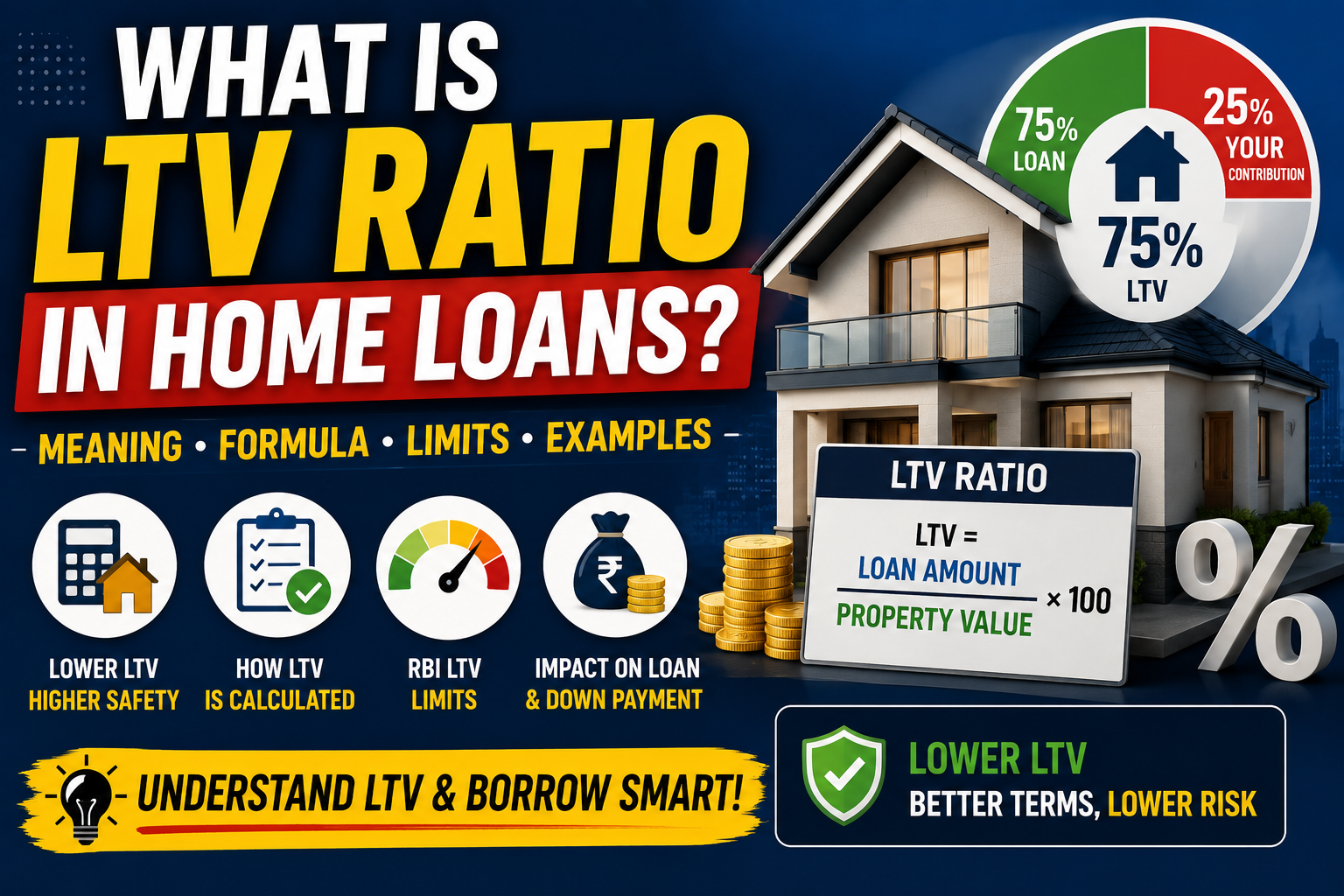
What is LTV ratio in home loans? Learn the LTV formula, RBI limits, how LTV affects your down payment and loan eligibility, with examples and practical tips.
Table of Contents
Buying a home usually requires a large amount of money, and very few buyers can finance the entire purchase from their savings. A home loan helps bridge that gap, but lenders generally do not finance 100% of a property’s value.
One of the most important concepts that determines how much a lender can finance is the Loan-to-Value ratio, commonly called LTV ratio.
LTV tells you how large the loan is compared with the value of the property being financed.
For example, if a house is valued at ₹80 lakh and a lender provides a ₹60 lakh home loan, the LTV is 75%.
In India, LTV is particularly important because regulatory limits restrict how much certain lenders can finance against residential property. For housing finance companies, RBI’s 2025 directions state that HFCs cannot grant individual housing loans above 90% LTV for loans up to ₹30 lakh, above 80% for loans above ₹30 lakh and up to ₹75 lakh, or above 75% for loans above ₹75 lakh.
But there is an important distinction:
The regulatory LTV ceiling is not the same as the loan amount you are guaranteed to receive.
A bank or housing finance company may offer a lower LTV depending on your income, credit profile, property valuation, internal policies and other factors.
Let’s understand exactly how LTV works.
What Is LTV Ratio in a Home Loan?
LTV stands for Loan-to-Value ratio.
It measures the percentage of a property’s value that is being financed through a loan.
The basic formula is:
LTV Ratio = Loan Amount ÷ Property Value × 100
For example:
Property value = ₹1 crore
Home loan = ₹75 lakh
LTV:
₹75 lakh ÷ ₹1 crore × 100
= 75%
This means the lender is financing 75% of the property’s value, while the remaining 25% represents the buyer’s contribution toward the property price, subject to the lender’s valuation and applicable rules.
A lower LTV generally means the borrower is contributing a larger amount from their own funds.
Why Is LTV Important?
LTV is important because it helps determine the relationship between:
Property value
and
Loan amount
From the lender’s perspective, the property serves as security for the home loan.
If a lender finances a very large percentage of the property’s value, its exposure is higher relative to the collateral.
For example:
Loan A
Property value: ₹1 crore
Loan: ₹50 lakh
LTV: 50%
Loan B
Property value: ₹1 crore
Loan: ₹80 lakh
LTV: 80%
The second loan has a significantly higher LTV.
If the borrower defaults and the property has to be sold, the lender generally has less margin between the outstanding loan and the property’s value.
This is one reason LTV limits exist.
RBI has historically explained LTV restrictions as a measure intended to prevent excessive leveraging in housing loans.
How to Calculate LTV Ratio: Example
Suppose you are purchasing a property for:
₹60 lakh
You want a home loan of:
₹48 lakh
The calculation is:
₹48 lakh ÷ ₹60 lakh × 100
= 80% LTV
This means:
- Property value: ₹60 lakh
- Loan: ₹48 lakh
- Buyer’s contribution: ₹12 lakh
- LTV: 80%
However, your actual upfront requirement can be higher because the purchase involves costs beyond the basic property price.
These can include:
- Stamp duty
- Registration charges
- Legal expenses
- Brokerage
- Processing charges
- Interior expenses
- Moving costs
RBI guidance has specifically stated that banks should generally not include stamp duty, registration and documentation charges in the property cost for calculating LTV, because these charges do not represent realizable property value.
Therefore, don’t assume that your down payment is simply:
Property price − sanctioned loan
You should budget for the additional transaction costs separately.
What Are the LTV Limits for Home Loans in India?
The commonly referenced regulatory structure for individual housing loans is:
| Loan Amount | Maximum LTV |
|---|---|
| Up to ₹30 lakh | Up to 90% |
| Above ₹30 lakh and up to ₹75 lakh | Up to 80% |
| Above ₹75 lakh | Up to 75% |
For housing finance companies, these limits are expressly set out in RBI’s Housing Finance Companies Directions, 2025.
For example:
Property/loan falls within ₹30 lakh category
A regulatory ceiling of 90% could mean that, subject to the lender’s valuation and other eligibility conditions, the loan cannot exceed 90% of the property’s realizable value.
Loan above ₹30 lakh and up to ₹75 lakh
The applicable ceiling is 80%.
Loan above ₹75 lakh
The applicable ceiling is 75%.
The important point is that these are upper regulatory limits, not automatic loan offers.
A lender can choose to finance less.
Example: ₹50 Lakh Home Loan and LTV
Suppose you purchase a home worth:
₹60 lakh
You want:
₹50 lakh
Your LTV would be:
₹50 lakh ÷ ₹60 lakh × 100
= 83.33%
If the applicable regulatory ceiling is 80%, a lender subject to that limit could not finance the full ₹50 lakh against a ₹60 lakh valuation.
At 80% LTV, the maximum loan based purely on that ceiling would be:
₹60 lakh × 80%
= ₹48 lakh
Therefore, you may need to arrange at least:
₹60 lakh − ₹48 lakh
= ₹12 lakh
from your own funds, before considering other purchase-related expenses.
Example: ₹1 Crore Property
Suppose your property is valued at:
₹1 crore
If the applicable maximum LTV is 75%, the maximum loan based on the LTV ceiling would be:
₹1 crore × 75%
= ₹75 lakh
Your minimum contribution toward the property value would therefore be:
₹1 crore − ₹75 lakh
= ₹25 lakh
Again, this doesn’t mean every lender will automatically approve ₹75 lakh.
Your income, existing EMIs, credit score, employment profile, property characteristics and lender-specific rules still matter.
Does LTV Determine Your Home Loan Eligibility?
Partly, but not by itself.
This is one of the biggest misconceptions about LTV.
Suppose you buy a ₹1 crore property.
You may think:
“The LTV limit is 75%, so I can definitely get ₹75 lakh.”
Not necessarily.
The lender may determine that your income supports only a ₹60 lakh loan.
In that situation:
Regulatory maximum: ₹75 lakh
Your actual eligibility: ₹60 lakh
Your actual loan would therefore be ₹60 lakh.
This is because lenders also assess your repayment capacity.
RBI’s consumer guidance on home loans explains that banks consider factors such as monthly disposable or surplus income, income stability and existing liabilities when assessing repayment capacity.
So there are effectively two different questions:
How much can the property support as collateral?
and
How much can you afford to repay?
LTV primarily addresses the first question.
Your income and credit profile help answer the second.
LTV vs Loan Eligibility: An Easy Example
Consider two borrowers buying identical properties worth ₹80 lakh.
Borrower A
- Income: ₹1.5 lakh/month
- Existing EMIs: ₹10,000
- Strong credit history
- Stable employment
Borrower B
- Income: ₹80,000/month
- Existing EMIs: ₹30,000
- Similar credit score
- Higher existing obligations
Even though the property is worth exactly the same for both borrowers, their loan eligibility can be very different.
LTV might establish a maximum percentage of the property’s value that can be financed.
But income-based affordability could result in a much lower sanctioned amount.
How LTV Affects Your Down Payment
The lower the LTV, the larger your own contribution generally needs to be toward the property price.
For example:
90% LTV
Property value: ₹30 lakh
Loan: ₹27 lakh
Your contribution: ₹3 lakh
80% LTV
Property value: ₹50 lakh
Loan: ₹40 lakh
Your contribution: ₹10 lakh
75% LTV
Property value: ₹1 crore
Loan: ₹75 lakh
Your contribution: ₹25 lakh
These examples illustrate the relationship; actual loan approval can differ based on lender valuation and eligibility.
A lower LTV therefore means:
Higher upfront contribution
but also:
Lower loan amount
and potentially:
Lower EMI and lower total interest cost, assuming other terms are unchanged.
Is a Lower LTV Better for the Borrower?
Generally, a lower LTV can be financially healthier because you’re borrowing less relative to the property’s value.
Suppose you buy a ₹1 crore property.
Option A
Loan = ₹75 lakh
Option B
Loan = ₹60 lakh
Option B requires a larger upfront contribution, but the monthly EMI and total interest cost can be substantially lower, depending on the interest rate and tenure.
A lower loan balance can also provide a larger cushion between the property’s value and outstanding debt.
However, there is a catch.
You shouldn’t put every rupee of your savings into the down payment.
Homeownership comes with unexpected expenses.
You should also consider maintaining an emergency fund for:
- Job loss
- Medical expenses
- Repairs
- Family emergencies
- Temporary income disruption
A technically low LTV is not useful if achieving it leaves you financially vulnerable.
Can a Higher LTV Make a Home Loan More Expensive?
Potentially.
The higher the loan amount, the more interest you generally pay if the interest rate and tenure remain comparable.
For example:
Property value = ₹80 lakh
75% LTV
Loan = ₹60 lakh
80% LTV
Loan = ₹64 lakh
That additional ₹4 lakh is borrowed rather than funded by you.
You therefore pay interest on that additional amount over the loan tenure.
The exact difference depends on:
- Interest rate
- Loan tenure
- EMI structure
- Prepayments
- Rate changes for floating-rate loans
Therefore, don’t focus only on getting the maximum possible loan.
Ask:
“How much should I borrow?”
rather than:
“How much can I borrow?”
How Property Valuation Affects LTV
This is extremely important.
You might agree to purchase a property for:
₹80 lakh
But the lender’s valuation may determine that the property’s realizable value is only:
₹75 lakh
Suppose the applicable maximum LTV is 80%.
The lender may calculate the maximum loan based on its accepted property value rather than simply using the seller’s asking price.
80% of ₹75 lakh:
₹60 lakh
So, even though you agreed to pay ₹80 lakh, you may have to arrange:
₹80 lakh − ₹60 lakh
= ₹20 lakh
plus applicable transaction and other costs.
This is one reason buyers should not assume that the purchase price and lender’s valuation will always be identical.
Why Banks Don’t Finance 100% of a Property
There are several reasons.
1. Risk Management
The property is security for the loan.
A lower LTV provides the lender with a larger margin.
2. Property Values Can Change
Real estate prices don’t always rise.
Property values can fall due to:
- Local economic conditions
- Infrastructure changes
- Oversupply
- Legal issues
- Market downturns
- Poor property maintenance
3. Selling a Property Takes Time
If a borrower defaults, recovering money through a property sale isn’t necessarily immediate.
There can be:
- Legal procedures
- Valuation issues
- Finding buyers
- Market delays
- Transaction costs
4. Borrower Has Some Financial Stake
A meaningful down payment means the borrower has invested their own money into the property.
Does CIBIL Score Affect LTV?
Not directly.
LTV is primarily a relationship between:
Loan amount
and
Property value
Your CIBIL Score doesn’t mathematically change the LTV formula.
However, your CIBIL Score can influence whether the lender is willing to approve the loan and on what terms.
For example:
LTV: 75%
CIBIL: Strong
This may be a favorable combination.
But:
LTV: 75%
CIBIL: Weak
could still lead to rejection or less favorable terms depending on the lender.
Therefore:
LTV and CIBIL serve different purposes.
LTV evaluates the loan relative to collateral value.
CIBIL helps lenders understand your credit history.
LTV vs FOIR: What’s the Difference?
If you’re researching home loans, you’ll often come across another term: FOIR.
The two concepts are completely different.
LTV
Measures:
Loan ÷ Property Value
It focuses on the property and collateral.
FOIR
Measures:
Financial obligations ÷ Income
It focuses on your repayment capacity.
For example:
Property value = ₹1 crore
Loan = ₹75 lakh
LTV = 75%
Meanwhile:
Monthly income = ₹1 lakh
Total monthly obligations = ₹45,000
FOIR under a simplified calculation = 45%
A lender can consider both.
In simple terms:
LTV asks: “How much are we lending against the property?”
FOIR asks: “Can this borrower comfortably handle the repayments?”
Does Stamp Duty Count in LTV?
Generally, borrowers should not assume that stamp duty and registration charges can simply be added to the property value for LTV purposes.
RBI has stated that banks should not include stamp duty, registration and documentation charges in the cost of the housing property for LTV calculations because these costs are not realizable value of the property.
The current RBI directions for HFCs similarly state that stamp duty, registration and documentation charges should not be included in the financed property cost for LTV purposes, subject to a limited exception for houses/dwelling units costing up to ₹10 lakh.
Therefore, buyers should generally budget these expenses separately.
Can You Improve Your LTV?
You don’t “improve” LTV in the same way you improve a credit score.
You can, however, reduce your LTV by contributing more money toward the purchase.
For example:
Property value = ₹80 lakh
Loan = ₹64 lakh
LTV = 80%
If you instead borrow ₹56 lakh:
LTV = 70%
Your LTV has decreased because your own contribution has increased.
You can also reduce the effective LTV over time by making eligible principal prepayments, although the property’s current value and the lender’s calculation methodology matter when determining an actual LTV.
Should You Aim for the Lowest Possible LTV?
Not necessarily.
This is where personal financial planning matters.
Suppose you have ₹30 lakh in savings.
You are buying a ₹1 crore home.
You could use ₹25 lakh as a down payment and keep ₹5 lakh as emergency savings.
Or you could use the entire ₹30 lakh to reduce the loan.
The second option gives you a lower loan balance.
But it leaves you with little liquidity.
If an emergency occurs immediately after buying the home, you might have to rely on expensive credit.
Therefore, the best LTV isn’t necessarily the mathematically lowest one.
The better target is an LTV that allows you to:
- Meet lender requirements
- Keep your EMI manageable
- Avoid excessive interest
- Maintain emergency savings
- Handle other home-buying costs
Common Mistakes About LTV Ratio
Mistake 1: Assuming the Lender Will Give the Maximum LTV
A regulatory ceiling is not a guarantee.
Your actual loan may be lower.
Mistake 2: Ignoring Property Valuation
The lender may use its accepted property valuation rather than simply the negotiated purchase price.
Mistake 3: Forgetting Registration and Stamp Costs
These expenses can require significant additional cash.
Mistake 4: Using All Savings for the Down Payment
Don’t sacrifice your emergency fund simply to achieve a lower LTV.
Mistake 5: Focusing Only on LTV
Income, FOIR, credit history, employment and property-related factors can also influence approval.
Mistake 6: Borrowing the Maximum Just Because You Can
A larger sanctioned loan isn’t necessarily a better financial decision.
Frequently Asked Questions About LTV Ratio
What does LTV mean in a home loan?
LTV means Loan-to-Value ratio. It represents the loan amount as a percentage of the property’s accepted value.
What is the LTV formula?
The basic formula is:
LTV = Loan Amount ÷ Property Value × 100
What is the maximum LTV for a home loan in India?
For HFCs under RBI’s 2025 directions, the ceilings are 90% for loans up to ₹30 lakh, 80% for loans above ₹30 lakh and up to ₹75 lakh, and 75% for loans above ₹75 lakh.
Does 90% LTV mean I only need to pay 10%?
Not necessarily.
Your actual contribution may be higher because the lender may sanction less than the regulatory maximum, and costs such as stamp duty and registration generally need to be funded separately.
Is a lower LTV better?
A lower LTV generally means a smaller loan relative to the property’s value, which can reduce borrowing costs and EMI. However, you should not exhaust your savings just to achieve a very low LTV.
Does CIBIL Score affect LTV?
CIBIL Score does not form part of the LTV formula, but it can influence the lender’s overall credit decision.
Can property valuation reduce my eligible loan?
Yes. If the lender’s accepted property value is lower than the purchase price, the maximum loan based on LTV may also be lower.
Final Takeaway
The Loan-to-Value ratio, or LTV ratio, is one of the most important concepts to understand before taking a home loan.
It tells you how much you’re borrowing compared with the property’s value.
For example:
₹75 lakh loan on a ₹1 crore property = 75% LTV.
In India, regulatory ceilings restrict how much certain regulated lenders can finance against residential property. Under RBI’s current 2025 directions for housing finance companies, the maximum LTV is 90% for individual housing loans up to ₹30 lakh, 80% for loans above ₹30 lakh and up to ₹75 lakh, and 75% for loans above ₹75 lakh.
But these percentages should not be interpreted as guaranteed loan eligibility.
Your actual loan amount can be lower because lenders also evaluate:
- Income
- Existing EMIs
- FOIR or other affordability measures
- CIBIL Score
- Employment stability
- Property valuation
- Loan tenure
- Internal credit policies
The biggest mistake a homebuyer can make is to think:
“The lender can finance 75% or 80%, so I should borrow the maximum.”
Instead, calculate what you can comfortably afford.
A lower loan amount may mean a larger down payment today, but it can also mean lower EMI and lower total interest over the life of the loan.
At the same time, don’t put every rupee of your savings into the property. Keep enough liquidity for emergencies and the additional costs that come with purchasing a home.
LTV tells you how much you may borrow against the property. Your income and financial health determine how much you should borrow.
Authoritative Outbound Resources
- Reserve Bank of India – Housing Loans FAQ
- RBI – Housing Loans by Commercial Banks: LTV Ratio
- RBI – Individual Housing Loans: Rationalisation of LTV Ratios
- National Housing Bank – RBI Housing Finance Companies Directions, 2025
- National Housing Bank – FAQs
What is FOIR in home loans? Learn how Fixed Obligation to Income Ratio is calculated, why banks use it, ideal FOIR ranges, examples, and how FOIR affects your home loan eligibility
