What is the cooling-off period in digital lending? Learn how borrowers can exit a digital loan, what charges apply, RBI rules, KFS requirements and how the process works.
Table of Contents
Digital lending has made borrowing money faster than ever. With a smartphone and a few documents, a borrower can apply for a personal loan, complete verification, receive approval and get funds without visiting a traditional bank branch.
But this convenience also creates a risk.
A borrower may accept a loan quickly without fully thinking about the interest rate, fees, EMI, repayment period or whether the loan is actually needed.
To provide borrowers with an opportunity to reconsider a digital loan shortly after accepting it, the Reserve Bank of India has a cooling-off period requirement for digital lending.
The cooling-off period is essentially a short window during which a borrower can decide:
“Do I really want to continue with this loan?”
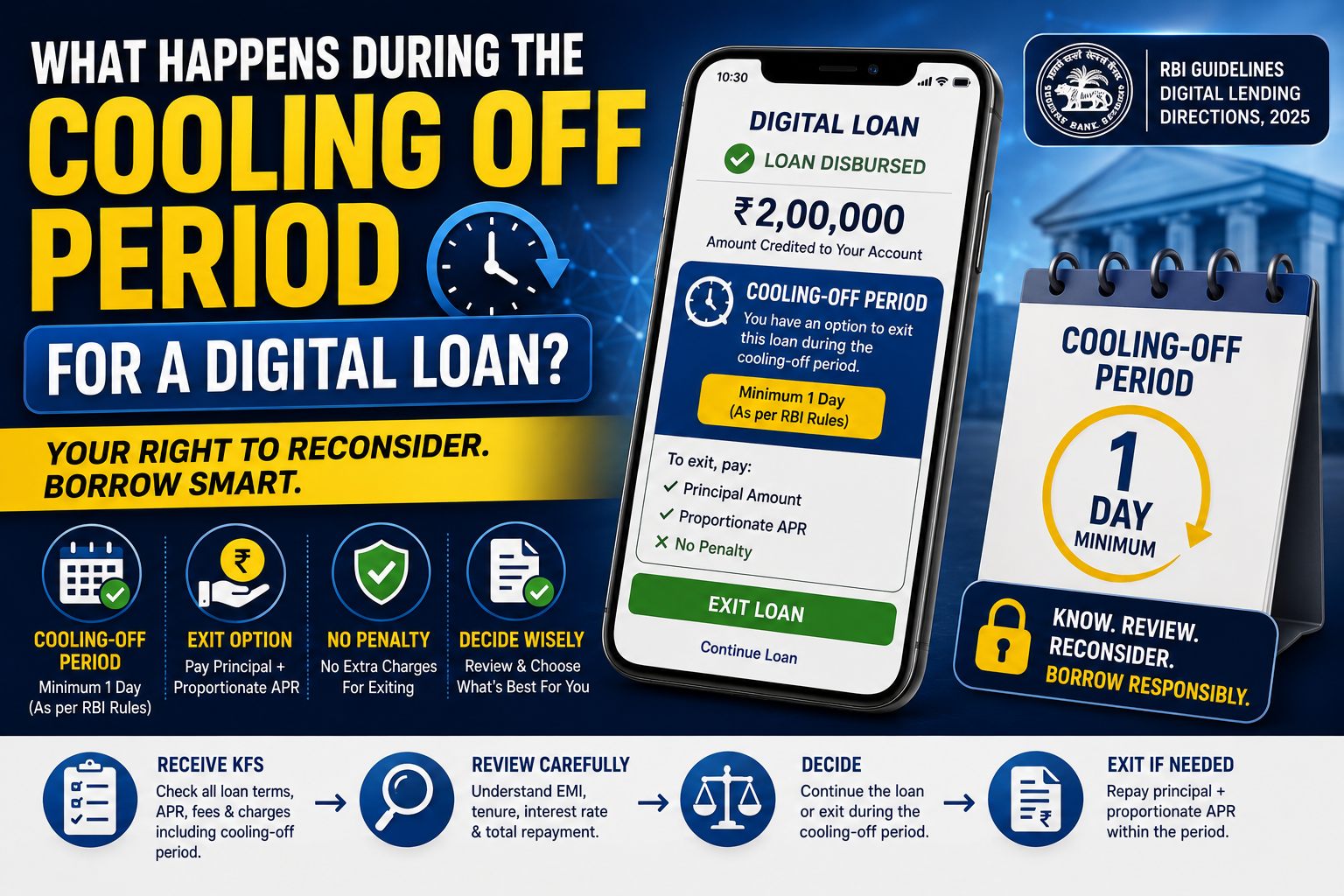
Under the RBI’s Digital Lending Directions, 2025, borrowers must be given an explicit option to exit a digital loan during an initial cooling-off period by paying the principal and the proportionate Annual Percentage Rate (APR), without a penalty. The regulated entity’s Board determines the applicable period through its loan policy, but it cannot be less than one day.
This is an important consumer-protection mechanism, but it is often misunderstood.
The cooling-off period does not mean that every digital loan can be cancelled for free.
It also does not mean you can simply ignore the loan and walk away.
Let’s understand exactly what happens during this period.
What Is the Cooling-Off Period in Digital Lending?
The cooling-off period is an initial period after a digital loan is accepted during which the borrower has an explicit option to exit the loan.
To exit, the borrower generally has to repay:
- The principal amount
- The proportionate APR applicable for the period
The RBI’s 2025 Directions state that no penalty should be charged for such an exit during the cooling-off period.
The exact duration is determined by the regulated entity according to its Board-approved loan policy.
However:
The cooling-off period cannot be less than one day.
This is an important change from the earlier 2022 framework, which prescribed a minimum of three days for loans with a tenor of seven days or more and one day for shorter-tenor loans. The 2025 Directions now provide a uniform minimum of one day, regardless of loan tenor.
Why Does the Cooling-Off Period Exist?
The main purpose is to give borrowers a chance to reconsider a digital credit decision.
Digital lending can happen extremely quickly.
Imagine this situation:
You urgently need ₹1 lakh.
You open a loan app.
The app says:
“You’re eligible for ₹1,50,000.”
You click through the application.
Within minutes:
Loan approved.
The money arrives in your bank account.
Only later do you realize:
- The APR is higher than expected.
- The processing fee is substantial.
- The EMI is difficult to manage.
- You don’t actually need the full amount.
- You accepted the loan without comparing alternatives.
The cooling-off period gives you a limited opportunity to reconsider the decision.
It is therefore designed to reduce the risk of impulsive borrowing.
RBI’s digital-lending framework was developed partly in response to concerns including mis-selling, excessive interest rates, data-privacy issues and unethical recovery practices.
How Long Is the Cooling-Off Period?
Under the current RBI Digital Lending Directions, 2025:
Minimum cooling-off period = 1 day
However, the actual period offered by a lender can be longer.
For example, a lender could establish a policy offering:
- 1 day
- 2 days
- 3 days
- 5 days
or another period, provided it complies with applicable RBI requirements.
The exact period should be disclosed to the borrower.
The KFS for a digital loan is one place where the cooling-off/look-up period is disclosed.
Therefore, don’t assume that every digital lender gives you three days.
Check your specific KFS and loan documents.
What Happens During the Cooling-Off Period?
The loan has already been accepted and may already have been disbursed.
You now have a short window to decide whether to continue.
There are essentially two choices.
Option 1: Continue With the Loan
You decide that the loan is suitable.
You do nothing to exit.
The loan continues according to the agreed terms.
Your regular repayment obligations remain applicable.
Option 2: Exit the Loan
You decide that you don’t want to continue.
You exercise the cooling-off option and repay the required amount according to the lender’s process.
This generally means paying:
Principal + proportionate APR
without a penalty for exercising the cooling-off option.
The important point is that you must actively exercise the exit option.
Simply deciding that you don’t want the loan is not enough.
Is the Cooling-Off Period the Same as Cancelling a Loan?
Not exactly.
A cooling-off exit is a specific contractual and regulatory mechanism available for eligible digital loans.
It is different from simply refusing to repay a loan after receiving the money.
Once a loan has been disbursed, you generally have a financial obligation unless you properly use the applicable exit or prepayment mechanism.
Therefore:
Do not assume that ignoring the EMI cancels the loan.
If you want to exit, contact the regulated lender and follow its official process.
Do You Have to Pay Interest During the Cooling-Off Period?
The RBI framework says the borrower can exit by paying the principal and proportionate APR without a penalty during the cooling-off period.
This means the exit is not necessarily completely cost-free.
Suppose:
Loan principal = ₹1,00,000
You keep the money for a short period before exercising the cooling-off option.
The lender may calculate the proportionate cost applicable under the loan’s APR.
You would therefore generally need to pay:
Principal + proportionate APR
rather than simply returning the original principal.
This distinction is important.
Can the Lender Charge a Processing Fee During the Cooling-Off Period?
Yes, under the 2025 framework, the regulated entity may retain a reasonable one-time processing fee if the borrower exits during the cooling-off period.
However, this fee must be disclosed to the customer upfront in the Key Facts Statement (KFS).
For example, suppose your KFS states:
Processing fee: ₹2,000
and explains that this reasonable one-time processing fee may be retained if you exit during the cooling-off period.
You should not be surprised if that amount is not refunded.
But if an unexpected charge appears that was not properly disclosed, you should ask the lender for an explanation and review your KFS and loan agreement.
This is one reason why reading the KFS before accepting a digital loan is so important.
Example: How a Cooling-Off Exit Could Work
Imagine you take:
Loan amount: ₹2,00,000
The digital lender disburses the amount to your bank account.
The KFS states:
Cooling-off period: 2 days
You reconsider the loan the next day.
You decide that you don’t need it.
The lender’s process may require you to repay:
- ₹2,00,000 principal
- Proportionate APR
- Any disclosed and permitted one-time processing fee
There should be no penalty simply for exercising the cooling-off exit option.
Once the lender confirms the exit and the required amount is settled, the digital loan should be closed according to the applicable process.
Keep proof of the closure.
What If You Miss the Cooling-Off Period?
This is extremely important.
The cooling-off period is limited.
Suppose your lender provides:
2-day cooling-off period
You decide not to exit on the first or second day.
After the cooling-off period ends, you generally cannot demand the same penalty-free cooling-off exit.
However, the RBI framework states that borrowers who continue with the loan after the cooling-off period should continue to have prepayment rights according to applicable RBI guidelines.
That means you may still be able to repay the loan early, but the terms applicable to regular prepayment or foreclosure can differ from the cooling-off mechanism.
Therefore:
Cooling-off period ≠ unlimited cancellation period.
Cooling-Off Period vs Prepayment
These two concepts are often confused.
Cooling-Off Exit
This is the special initial exit window for digital loans.
You pay:
Principal + proportionate APR
and no penalty is charged for exercising the cooling-off exit, subject to the disclosed processing-fee provision.
Prepayment
Prepayment happens when you repay some or all of the loan before the scheduled end of the tenure.
Prepayment after the cooling-off period is governed by the applicable rules and loan terms.
So the timing matters.
During cooling-off
Special exit mechanism applies.
After cooling-off
Regular prepayment/foreclosure rules apply.
Does Every Digital Loan Have a Cooling-Off Period?
The RBI requirement applies to digital lending activities covered by the Digital Lending Directions.
The 2025 Directions apply to digital lending activities of regulated entities including commercial banks, specified cooperative banks, NBFCs including HFCs and All-India Financial Institutions.
However, borrowers should still check the actual loan documentation.
The important question is:
Is this a digital loan covered by the applicable RBI framework, and who is the regulated lender?
This is another reason why borrowers should not blindly trust an unknown loan app.
How Can You Find Your Cooling-Off Period?
There are several places you can check.
1. Key Facts Statement
Look for:
Cooling-off/look-up period
The KFS is designed to provide important loan information before you enter the contract.
2. Loan Agreement
Read the relevant cancellation, cooling-off and prepayment clauses.
3. Digital Lending App
The lender may display the applicable period in the loan information section.
4. Contact the Actual Lender
If you’re unsure, contact the regulated entity through its official customer-care channel.
Don’t rely only on a random WhatsApp number or third-party agent.
Why the KFS Is Important
The Key Facts Statement (KFS) is one of the most important documents in digital lending.
It can disclose information such as:
- Loan amount
- Interest rate
- APR
- Fees
- EMI
- Tenure
- Repayment schedule
- Cooling-off period
- Other important terms
The RBI’s digital-lending framework requires borrowers to receive key loan documents, including the KFS, and the cooling-off period is part of the relevant disclosure framework.
Therefore, before accepting a digital loan, don’t simply look at:
“Approved amount: ₹3 lakh.”
Look at:
“What will this ₹3 lakh actually cost me?”
Can You Use the Cooling-Off Period If the Loan Was a Mistake?
Yes, that’s one of the practical reasons the mechanism can be valuable.
Consider a borrower who accidentally accepts:
₹2 lakh
instead of:
₹1 lakh
If the loan is eligible and still within the cooling-off period, the borrower may have an opportunity to exit by following the prescribed process.
Another example:
You compare loans after receiving the funds and realize another suitable lender offers significantly better terms.
The cooling-off period can give you a short opportunity to reconsider.
But don’t treat it as a strategy for constantly borrowing and cancelling loans.
Every loan application and credit activity can have broader financial consequences.
Does Cooling-Off Mean Your CIBIL Score Will Not Be Affected?
You should not assume that.
The cooling-off mechanism concerns your ability to exit the digital loan.
It does not automatically mean that all credit-bureau reporting disappears.
RBI’s Digital Lending Directions require regulated entities to report digital lending activity to Credit Information Companies according to the applicable framework.
Therefore, if you are concerned about the effect of a particular loan on your credit history, ask the actual lender how the account will be reported.
The cooling-off period should not be interpreted as:
“This loan never existed.”
What Happens If You Don’t Repay During the Cooling-Off Period?
This is another common misunderstanding.
Suppose you receive ₹1 lakh and decide:
“I don’t want this loan anymore.”
You cannot simply leave the money untouched and wait.
If you want to exit, you must follow the lender’s official process and repay the amount required under the cooling-off terms.
If you fail to make the required payment, the loan may continue as an outstanding obligation.
Depending on the circumstances, non-payment can result in:
- Late charges
- Penal charges where applicable
- Collection activity
- Negative credit reporting
- Other consequences under the loan agreement
Therefore:
Wanting to cancel a loan and actually cancelling it are two different things.
How to Exit a Digital Loan During the Cooling-Off Period
The exact procedure depends on the lender, but a typical process can look like this:
Step 1: Check the KFS
Confirm that you’re still within the cooling-off period.
Step 2: Contact the Actual Lender
Use the official app, website or customer-care channel.
Step 3: Select the Exit/Closure Option
Some digital lenders may provide a dedicated option.
Step 4: Confirm the Amount Payable
Ask for the exact amount required to close the loan.
This may include:
- Principal
- Proportionate APR
- Disclosed one-time processing fee, if applicable
Step 5: Make the Payment
Use the lender’s official repayment mechanism.
Step 6: Obtain Confirmation
Save:
- Payment receipt
- Closure confirmation
- Loan statement
- Email/SMS confirmation
Step 7: Check Your Account
Make sure the loan is shown as closed or settled according to the applicable status.
Never Repay Through an Unknown Personal Account
This is particularly important with digital lending.
If someone claiming to be an agent tells you:
“Send the cancellation amount to my personal UPI ID.”
Stop.
Verify the payment instructions through the actual regulated lender.
The RBI’s digital-lending framework generally requires loan repayments to flow directly to the regulated entity rather than through third-party accounts, subject to specified exceptions.
This is one of the reasons you should identify the actual lender behind the digital lending app.
Cooling-Off Period and Fraudulent Loan Apps
The cooling-off mechanism does not make a loan app legitimate.
A fraudulent app could falsely claim:
“RBI approved.”
That doesn’t prove anything.
RBI created a public repository of Digital Lending Apps associated with regulated entities to help customers verify claimed associations. The repository is based on information submitted by regulated entities.
Before borrowing:
- Identify the actual lender.
- Check the lender’s official website.
- Verify the digital lending app relationship.
- Read the KFS.
- Check the cooling-off period.
- Understand the APR and fees.
What Borrowers Should Check Before Accepting a Digital Loan
Don’t wait until after disbursement to think about the cooling-off period.
Before clicking “Accept”, check:
Loan Amount
Do you actually need this much?
Interest Rate
What rate applies?
APR
What is the all-inclusive annualized cost?
Processing Fee
How much will be charged?
EMI
Can you comfortably afford it?
Tenure
How long will you be in debt?
Total Repayment
How much will you ultimately pay?
Cooling-Off Period
How long do you have to reconsider?
Exit Cost
What principal, proportionate APR and disclosed processing fee may apply?
Prepayment
What happens if you repay early after the cooling-off period?
This takes only a few minutes and can prevent expensive mistakes.
Common Misconceptions About the Cooling-Off Period
Myth 1: “I Can Cancel the Loan for Free.”
Not necessarily.
You generally have to pay the principal and proportionate APR, and a reasonable one-time processing fee may be retained if disclosed upfront in the KFS.
Myth 2: “I Get Three Days Automatically.”
No.
Under the current 2025 Directions, the minimum is one day. A lender may provide a longer period under its policy.
Myth 3: “Cooling-Off Means I Don’t Have to Repay.”
Wrong.
You must follow the lender’s exit process and repay the required amount.
Myth 4: “After the Cooling-Off Period I Can Never Prepay.”
Not necessarily.
Regular prepayment may still be available under applicable RBI rules and the loan terms.
Myth 5: “The App Is the Lender.”
Not necessarily.
A digital lending app may be operated by a regulated entity or an LSP. Always identify the actual regulated lender.
Why the 2025 RBI Change Matters
The transition from the earlier 2022 framework to the 2025 Digital Lending Directions is important.
Under the 2022 guidelines, the minimum cooling-off period was:
3 days for loans with a tenor of 7 days or more
and
1 day for loans with a tenor of less than 7 days.
The 2025 Directions changed this structure.
Now:
Minimum cooling-off period = 1 day
for covered digital loans, regardless of tenor. The actual period is determined by the regulated entity’s Board-approved policy.
This is worth highlighting in financial content because articles that still say “three days is mandatory for loans above seven days” may be relying on the older rules.
For a current article, the 2025 framework should be used.
Frequently Asked Questions
What is a cooling-off period in digital lending?
It is an initial period during which a borrower has an explicit option to exit a digital loan by paying the principal and proportionate APR without a penalty.
What is the minimum cooling-off period under RBI rules?
Under the RBI Digital Lending Directions, 2025, the minimum is one day. The regulated entity’s Board determines the actual period through its loan policy.
Can the cooling-off period be longer than one day?
Yes. One day is the minimum regulatory requirement. A regulated entity can provide a longer period under its Board-approved policy.
Do I have to pay interest if I exit?
The borrower must pay the principal and proportionate APR during the cooling-off exit.
Can the lender keep the processing fee?
A reasonable one-time processing fee may be retained if the customer exits during the cooling-off period, provided it was disclosed upfront in the KFS.
What happens after the cooling-off period?
The special cooling-off exit mechanism ends. Regular prepayment rights continue according to applicable RBI guidelines and the loan terms.
Is the cooling-off period the same as prepayment?
No. Cooling-off is a special initial exit mechanism. Prepayment is repayment before the scheduled end of the loan after or outside that specific period.
Where can I find my cooling-off period?
Check your Key Facts Statement, loan agreement and digital loan information. If unclear, contact the actual regulated lender.
Final Takeaway
The cooling-off period is an important borrower-protection feature in India’s digital lending ecosystem.
Digital loans can be approved and disbursed extremely quickly. That speed can be useful during emergencies, but it can also encourage impulsive borrowing.
The cooling-off mechanism gives borrowers a short opportunity to reconsider.
Under the RBI Digital Lending Directions, 2025, a borrower must be given an explicit option to exit a digital loan during the initial cooling-off period by paying the principal and proportionate APR without a penalty. The applicable period is determined by the regulated entity’s Board-approved policy and cannot be less than one day. A reasonable one-time processing fee can be retained if it was disclosed upfront in the KFS.
The most important thing to remember is:
Cooling-off does not mean free cancellation.
You still have to follow the lender’s official exit procedure and pay the amount required under the applicable terms.
If you decide to continue with the loan beyond the cooling-off period, normal repayment obligations apply. Prepayment may still be available according to applicable rules and the loan agreement.
Before accepting any digital loan, check:
KFS → APR → EMI → Fees → Total repayment → Cooling-off period → Exit amount → Prepayment terms
And always identify the actual regulated lender behind the digital lending app.
The biggest mistake is to think:
“I can always cancel it later.”
You may have an exit window—but it is limited.
So use the cooling-off period exactly as it is intended:
Take a step back, review the cost, decide whether you genuinely need the loan, and act before the window closes.
Useful Outbound Resources
- Reserve Bank of India – Digital Lending Directions, 2025 — Official RBI regulatory framework covering the current cooling-off period requirements.
- RBI – Earlier Digital Lending Guidelines, 2022 — Useful for understanding how the cooling-off framework originally worked and how it has changed.
- RBI – Public Repository of Digital Lending Apps — RBI information on verifying the association of Digital Lending Apps with regulated entities.
- RBI – Handbook on Regulations at a Glance — RBI’s regulatory overview covering digital-lending requirements.
What is a Lending Service Provider (LSP) in digital lending? Learn how LSPs work with banks and NBFCs, their responsibilities, role in loan apps, data privacy, borrower protection, and RBI rules.
