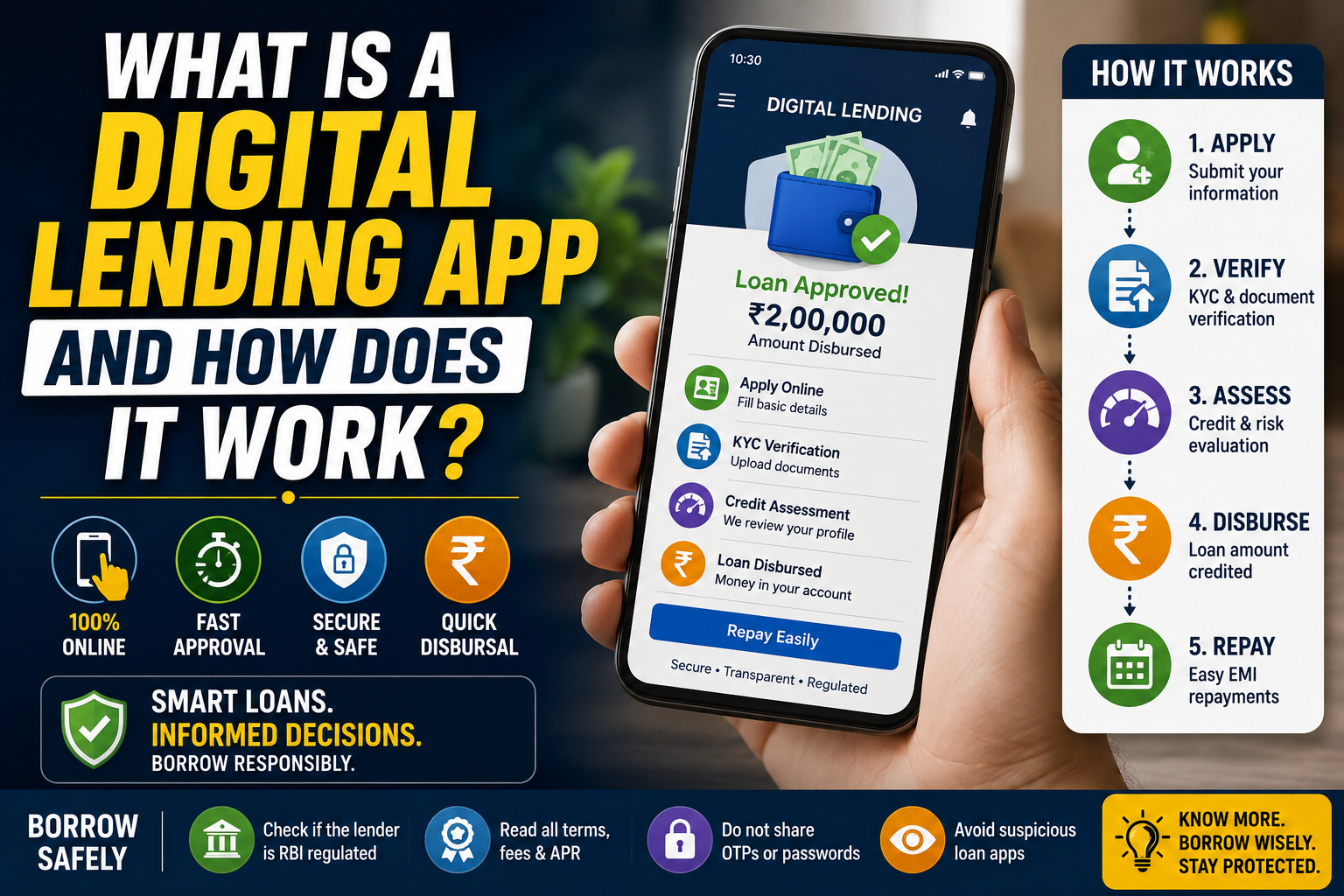
What is a digital lending app and how does it work? Learn how online loan apps process applications, verify borrowers, assess credit, disburse loans, calculate APR, and protect customer data.
Table of Contents
The way people borrow money has changed significantly with the growth of smartphones, digital payments and financial technology.
Instead of visiting a bank branch, submitting physical documents and waiting several days for a decision, borrowers can now apply for certain loans through a smartphone or web application.
These platforms are commonly known as Digital Lending Apps (DLAs).
A digital lending app can make the borrowing process faster and more convenient by allowing customers to complete activities such as loan applications, identity verification, document submission, approval, disbursement and repayment digitally.
However, there is an important distinction that every borrower should understand:
A digital lending app is not necessarily the actual lender.
Under the Reserve Bank of India’s framework, a DLA can be an app operated by a regulated entity such as a bank or NBFC, or an app operated by a Lending Service Provider (LSP) working with a regulated entity. The regulated entity remains responsible for complying with applicable RBI requirements even when it uses an LSP or DLA.
This distinction is extremely important because the popularity of online lending has also created opportunities for fraudulent and unauthorized loan apps.
So, how does a legitimate digital lending app work?
Let’s break down the entire process.
What Is a Digital Lending App?
A Digital Lending App (DLA) is a mobile or web-based application that facilitates digital lending services.
The Reserve Bank of India defines DLAs as mobile and web-based applications that provide a user interface for digital lending services. They can include applications belonging to regulated entities or applications operated by Lending Service Providers engaged by regulated entities.
In simple terms, a digital lending app acts as the technology layer through which a borrower interacts with a lender.
Instead of doing everything at a physical branch, the borrower can potentially:
- Enter personal details
- Complete KYC
- Submit income information
- Upload documents
- Give required consent
- Receive a loan decision
- Sign loan documents electronically
- Receive funds
- Make repayments digitally
The exact process depends on the lender and the type of loan.
Who Is Actually Giving You the Loan?
This is one of the most important questions to ask before using any lending app.
The app you see on your smartphone may not be the company actually providing the money.
There can be several participants.
1. Regulated Entity
This is the actual lender, such as an eligible bank or NBFC regulated by the RBI.
The lender provides the credit and carries the lending responsibility.
2. Lending Service Provider
An LSP is an agent of a regulated entity that can perform functions such as customer acquisition, underwriting support, pricing support, servicing, monitoring or recovery on behalf of the lender.
3. Digital Lending App
The DLA provides the digital interface through which the borrower interacts with the lending ecosystem.
Therefore, a simple example might look like this:
Borrower → Digital Lending App → LSP → Bank/NBFC → Loan
But not every lending app has all these layers.
Some banks and NBFCs operate their own digital lending applications.
How Does a Digital Lending App Work?
The digital lending process can be divided into several stages.
Step 1: Download or Open the App
The borrower accesses the digital lending platform through a mobile application or website.
At this stage, you should verify that the app is genuinely associated with the claimed lender.
RBI specifically advises consumers to check whether a digital lending app is associated with an RBI-regulated bank or NBFC through the lender’s website. It also advises consumers to avoid downloading loan apps received through SMS or social-media links.
This is important because scammers can create applications that look similar to legitimate financial services.
Step 2: Select the Loan Product
Depending on the platform, you may be able to choose a product such as:
- Personal loan
- Consumer loan
- Small-ticket loan
- Business loan
- Credit line
- Other eligible digital credit products
The available products depend on the lender.
At this stage, don’t focus only on the maximum amount advertised.
A lender might advertise:
“Loans up to ₹5 lakh.”
That doesn’t mean you personally qualify for ₹5 lakh.
Your actual eligibility can depend on factors such as:
- Income
- Credit history
- Existing debt
- Employment
- Loan tenure
- Repayment capacity
- Internal risk assessment
Step 3: Enter Your Personal Information
The app may request information needed for identification and credit assessment.
This can include:
- Name
- Date of birth
- Address
- PAN details
- Employment information
- Income
- Bank-account information
- Other information relevant to the loan
However, borrowers should pay close attention to permissions and privacy disclosures.
RBI’s digital-lending framework requires data collection to be need-based and supported by prior explicit consent. Borrowers should also have the ability to accept or deny consent for specific data uses.
A legitimate lending process should not require unlimited access to your phone simply because you want a loan.
Step 4: Complete KYC and Verification
The lender must establish the identity of the borrower according to applicable KYC requirements.
Depending on the product and lender, verification can involve digital methods and electronic document submission.
The objective is to confirm:
“Are you really the person applying for this loan?”
This helps reduce:
- Identity theft
- Fraudulent applications
- Money laundering
- Fake accounts
- Impersonation
The exact KYC process varies depending on the lender, product and applicable regulations.
Step 5: Credit and Eligibility Assessment
This is where technology becomes particularly important.
The lender may evaluate information such as:
- Credit history
- Income
- Existing loans
- Repayment history
- Credit-card obligations
- Employment information
- Bank-related financial information
- Requested loan amount
- Loan tenure
Some digital lending systems use automated rules, statistical models or machine-learning techniques to support underwriting.
The Reserve Bank has recognized the increasing use of algorithms and machine learning in credit decisioning and has highlighted the importance of model governance and risk management.
However, borrowers should understand that “instant approval” does not mean there is no underwriting.
The technology may simply perform parts of the underwriting process much faster.
Step 6: Loan Offer and Pricing
If you meet the lender’s criteria, you may receive a loan offer.
This could include:
- Loan amount
- Interest rate
- Tenure
- EMI
- Processing fee
- Other applicable charges
- Total repayment amount
- APR
This is the stage where you should slow down.
Don’t accept a loan simply because the app says:
“Congratulations! You are pre-approved.”
A pre-approved or eligible offer doesn’t automatically mean it is a good financial deal.
Compare the total cost of borrowing.
What Is APR in Digital Lending?
APR stands for Annual Percentage Rate.
It is intended to represent the annualized cost of credit, including the applicable interest and charges associated with the loan.
RBI’s framework requires covered digital lending arrangements to disclose the all-inclusive cost of the loan as APR to the borrower. The Key Facts Statement also provides important loan information and an amortization schedule.
For example, two apps may advertise:
App A: 12% interest
App B: 12% interest
That doesn’t automatically mean the two loans cost the same.
One may have significantly higher:
- Processing fees
- Service charges
- Other applicable costs
Therefore, compare the APR and the Key Facts Statement rather than looking only at the headline interest rate.
Step 7: Key Facts Statement
Before accepting a covered loan, borrowers should pay close attention to the Key Facts Statement (KFS).
The KFS is designed to present important loan information in a standardized and understandable format.
Depending on the applicable framework, it can include:
- Loan amount
- Interest rate
- APR
- Charges
- Repayment schedule
- Tenure
- Other important terms
RBI’s KFS framework states that charges not disclosed in the KFS generally cannot subsequently be charged during the loan term without the borrower’s explicit consent, subject to the applicable regulatory framework.
The KFS is therefore one of the most useful documents for comparing digital loan offers.
Step 8: Digital Acceptance and Loan Agreement
If you decide to accept the loan, the platform may facilitate electronic acceptance of the loan documents.
Depending on the lender, this can involve:
- Digital consent
- Electronic signatures
- OTP-based verification
- Electronic documentation
You should read the loan agreement before accepting it.
Pay particular attention to:
- Interest rate
- EMI
- Due date
- Processing fee
- Late-payment charges
- Penal charges
- Prepayment rules
- Foreclosure conditions
- Default consequences
Don’t treat the agreement as something you can read later.
Step 9: Loan Disbursement
Once the loan is approved and the necessary documentation is completed, the money can be disbursed.
RBI’s digital-lending framework states that loan disbursal should generally take place directly into the borrower’s bank account, subject to specified exceptions. Loan servicing and repayments are also required to flow directly between the borrower and the regulated entity rather than through a third-party pass-through or pool account.
This is an important consumer-protection feature.
For example, if a random intermediary tells you:
“Send ₹10,000 to my personal account first and I’ll release your loan.”
That should be treated as a major warning sign.
Step 10: EMI Repayment
After disbursement, the borrower has to repay the loan according to the agreed schedule.
Depending on the lender, repayment may occur through:
- Bank account mandate
- UPI-related payment methods
- Net banking
- Other permitted digital payment methods
Your loan repayment behavior can also become part of your credit history when the lending activity is reported to credit information companies.
RBI’s digital-lending framework requires regulated entities to ensure lending done through DLAs is reported to credit information companies, subject to the applicable rules.
This means a digital loan is still a real credit obligation.
The fact that you obtained it through a smartphone does not make it financially different from other formal credit in terms of repayment responsibility.
What Technology Is Used Behind a Digital Lending App?
A digital lending app can use several technologies to automate the borrowing process.
Artificial Intelligence and Machine Learning
These technologies can help lenders analyze large amounts of information and support credit-risk decisions.
Optical Character Recognition
OCR can extract information from documents such as identity or income documents.
APIs
APIs allow different systems to communicate with each other.
For example, a lending platform may connect with:
- Identity-verification systems
- Banking infrastructure
- Credit bureaus
- Payment systems
- Fraud-detection tools
Digital KYC
Technology can reduce the need for physical paperwork and branch visits.
Automated Underwriting
Software can apply predefined lending rules and risk models to applications.
The result can be a faster lending process.
But faster processing doesn’t eliminate financial risk.
What Data Can a Digital Lending App Collect?
This is one of the most sensitive parts of digital lending.
A lending app may need certain information to:
- Verify identity
- Assess eligibility
- Process the loan
- Prevent fraud
- Service the account
But RBI’s digital-lending framework requires data collection to be need-based and based on prior explicit consent. It also requires DLAs/LSPs to have clear privacy policies and restricts the storage of borrowers’ personal information, subject to specified minimum information requirements.
RBI’s framework also requires relevant data to be stored on servers located in India under the applicable digital-lending requirements.
Red flag
Be extremely cautious if a loan app asks for unnecessary access to:
- Contacts
- Photos
- Messages
- Call logs
- Files
- Location
especially when the app cannot clearly explain why the information is needed and how it will be used.
Are All Loan Apps Safe?
No.
This is perhaps the most important reality check in this entire topic.
The existence of RBI-regulated digital lending does not mean every app claiming to provide loans is legitimate.
RBI has specifically acknowledged concerns about unscrupulous digital-lending apps falsely claiming association with regulated entities. In 2024, RBI announced the creation of a public repository of Digital Lending Apps deployed by regulated entities to help customers verify those associations.
RBI’s consumer awareness material also tells users to verify an app’s association with a regulated bank or NBFC through the lender’s website and to avoid apps received through SMS or social-media links.
Therefore:
Never assume an app is legitimate simply because it appears in an app store.
How to Check Whether a Digital Lending App Is Legitimate
Before applying, follow these steps.
1. Identify the Actual Lender
Find out:
Who is actually giving me the loan?
Look for the name of the bank or NBFC.
If the app refuses to clearly identify the lender, don’t proceed.
2. Visit the Lender’s Official Website
Check whether the lender lists the app or its relevant LSP relationship.
RBI specifically recommends checking the association through the regulated entity’s website.
3. Check the RBI’s Digital Lending App Repository
RBI created a public repository to help consumers verify DLA associations reported by regulated entities.
You can refer to the Reserve Bank of India for official regulatory information and digital-lending resources.
4. Check the Privacy Policy
Understand:
- What data is collected
- Why it is collected
- How it is used
- How it is stored
- Who can access it
5. Read the KFS
Don’t accept the loan before understanding the cost.
6. Avoid Upfront “Release Fees”
Be suspicious if someone demands a large payment before releasing a supposedly approved loan.
What Are the Advantages of Digital Lending Apps?
Digital lending has several potential advantages.
Faster Application
Borrowers can apply without visiting a branch.
Convenience
Documents and information can often be submitted digitally.
Automated Processing
Technology can reduce manual processing.
Accessibility
Digital platforms can reach customers outside traditional branch networks.
Faster Communication
Applicants can receive notifications about application status and repayment schedules.
Paperless Documentation
Many processes can be completed electronically.
These advantages explain why digital lending has grown rapidly.
But convenience should never replace due diligence.
What Are the Risks of Digital Lending Apps?
High Cost
Some loans can carry high interest rates or fees.
Fraudulent Apps
Unauthorized apps can misuse borrowers’ information or money.
Data Privacy Risks
Poorly designed or malicious applications can expose sensitive information.
Debt Traps
Easy access to credit can encourage borrowers to take loans they cannot comfortably afford.
Aggressive Recovery Practices
RBI’s digital-lending framework specifically addresses recovery-agent disclosure and conduct requirements because recovery practices have been an area of concern.
Multiple Loans
Because digital applications are convenient, borrowers may apply for several loans without considering their total EMI burden.
This can lead to serious financial stress.
Digital Lending Apps vs Traditional Bank Branches
| Feature | Digital Lending App | Traditional Branch |
|---|---|---|
| Application | Online | Usually in person |
| Documentation | Mostly digital | Often physical/digital |
| Processing | Highly automated in many cases | More manual in some cases |
| Convenience | High | Lower |
| Branch visit | Usually not required | May be required |
| Speed | Can be faster | Can take longer |
| Human interaction | Limited in some journeys | More direct |
| Risk of fake intermediaries | Exists | Generally lower in branch-based interactions |
Digital lending isn’t necessarily “better” than traditional banking.
It’s simply a different delivery mechanism.
Does a Digital Loan Affect Your CIBIL Score?
It can.
If the digital loan is provided by a regulated lender and is reported to credit information companies, the account can become part of your credit history.
RBI has stated that lending done through DLAs by regulated entities is to be reported to credit information companies, irrespective of the nature or tenor of the loan, subject to the applicable framework.
Therefore, don’t think:
“It’s only a small app-based loan, so it won’t affect my credit.”
It can.
Timely repayment can support your credit history, while missed payments can negatively affect your credit profile.
What Should You Check Before Taking a Digital Loan?
Use this checklist:
Before applying
- Identify the actual lender.
- Verify the lender’s regulatory status.
- Check the app’s association with the lender.
- Review the privacy policy.
- Understand what data is requested.
Before accepting
- Check the interest rate.
- Check the APR.
- Read the Key Facts Statement.
- Check the processing fee.
- Check the total repayment.
- Check late and penal charges.
- Understand prepayment conditions.
- Check the EMI and due dates.
After accepting
- Save the loan agreement.
- Save the KFS.
- Keep repayment records.
- Pay EMIs on time.
- Monitor your credit report.
- Report suspicious activity.
Frequently Asked Questions
What is a digital lending app?
A digital lending app is a mobile or web application that facilitates digital lending services. It can belong to a regulated lender or be operated by an LSP working with a regulated entity.
Is a digital lending app the actual lender?
Not necessarily. The actual lender may be a bank or NBFC, while the app may be operated by the regulated entity itself or by an LSP.
Are digital lending apps regulated by RBI?
The regulatory framework applies to RBI-regulated entities and their digital lending arrangements. RBI has established requirements covering areas such as customer protection, data collection, disclosures, LSP arrangements and loan disbursal.
How do digital lending apps approve loans?
They can use digital KYC, financial information, credit-bureau data, automated rules and other underwriting technologies to evaluate an application.
Can a digital loan affect CIBIL?
Yes. Loans originated by regulated entities through digital channels can be reported to credit information companies.
How can I check if a loan app is genuine?
Identify the actual lender and verify the app’s association through the lender’s official website and the RBI’s available digital-lending resources. RBI specifically recommends this approach.
Should I take a loan from an app offering instant approval?
Not without checking the lender and the total cost. “Instant approval” is a speed feature, not proof that the loan is affordable or legitimate.
Final Takeaway
A Digital Lending App is essentially a technology-enabled gateway to borrowing, allowing customers to complete many parts of the lending journey online.
The process can involve:
Application → KYC → Credit Assessment → Loan Offer → KFS → Digital Acceptance → Disbursement → Repayment
The biggest advantage is convenience. A borrower may be able to complete a process that previously required multiple branch visits from a smartphone.
But convenience also creates responsibility.
The most important thing to remember is that the app is not necessarily the lender. A legitimate digital lending arrangement may involve a regulated bank or NBFC and an LSP that provides technology or other lending-related services. RBI’s rules make the regulated entity responsible for complying with applicable requirements even when LSPs or DLAs are involved.
Before taking any digital loan:
Verify the lender. Check the app. Read the KFS. Compare the APR. Understand the fees. Review the privacy policy. And calculate whether you can actually afford the EMI.
Don’t let a five-minute application process convince you to take a five-year financial commitment without proper research.
A digital loan may be easy to obtain.
Repaying it is the part that matters.
Useful Outbound Resources
- Reserve Bank of India – Guidelines on Digital Lending
- RBI – Public Repository of Digital Lending Apps
- RBI – Financial Awareness Messages on Digital Lending Apps
- RBI – Handbook on Regulations at a Glance: Digital Lending
- RBI – Working Group Report on Digital Lending
Bank vs NBFC personal loan: compare interest rates, eligibility, approval speed, fees, credit score requirements, customer service and repayment terms to choose the right lender.
