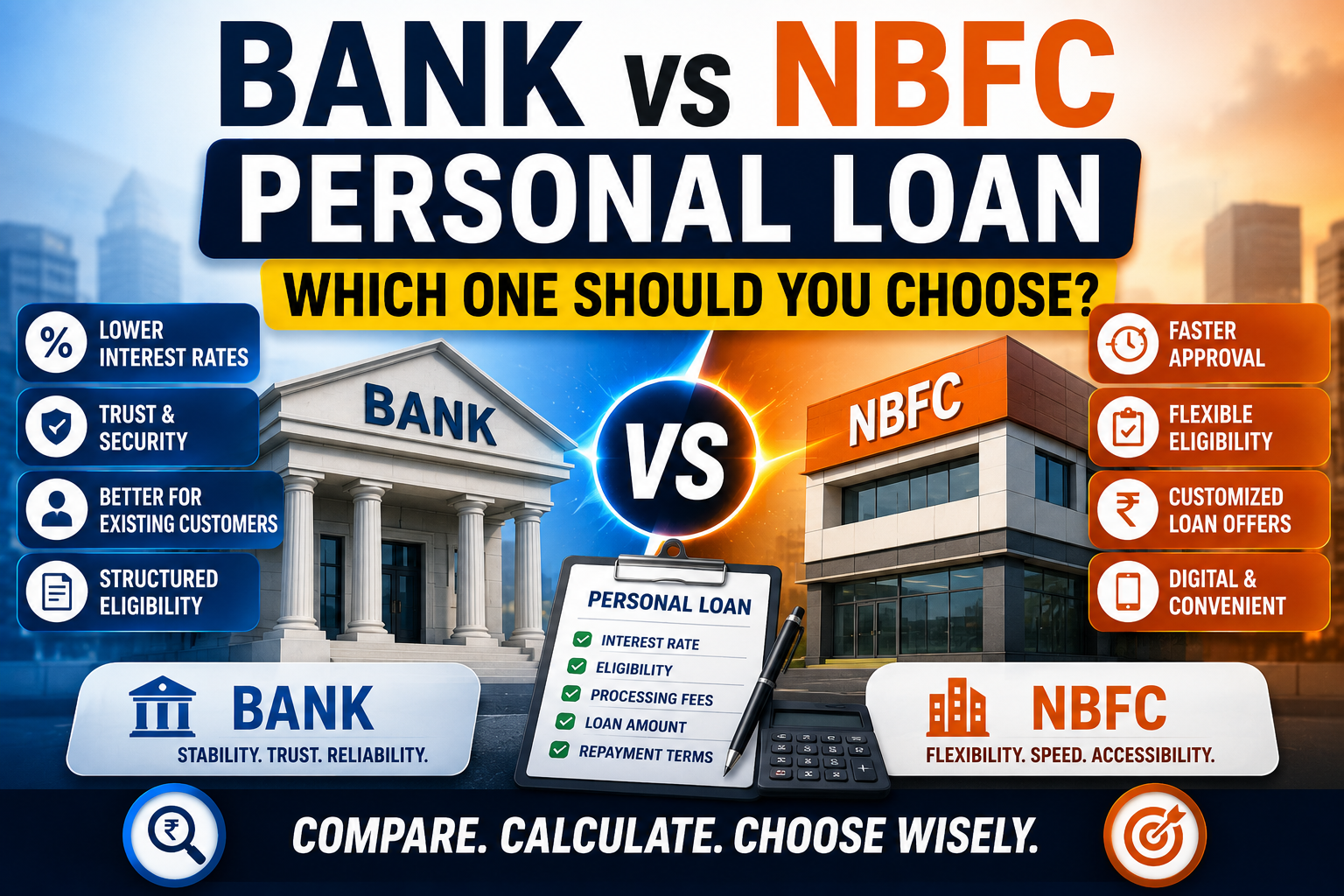
Bank vs NBFC personal loan: compare interest rates, eligibility, approval speed, fees, credit score requirements, customer service and repayment terms to choose the right lender.
Table of Contents
When you need money for an emergency, wedding, medical expense, education, travel, home renovation or another major expense, a personal loan can provide access to funds without requiring property or another major asset as collateral.
But before applying, borrowers face an important decision:
Should you take a personal loan from a bank or an NBFC?
There is no universal answer.
Banks and Non-Banking Financial Companies (NBFCs) both provide personal loans, but they can differ in their eligibility criteria, underwriting approach, customer segments, loan products, application processes and pricing.
An NBFC is a company engaged in financial activities such as lending and investment and is regulated by the Reserve Bank of India when it falls within the applicable regulatory framework. RBI explains that NBFCs perform activities similar to banks in several respects, but there are important differences between the two types of institutions.
For borrowers, the most important question isn’t:
“Are banks better than NBFCs?”
It is:
“Which lender offers me the most suitable loan at a cost I can comfortably repay?”
Let’s compare the two.
What Is a Bank Personal Loan?
A bank personal loan is an unsecured loan provided by a banking institution.
Because the loan is generally unsecured, you don’t normally have to pledge a house, gold or another asset as collateral.
The lender instead evaluates your creditworthiness and repayment capacity.
Banks may consider factors such as:
- Credit score and credit history
- Monthly income
- Employment stability
- Existing EMIs
- Debt obligations
- Banking relationship
- Employer profile
- Loan amount
- Loan tenure
Banks can offer personal loans to existing customers as well as eligible new customers, depending on their policies.
For some borrowers, an existing relationship with a bank can make the application process more convenient because the lender may already have information about salary credits, account activity or previous borrowing.
However, being an existing customer does not guarantee approval.
What Is an NBFC Personal Loan?
An NBFC personal loan is a personal loan provided by a Non-Banking Financial Company.
NBFCs are financial institutions that can engage in lending and other financial activities but are not banks.
RBI notes that NBFCs perform functions similar to banks in lending and investment, while also having important structural differences—for example, NBFCs cannot accept demand deposits in the way banks do and do not form part of the payment and settlement system in the same manner as banks.
For borrowers, the practical difference is that NBFCs can provide another source of personal credit alongside banks.
Some NBFCs focus heavily on particular customer segments, digital lending, consumer finance, small businesses or borrowers who may not fit the most conservative lending criteria of traditional banks.
That doesn’t mean every NBFC will approve applications that banks reject.
Each lender has its own risk model.
Bank vs NBFC Personal Loan: Quick Comparison
| Factor | Bank | NBFC |
|---|---|---|
| Regulation | Regulated by RBI under banking framework | RBI-regulated NBFCs follow applicable NBFC framework |
| Interest rate | Can be competitive | Can be competitive but varies significantly |
| Eligibility | Often structured and policy-driven | Can vary significantly by lender |
| Approval | May be slower in some cases | Can be faster for some digital processes |
| Documentation | May be more structured | Requirements vary |
| Credit profile | Often important | Also important |
| Existing customer benefit | Can be significant | May also exist |
| Digital application | Common | Often a major focus |
| Flexibility | Depends on bank | Depends on NBFC |
| Best for | Strong profiles seeking competitive offers | Borrowers who value speed, flexibility or alternative eligibility |
This table is only a general comparison.
The actual loan offer matters more than whether the lender’s name says “Bank” or “NBFC.”
Bank vs NBFC: Which Usually Offers Lower Interest Rates?
This is one of the most common questions.
The honest answer is:
There is no universal rule that banks always offer lower personal-loan rates than NBFCs.
Interest rates depend on:
- Credit score
- Income
- Employment
- Existing relationship
- Loan amount
- Tenure
- Internal risk assessment
- Market conditions
- Lender’s business model
A borrower with an excellent credit profile might receive a very competitive offer from an NBFC, while another borrower could receive a better offer from a bank.
Therefore, don’t choose a lender simply because you assume:
“Bank = cheap”
or
“NBFC = expensive.”
Compare the actual offer.
RBI has emphasized transparency in the pricing of credit and has required regulated lenders to disclose relevant pricing information.
Don’t Compare Only the Interest Rate
This is extremely important.
Suppose:
Lender A
Interest rate: 11.5%
Processing fee: ₹5,000
Lender B
Interest rate: 11.2%
Processing fee: ₹15,000
At first glance, Lender B looks cheaper because its interest rate is lower.
But the processing fee and other charges could change the overall economics.
That’s why borrowers should compare the total cost of credit, not just the advertised interest rate.
Look at:
- Interest rate
- Annual Percentage Rate (APR), where applicable
- Processing fee
- Documentation charges
- Insurance-related charges
- Late-payment charges
- Prepayment or foreclosure terms
- Other applicable fees
RBI’s framework around Key Facts Statements requires regulated entities to provide borrowers with important loan information, including APR and an amortisation schedule, for covered lending products. The KFS framework is designed to help borrowers make informed comparisons.
What Is APR and Why Should You Check It?
APR stands for Annual Percentage Rate.
It is designed to represent the annual cost of credit, including interest and applicable charges associated with the loan.
This can make it more useful than looking at the headline interest rate alone.
For example:
Loan A
Interest rate: 11.5%
Fees: ₹3,000
Loan B
Interest rate: 11.2%
Fees: ₹15,000
The lower headline interest rate doesn’t automatically make Loan B cheaper.
That’s why you should request and examine the lender’s Key Facts Statement and understand the total cost before accepting the loan.
RBI’s KFS framework states that APR includes interest and other charges associated with the credit facility and that charges not disclosed in the KFS generally cannot subsequently be charged without the borrower’s explicit consent, subject to the applicable framework.
Bank vs NBFC: Which Has Easier Eligibility?
This depends entirely on the lender.
Traditionally, banks may have relatively structured eligibility requirements around:
- Income
- Employer
- Credit history
- Existing liabilities
- Employment stability
Some NBFCs may use different underwriting models and may serve borrowers who don’t fit certain traditional bank criteria.
For example, an NBFC may have a product specifically designed around a particular customer segment.
But this does not mean:
“Low CIBIL = NBFC will approve you.”
That’s an oversimplification.
NBFCs also evaluate credit risk.
A borrower with a weak repayment history, excessive debt or unstable income can be rejected by both banks and NBFCs.
Which Is Faster: Bank or NBFC?
This depends heavily on the lender and application channel.
Some banks now provide highly digital personal-loan journeys, particularly for existing customers.
At the same time, many NBFCs have invested heavily in digital onboarding, automated verification and technology-driven underwriting.
As a result, an NBFC may sometimes provide a faster application experience than a particular bank—but another bank may be equally fast or faster.
Therefore:
Don’t assume NBFC = instant approval.
Instead, compare the actual process.
Also be careful with loan apps promising extremely fast loans.
Speed should never come at the expense of understanding the loan’s cost and terms.
Is an NBFC Personal Loan Safe?
An RBI-regulated NBFC is a legitimate financial institution subject to the regulatory framework applicable to NBFCs.
But borrowers should distinguish between:
RBI-regulated lender
and
an unknown loan app or intermediary claiming to arrange a loan.
RBI has established regulatory requirements for digital lending, including requirements relating to transparency, borrower consent, data practices and the involvement of regulated entities. RBI’s digital-lending guidance also emphasizes disclosure of the all-inclusive cost through APR and requirements around Lending Service Providers.
Before taking a digital personal loan, verify:
- Who is the actual lender?
- Is the lender an RBI-regulated entity?
- What is the APR?
- What is the processing fee?
- What is the repayment schedule?
- What happens if you miss an EMI?
- What data will be collected?
- Where is the official loan agreement?
Never judge a lender solely by an attractive advertisement.
Bank vs NBFC for a Low CIBIL Score
If your CIBIL Score is relatively low, you may find that some traditional banks have stricter eligibility criteria.
An NBFC may sometimes be willing to evaluate a broader range of borrowers.
However, there’s a major trade-off.
If the lender considers you higher risk, the loan may come with:
- Higher interest rate
- Lower loan amount
- Shorter tenure
- Higher fees
- Stricter repayment conditions
Therefore, getting approved isn’t necessarily a victory.
Imagine:
Bank offer: 12%
NBFC offer: 20%
The NBFC approves your application immediately.
You might think:
“The NBFC was better.”
But if you can afford to wait and improve your financial profile, the cheaper loan could ultimately save substantial money.
Approval speed should not be confused with financial advantage.
What About a Good CIBIL Score?
If your CIBIL Score is strong, you may have more choices.
That can be an advantage because you can compare lenders instead of accepting the first offer.
For example:
Bank A
Rate: 11.5%
Bank B
Rate: 11.8%
NBFC A
Rate: 12.2%
NBFC B
Rate: 12.0%
Rather than automatically choosing a bank, compare:
Total repayment + fees + flexibility + service
A strong credit profile gives you an opportunity to shop around.
Use that advantage.
Bank vs NBFC: What About Loan Amount?
The maximum personal-loan amount varies significantly by lender.
It can depend on:
- Income
- Credit score
- Existing obligations
- Employment
- Banking relationship
- Loan tenure
- Internal risk policy
A bank may offer a larger loan to a high-income existing customer.
An NBFC may offer a different amount based on its own underwriting model.
But don’t select a lender simply because it advertises a larger maximum loan.
If you need ₹5 lakh, borrowing ₹15 lakh because it is available can create unnecessary interest costs and repayment pressure.
Your maximum eligibility is not your recommended borrowing amount.
Which Is Better for Self-Employed Borrowers?
Self-employed applicants sometimes face more complex income verification because their income may not arrive as a fixed monthly salary.
Lenders can examine:
- Income-tax returns
- Bank statements
- Business financials
- Business vintage
- Cash flows
- Existing liabilities
- Credit history
Different lenders can interpret self-employed income differently.
An NBFC may have a product designed for certain self-employed segments, while a bank may offer more competitive pricing to applicants with strong documented income.
Therefore, self-employed borrowers should compare lender-specific eligibility requirements rather than assuming one category is always better.
Which Is Better for Salaried Employees?
For salaried borrowers with:
- Stable employment
- Strong credit history
- Consistent income
- Low existing debt
a bank can often be worth checking first, especially if they already have a relationship with that bank.
But again, don’t stop there.
An NBFC may provide a competitive offer.
The correct strategy is:
Compare offers rather than institutions.
Bank vs NBFC: Processing Fees and Other Charges
Processing fees can have a meaningful effect on the total cost of a personal loan.
For example:
Loan amount = ₹5 lakh
Processing fee = 2%
Processing fee:
₹5,00,000 × 2%
= ₹10,000
If GST or other applicable charges are added according to the lender’s terms, your actual cost can be higher.
Therefore, ask for a complete fee schedule.
Look for:
- Processing fee
- GST or applicable taxes
- Documentation charges
- Prepayment charges, if applicable
- Late-payment charges
- Penal charges
- Bounce charges
- Other service fees
Don’t assume that the advertised interest rate represents the entire cost.
What Should You Compare Before Choosing a Lender?
Before selecting a bank or NBFC, create a simple comparison.
| Factor | Lender A | Lender B |
|---|---|---|
| Interest Rate | 11.5% | 12.0% |
| APR | Check KFS | Check KFS |
| Processing Fee | ₹5,000 | ₹3,000 |
| Loan Amount | ₹5 lakh | ₹5 lakh |
| Tenure | 5 years | 5 years |
| EMI | Compare | Compare |
| Total Repayment | Compare | Compare |
| Prepayment Terms | Check | Check |
| Late Charges | Check | Check |
This approach is much better than simply asking:
“Which bank has the lowest interest rate?”
When Should You Prefer a Bank?
A bank may be worth considering if:
- You have a strong credit profile.
- You have stable employment.
- You already bank with the institution.
- You qualify for a competitive rate.
- You want a potentially lower-cost loan.
- You don’t need highly specialized underwriting.
- The bank’s processing and service meet your expectations.
But these are not guarantees.
A bank isn’t automatically the best choice.
When Should You Consider an NBFC?
An NBFC may be worth considering if:
- You don’t fit a particular bank’s eligibility criteria.
- You want to compare alternative offers.
- You are self-employed and the NBFC’s underwriting fits your profile.
- You value a digital application process.
- The NBFC offers competitive pricing.
- You need a lender with a particular product or customer focus.
But again, don’t accept a high-cost loan simply because it is easier to obtain.
Which One Is Better for You?
The answer depends on your financial profile.
Choose a Bank if:
You have a strong credit history, stable income and access to a genuinely competitive bank offer.
Consider an NBFC if:
Its eligibility criteria suit you better and its total loan cost is competitive.
Compare Both if:
You have time to shop around and want to optimize your borrowing cost.
This third option is often the smartest.
You don’t have to decide:
Bank OR NBFC
before seeing the offers.
Instead:
Bank + NBFC → Compare → Choose
A Practical Example
Suppose you need:
₹6 lakh
for a personal expense.
You receive two offers.
Bank
Interest rate: 11.5%
Processing fee: ₹7,000
Tenure: 5 years
NBFC
Interest rate: 12.0%
Processing fee: ₹3,000
Tenure: 5 years
The bank has the lower interest rate.
The NBFC has the lower processing fee.
Which is cheaper?
You need to calculate the total repayment and compare the effective cost.
If the bank’s lower interest rate saves significantly more than the additional processing fee, it may be the better option.
If the difference is negligible, you could consider other factors such as service, foreclosure terms and application convenience.
This is why APR and total repayment matter more than a single headline number.
Important: Don’t Apply to Too Many Lenders
Some borrowers make this mistake:
They apply to:
- 5 banks
- 5 NBFCs
- Several loan apps
within a short period.
This isn’t necessarily a smart strategy.
Multiple formal credit applications can result in multiple credit enquiries and may affect how lenders view recent credit-seeking activity.
Instead:
- Check your credit profile.
- Compare eligibility criteria.
- Shortlist two or three suitable lenders.
- Compare their offers.
- Apply selectively.
What Documents Should You Check Before Signing?
Before accepting a personal loan, read the:
- Key Facts Statement, where applicable
- Loan agreement
- Repayment schedule
- APR
- Interest rate
- Processing fee
- Penal charges
- Prepayment conditions
- Other applicable fees
Don’t sign simply because the money is urgently required.
RBI’s KFS framework is specifically designed to give prospective borrowers standardized key information so they can make informed decisions.
Take the time to understand what you’re agreeing to.
Bank vs NBFC Personal Loan: Final Verdict
So, which is better—bank or NBFC?
There is no universal winner.
A bank can be an excellent choice for a borrower with a strong financial profile who receives a competitive offer.
An NBFC can be a useful alternative when its underwriting, product structure or application process better suits the borrower.
But the most important principle is this:
Choose the loan, not the logo.
Don’t choose a bank simply because you believe banks are cheaper.
Don’t choose an NBFC simply because you believe NBFCs approve loans faster.
Instead, compare the actual offer.
Look at:
- Interest rate
- APR
- Processing fee
- Total repayment
- EMI
- Tenure
- Prepayment conditions
- Penal charges
- Eligibility requirements
- Lender reputation and regulatory status
A slightly lower interest rate can matter, but a low rate with expensive fees may not be the cheapest overall option.
Similarly, an easy approval is not necessarily a good deal if the loan carries a substantially higher total cost.
Final Takeaway
Both banks and NBFCs can be legitimate sources of personal loans in India, and neither category is automatically better for every borrower.
Banks may be particularly attractive to borrowers with strong credit profiles, stable incomes and existing banking relationships. NBFCs can provide additional choice and may use different underwriting models or offer specialized products.
But your decision should ultimately be based on the specific loan offer, not the type of institution alone.
Before borrowing, compare the APR, interest rate, processing fees, total repayment, EMI, tenure and other charges. Check the Key Facts Statement and loan agreement carefully, and verify that you are dealing with the actual regulated lender.
Most importantly, don’t borrow simply because you qualify.
The best personal loan is not necessarily the one that gets approved fastest. It is the one whose total cost and monthly repayment you can comfortably manage.
Useful Outbound Resources
- RBI – FAQs on Non-Banking Financial Companies
- RBI – Key Facts Statement and APR Framework
- RBI – Handbook of Statistics / Digital Lending Information
- RBI – FAQs on Floating-Rate EMI-Based Personal Loans
- RBI – Bank Transparency and Credit Pricing Guidance
What is LTV ratio in home loans? Learn the LTV formula, RBI limits, how LTV affects your down payment and loan eligibility, with examples and practical tips.
