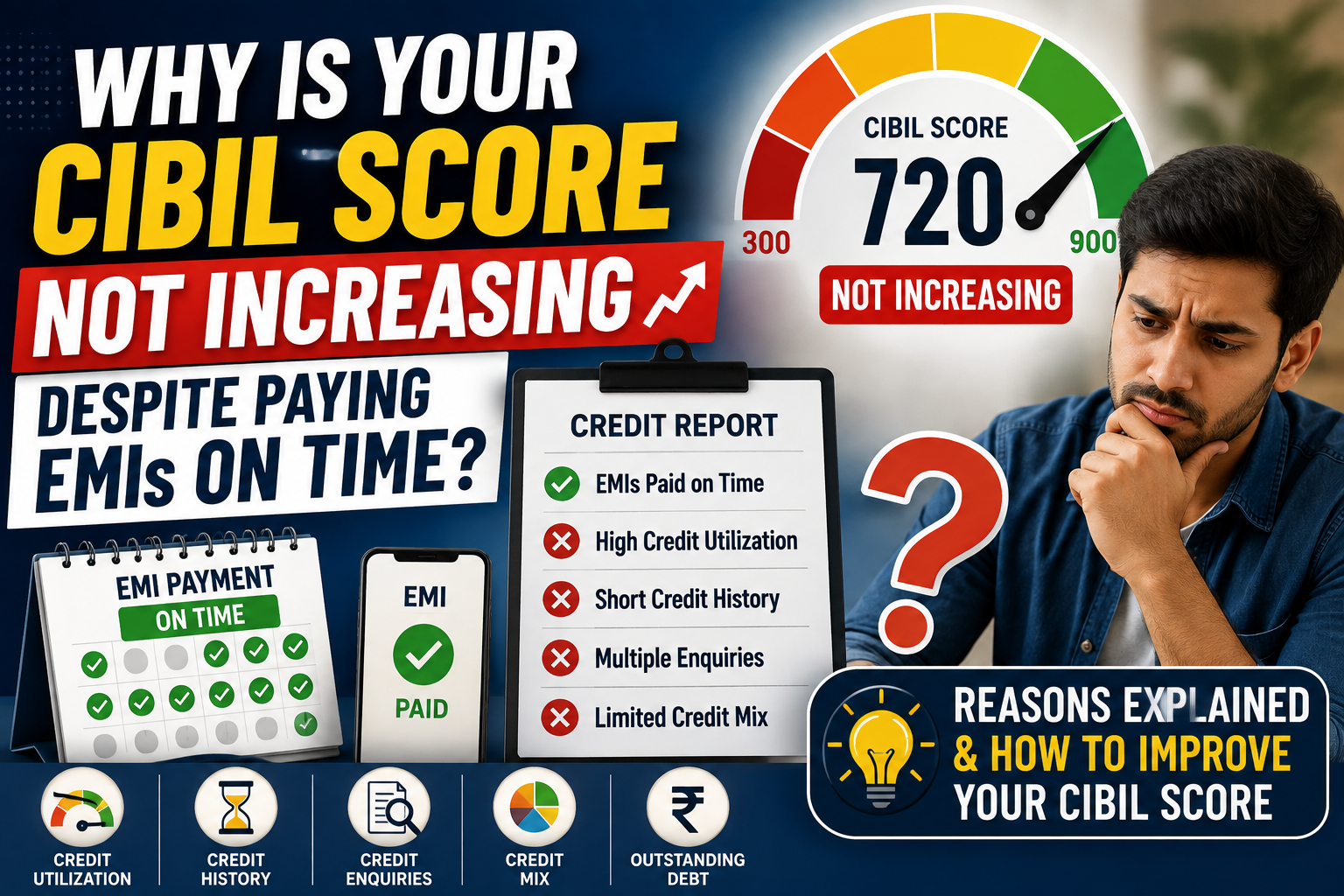
Why is your CIBIL score not increasing despite paying EMIs on time? Learn about credit utilization, loan age, credit mix, enquiries, reporting delays, and errors that may affect your CIBIL score.
Table of Contents
Paying your EMIs on time is one of the most important habits for maintaining a healthy credit profile. So, it can be frustrating when you check your CIBIL Score after several months of timely payments and discover that it has barely changed—or has not increased at all.
Many borrowers assume that every on-time EMI should automatically increase their CIBIL Score.
That’s not how credit scoring works.
Your CIBIL Score is calculated from multiple aspects of your credit history, including payment history, credit utilization, age of credit, and credit enquiries. CIBIL itself states that these are among the key factors influencing the score.
This means that paying your EMI on time is important, but it is only one part of the equation.
You could have a perfect repayment record and still see little movement in your score because of high credit-card utilization, a short credit history, frequent credit applications, limited credit information, or inaccurate information in your credit report.
Let’s understand why this happens and what you can realistically do to improve your CIBIL Score.
First, Understand How the CIBIL Score Works
A CIBIL Score is a three-digit number ranging from 300 to 900 that summarizes information in your credit history.
Your CIBIL Report contains information such as:
- Loan accounts
- Credit-card accounts
- Payment history
- Outstanding balances
- Credit enquiries
- Account opening and closing information
- Personal and employment information
CIBIL explains that the score is generated using information in your credit report, particularly information relating to accounts and enquiries.
The important point is that the score is not a simple reward system where:
“Pay EMI → gain 10 points.”
There is no fixed number of points you receive for every successful EMI payment.
Your score reflects your broader credit behavior.
Therefore, if you are expecting your score to rise by a predictable amount every month simply because you paid an EMI, you may be setting the wrong expectation.
1. Paying EMIs on Time Does Not Guarantee a Monthly Increase
This is the biggest misconception.
Timely EMI payments help establish a positive repayment history, but your score can remain unchanged for a period of time.
Think about it like this.
Suppose your CIBIL Score is 760.
You pay your next six EMIs on time.
You might expect:
760 → 765 → 770 → 775 → 780
But credit scoring doesn’t necessarily work that way.
Your score could remain around the same level because your overall credit profile has not changed significantly.
CIBIL itself identifies payment history, credit utilization, age of credit and enquiries as important score factors.
So, if payment history is already strong, improving other parts of your profile may matter more.
2. Your Credit-Card Utilization May Be Too High
This is one of the most common reasons a person’s score may not improve despite timely EMI payments.
Credit utilization refers to how much of your available revolving credit you are using.
For example:
Credit-card limit: ₹1,00,000
Outstanding balance: ₹80,000
Your utilization is 80%.
Even if you pay your bill on time, consistently using a very high percentage of your available credit can make your credit profile appear more stretched.
CIBIL specifically recommends keeping credit utilization low and explains that higher utilization can indicate greater credit risk.
Example
Imagine two borrowers:
Borrower A
- Credit limit: ₹2 lakh
- Typical utilization: ₹30,000
- Timely payments
Borrower B
- Credit limit: ₹2 lakh
- Typical utilization: ₹1.7 lakh
- Timely payments
Both pay their bills on time.
But Borrower B is using substantially more of the available revolving credit.
Therefore, simply making timely payments does not mean both profiles will be viewed identically.
What can you do?
If possible:
- Keep credit-card balances under control.
- Avoid consistently using most of your available limit.
- Pay bills in full where financially possible.
- Don’t spend unnecessarily just to “build CIBIL.”
3. Your Credit History May Be Too Short
Another reason your CIBIL Score may not be increasing significantly is that your credit history is relatively new.
Suppose you started using credit only one year ago.
You have:
- One personal loan
- One credit card
- Perfect payment history
That’s good—but you have limited historical information.
CIBIL considers the age of credit as one of the factors influencing the score. A longer history can provide more evidence of how you manage credit over time.
This is particularly relevant for young borrowers or people who have only recently entered the formal credit system.
The solution isn’t to take unnecessary loans.
You should not borrow money simply because you think another loan will increase your CIBIL Score.
Instead:
Maintain your existing accounts responsibly and allow your credit history to mature naturally.
4. You Have Very Few Credit Accounts
It may seem strange, but having only one credit account can sometimes provide less information than having a well-managed, established credit profile.
CIBIL considers credit mix as one component of credit behavior. A credit profile may contain secured and unsecured forms of credit, such as home loans, vehicle loans, personal loans and credit cards.
However, this does not mean you should deliberately take different types of loans.
That’s a common mistake.
For example, taking a personal loan you don’t need just to “create credit mix” can leave you paying unnecessary interest.
A healthy credit profile is about responsible use of credit, not collecting as many credit products as possible.
5. Your Credit Utilization Is Improving Slowly
Even if you’ve started reducing your credit-card balance, your CIBIL Score may not immediately reflect the improvement.
Credit information has to be reported by lenders and incorporated into the credit report.
The Reserve Bank of India has directed credit institutions to report credit information to credit information companies at least on a fortnightly basis, or at shorter intervals where mutually agreed, to make credit information more current.
However, there can still be a gap between your financial activity, the lender’s reporting cycle, and when the updated information becomes visible in your credit report.
CIBIL also notes that changes can occur when credit institutions submit new or updated information and that recently closed or paid-off accounts may take time to appear as updated in the report.
So, don’t assume that paying down a balance today means your score must change tomorrow.
6. You Have Applied for Too Much New Credit
You may be paying every EMI on time but simultaneously applying for several new loans and credit cards.
Every time a lender accesses your credit report in connection with a credit application, an enquiry can be recorded.
CIBIL identifies credit enquiries as one of the factors that can influence your score and warns that applying for credit too frequently within a short period may negatively affect the score.
For example, suppose you apply for:
- Personal Loan A
- Personal Loan B
- Credit Card A
- Credit Card B
within a short period.
Your payment history may still be perfect, but the sudden increase in credit-seeking activity can affect your profile.
Better approach
Don’t apply everywhere simply because you’re curious about eligibility.
Instead:
- Compare lenders.
- Understand their eligibility criteria.
- Apply selectively.
- Avoid unnecessary applications.
7. You Have Recently Taken a New Loan
Opening a new loan changes your credit profile.
A new account creates a new credit relationship and can affect different parts of your credit profile, including the average age or depth of credit and the amount of outstanding debt.
So, if you recently took a personal loan and are expecting your score to rise immediately because you are paying the EMI on time, don’t be surprised if it doesn’t.
The positive effect of responsible repayment is generally something that develops through your broader credit history rather than appearing as an immediate monthly reward.
CIBIL notes that the number of new accounts opened and accounts closed can also influence a credit profile.
8. Your Existing Credit History Contains Older Negative Information
Perhaps you are currently paying every EMI perfectly.
But what happened two or three years ago can still matter.
Your credit report contains historical credit information. A previous:
- Late payment
- Default
- Settlement
- High overdue balance
- Credit-card delinquency
may continue to be part of your credit history.
CIBIL explains that payment history and the magnitude of overdue payments are factors that can influence the score.
Example
Suppose your score fell significantly because of missed payments in the past.
You then start paying everything on time for the next 12 months.
That’s excellent behavior.
But don’t expect the score to instantly return to its previous level.
Credit recovery can take time because your current good behavior is being added to a history that may still contain negative information.
9. Your Credit Report May Contain an Error
Sometimes the reason your CIBIL Score isn’t improving has nothing to do with your financial behavior.
There could be inaccurate information in your credit report.
For example:
- A payment is incorrectly shown as late.
- A loan you closed is still shown as active.
- An outstanding balance is incorrect.
- A credit enquiry isn’t yours.
- An account belonging to another person has been associated with your profile.
CIBIL advises consumers to regularly review their reports and raise a dispute if information is inaccurate. It also explains that CIBIL itself cannot unilaterally change information; updates generally require confirmation from the relevant credit institution.
This is why checking your full credit report, rather than just your score, is important.
You can access your CIBIL Score and Report through the official CIBIL website.
10. Your EMI Is Being Paid, But Your Credit-Card Bills Aren’t
Some borrowers focus heavily on their loan EMIs and forget that credit-card payments also affect their credit profile.
For example:
You have a personal loan.
You pay its ₹15,000 EMI every month on time.
But you have a credit card with a ₹2 lakh limit and regularly carry ₹1.5 lakh in outstanding balances.
Your personal-loan repayment history may be excellent, but your overall credit profile still contains high revolving-credit utilization.
CIBIL considers credit utilization alongside payment history and other factors.
So, improving your CIBIL Score requires looking at all credit accounts, not just the loan you’re currently repaying.
11. Your Score May Already Be Strong
This is a point many borrowers overlook.
Suppose your CIBIL Score is already:
780
You have:
- No missed payments
- Low credit utilization
- Stable accounts
- Limited enquiries
- Long credit history
You may wonder:
“Why isn’t it becoming 800?”
The reality is that there is no requirement for your score to continuously rise.
A strong score remaining stable is not necessarily a problem.
CIBIL’s score ranges from 300 to 900, with higher scores generally indicating stronger creditworthiness.
If your credit profile is already healthy, stability can be a positive outcome.
Don’t take unnecessary loans or open unnecessary credit cards simply to chase a higher number.
12. Your Loan Is Being Paid Down, But the Score Hasn’t Updated Yet
Another possibility is simply timing.
Suppose you recently:
- Closed a personal loan
- Paid off a credit card
- Reduced your outstanding balance
- Cleared an overdue amount
The lender must report the updated information to the credit bureau.
RBI’s reporting framework is designed to make credit information more frequently updated, including through fortnightly reporting.
But borrowers should still allow time for the relevant data to be reported and reflected.
CIBIL itself notes that credit institutions submit information periodically and that recent repayment or closure activity may not immediately appear in the report.
Does Checking Your Own CIBIL Score Reduce It?
No.
This is another widespread myth.
Checking your own CIBIL Score does not negatively affect your score.
CIBIL explicitly states that checking your own score does not impact it and recommends regularly reviewing your report to identify errors or suspicious activity.
So, you don’t need to avoid checking your report because you’re afraid that checking it will reduce your score.
In fact, monitoring your credit profile can help you detect problems early.
How to Increase Your CIBIL Score Faster—Without Making Mistakes
There is no legitimate shortcut that guarantees a rapid increase in your CIBIL Score.
Be suspicious of anyone promising:
“We can increase your CIBIL Score by 100 points in 30 days.”
Your score is based on your credit profile, and there is no legitimate fee you need to pay simply to “unlock” a higher score.
CIBIL recommends several practical habits.
1. Continue Paying Every EMI on Time
This remains fundamental.
Set up reminders or automatic payments where appropriate, while ensuring sufficient funds are available.
2. Keep Credit-Card Utilization Low
Don’t consistently operate close to your credit limit.
3. Avoid Unnecessary Credit Applications
Only apply for credit when you actually need it.
4. Maintain a Healthy Credit Mix
Don’t borrow unnecessarily, but manage your existing secured and unsecured credit responsibly.
5. Keep Older Healthy Accounts
Don’t automatically close old accounts that have a positive history without understanding the potential consequences for your overall credit profile.
6. Monitor Your Credit Report
Look for:
- Unknown accounts
- Incorrect payment information
- Incorrect balances
- Unrecognized enquiries
7. Give the Process Time
This is perhaps the least exciting advice—but often the most realistic.
Building a strong credit history is a long-term process.
How Long Does It Take for CIBIL Score to Improve?
There is no fixed number of days or months that guarantees an increase.
Your score depends on:
- What your previous credit history looks like
- Whether negative information exists
- Credit utilization
- Account age
- Recent enquiries
- New accounts
- Payment behavior
- Accuracy of information reported by lenders
Therefore, two people who start paying all their EMIs on time today could see very different changes in their scores.
One person may already have an excellent credit history and see little movement.
Another person recovering from past missed payments may gradually see more noticeable improvement.
The important thing is to focus on consistent financial behavior rather than checking for a score increase after every EMI.
What You Should Check If Your CIBIL Score Isn’t Increasing
If your score has remained unchanged for several months, use this checklist:
Payment History
Are all EMIs and credit-card payments being reported correctly?
Credit Utilization
Are you using a large percentage of your credit-card limits?
Credit Enquiries
Have you applied for multiple loans or cards recently?
Credit Age
Is your credit history relatively new?
Existing Accounts
Are there old accounts, overdue balances or incorrect statuses?
Credit Mix
Is your profile heavily concentrated in unsecured credit?
New Loans
Have you recently opened several accounts?
Report Errors
Does every account and enquiry actually belong to you?
Reporting
Has enough time passed for recent payments or closures to be reflected?
Final Takeaway
If your CIBIL Score is not increasing despite paying your EMIs on time, don’t assume that your payments aren’t helping.
Timely repayments are one of the foundations of a healthy credit profile, but they are only one part of the scoring equation.
Your CIBIL Score can also be influenced by credit utilization, age of credit, enquiries, credit mix, new accounts, outstanding balances and historical repayment behavior.
The biggest mistake is to chase a higher score by taking unnecessary loans or applying for multiple credit cards.
Instead, focus on the fundamentals:
Pay on time. Keep balances under control. Limit unnecessary applications. Monitor your credit report. Correct errors. And give your credit history enough time to develop.
And remember:
A CIBIL Score that stays stable at a healthy level is not necessarily a bad result.
The objective isn’t to make your score increase every month.
The objective is to build a strong, accurate and sustainable credit profile that can help you access credit when you genuinely need it.
Useful Official Resources
- CIBIL – Free CIBIL Score & Report
- CIBIL – Credit Score and Loan Basics
- CIBIL – Understanding Your Credit Score and Report
- CIBIL – Factors Affecting Your CIBIL Score
- Reserve Bank of India – Credit Information Reporting
How many personal loans can you have at once? Learn whether multiple personal loans are allowed, how lenders assess debt-to-income ratio, credit score, existing EMIs, and the risks of borrowing multiple times.
