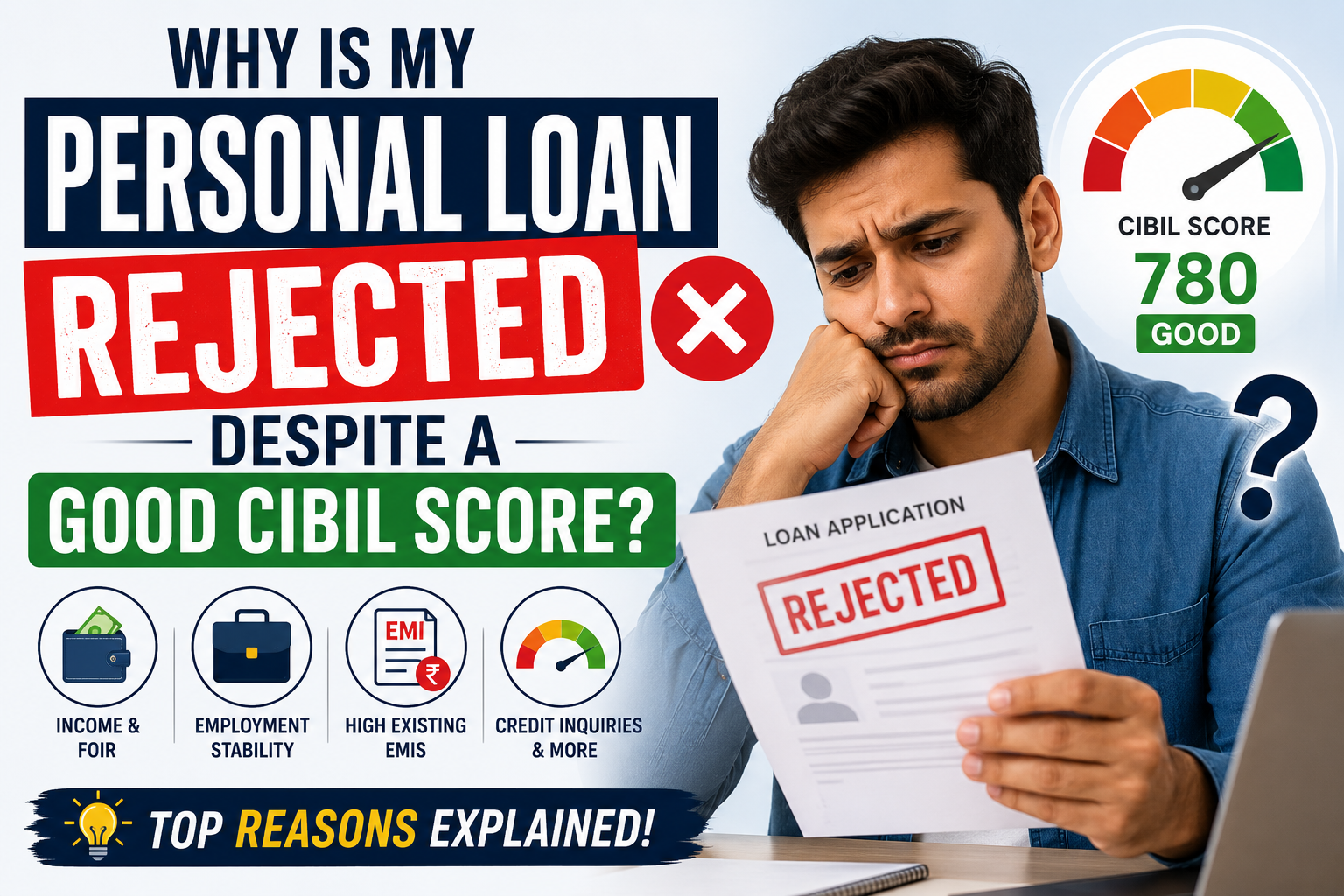
Why can a personal loan be rejected despite a good CIBIL score? Discover 12 common reasons, including income, FOIR, employment stability, credit enquiries, documentation, and lender policies.
Table of Contents
A good CIBIL score is often considered one of the most important requirements for getting a personal loan. Many borrowers assume that if their CIBIL score is 750 or above, loan approval is almost guaranteed.
That assumption is incorrect.
A high CIBIL score can significantly improve your chances of getting credit, but it does not guarantee loan approval. Lenders evaluate much more than your credit score before deciding whether you can comfortably repay the loan.
Your income, existing EMIs, employment stability, credit history, bank transactions, loan amount, documentation, recent credit applications, and the lender’s internal risk policies can all influence the final decision.
According to TransUnion CIBIL, the CIBIL Score is an important part of the loan application process, but lenders also consider factors such as employment status, income, repayment history, account details and the relationship between existing EMIs and income.
So, if your personal loan application has been rejected despite having a good CIBIL score, don’t immediately assume that something is wrong with your credit score.
There may be another reason.
What Does a “Good CIBIL Score” Actually Mean?
The CIBIL Score is a three-digit number ranging from 300 to 900. It summarizes information from your credit history and is generated from the information reported by credit institutions.
Generally, a higher score indicates a stronger credit profile. However, lenders do not use the score in isolation.
TransUnion CIBIL explains that a high score gives an applicant a better chance of having the application considered positively, but the final lending decision belongs to the lender.
For example, imagine two people:
Borrower A
- CIBIL Score: 790
- Monthly income: ₹35,000
- Existing EMIs: ₹20,000
- Recently changed jobs
- Applying for a ₹7 lakh personal loan
Borrower B
- CIBIL Score: 735
- Monthly income: ₹80,000
- Existing EMIs: ₹10,000
- Stable employment
- Applying for a ₹4 lakh personal loan
Borrower A has the higher CIBIL score, but Borrower B could still be the stronger loan applicant because the lender may consider the second applicant’s repayment capacity more comfortable.
This illustrates the most important point:
Your CIBIL score tells a lender about your credit history, but your overall financial profile tells the lender whether you can afford another loan.
12 Reasons Your Personal Loan Could Be Rejected Despite a Good CIBIL Score
1. Your Income Is Too Low for the Loan Amount
One of the most common reasons for rejection is insufficient income relative to the amount requested.
A lender may consider your CIBIL score excellent, but if your monthly income is not high enough to support the proposed EMI, the application can still be rejected.
For example, suppose you earn ₹40,000 per month and apply for a ₹10 lakh personal loan.
Even with a strong credit history, the lender may determine that the resulting EMI would place too much pressure on your monthly cash flow.
Personal loans are generally unsecured loans, meaning the lender does not have property or another asset as collateral. Consequently, the lender has to rely heavily on your income and repayment capacity. CIBIL also notes that annual income is an important consideration when lenders evaluate personal loan applications.
What you can do
If your loan amount is too high compared with your income, consider:
- Requesting a smaller loan amount
- Choosing a longer repayment period if financially appropriate
- Paying off existing debt first
- Increasing your documented income
- Applying after your financial profile becomes stronger
Don’t simply increase the loan tenure to force approval. A longer tenure can reduce the monthly EMI but may increase the total interest paid.
2. Your FOIR or EMI-to-Income Ratio Is Too High
Your lender may reject your application because too much of your income is already committed to debt repayments.
This is often discussed using terms such as FOIR (Fixed Obligations to Income Ratio) or EMI-to-income ratio.
For example:
Monthly income = ₹60,000
Existing EMIs = ₹25,000
Proposed new EMI = ₹20,000
Your total monthly EMI obligation would become ₹45,000.
That leaves only ₹15,000 from a ₹60,000 income before considering everyday expenses.
A lender may consider this repayment burden too high.
CIBIL’s loan approval guidance states that lenders consider the proportion of existing loan EMIs relative to salary and notes that approval chances can reduce when total EMIs become excessively high.
Reality check
A high CIBIL score cannot compensate indefinitely for poor repayment capacity.
You could have a score of 800, but if most of your income is already committed to EMIs, a lender may still consider another unsecured loan risky.
3. Your Employment History Is Not Stable
Your credit score mainly reflects your credit behavior. It does not necessarily tell a lender everything about your current employment stability.
Lenders may examine:
- Current employer
- Length of employment
- Frequency of job changes
- Employment type
- Industry
- Monthly salary
- Salary-credit pattern
For salaried applicants, a recent job change can sometimes make the application less attractive, particularly if the applicant has not completed a sufficient period with the new employer.
CIBIL specifically identifies employment status and job stability as factors lenders may consider when evaluating personal loan applications.
Example
Suppose you have:
- CIBIL Score: 780
- Monthly salary: ₹70,000
- No missed payments
But you changed jobs two months ago and are still within a probationary period.
A lender may decide to wait until your employment situation becomes more stable.
This does not mean your credit score is bad. It means your overall risk profile may not satisfy that lender’s criteria at that moment.
4. You Already Have Too Many Loans or Credit Cards
A good CIBIL score does not mean you should continue accumulating debt.
You may have never missed a payment and still have several active credit facilities.
For example:
- Home loan
- Car loan
- Personal loan
- Credit card
- Consumer durable loan
- Buy Now, Pay Later account
Even when every payment is made on time, the lender may calculate that your existing obligations are already substantial.
CIBIL advises consumers to maintain a healthy credit mix and notes that having too many unsecured loans may be viewed negatively.
This is particularly relevant to personal loans because they are unsecured.
What to do
Before applying, calculate:
Total Existing EMIs + Proposed Personal Loan EMI
Then compare that number with your monthly income.
If the resulting obligation is uncomfortable, reducing existing debt may be more effective than searching for another lender.
5. Too Many Recent Loan Applications
You may have a good CIBIL score but still face difficulties if you recently applied for several loans.
When you formally apply for credit, lenders may access your credit report, creating a credit enquiry.
CIBIL explains that enquiries generally occur when financial institutions access your report in connection with a credit application.
A few enquiries do not automatically mean rejection. However, a pattern of multiple recent applications can potentially make lenders question why you are seeking credit from several institutions within a short period.
Example
Imagine applying for:
- Personal Loan from Bank A
- Personal Loan from Bank B
- Personal Loan from NBFC C
- Credit Card from Bank D
within a few weeks.
Even if your score remains good, the overall application pattern may become a concern during underwriting.
Better approach
Don’t submit applications everywhere at once.
Instead:
- Compare eligibility criteria.
- Check your likely eligibility.
- Shortlist suitable lenders.
- Submit applications selectively.
CIBIL itself recommends applying for new credit in moderation.
6. Your Credit Report Contains an Error
Sometimes the problem isn’t your financial behavior at all.
Your credit report could contain incorrect information.
Possible errors include:
- An account that doesn’t belong to you
- Incorrect personal information
- Wrong outstanding balance
- Incorrect overdue amount
- An account marked active after closure
- An enquiry you did not authorize
- Incorrect repayment information
CIBIL states that inaccuracies can occur in account details, personal information, ownership information and enquiries.
For example, you may have completely repaid a personal loan, but the account could still appear incorrectly in your credit report.
Credit institutions generally submit information periodically, so recently paid or closed accounts may not immediately reflect as updated.
What should you do?
Get your latest credit report and carefully examine:
- Accounts
- Payment history
- Outstanding balances
- Enquiries
- Personal information
If you identify an error, you can raise a dispute with CIBIL and/or contact the relevant lender.
CIBIL also makes clear that it cannot independently change information without confirmation from the concerned credit institution.
You can learn more through the CIBIL loan rejection and dispute guidance.
7. Your Bank Account Doesn’t Support Your Declared Income
A lender may compare your stated income with your banking activity and financial documents.
Suppose you declare a monthly income of ₹75,000, but your bank statements consistently show salary credits of only ₹50,000.
That discrepancy may raise questions.
For self-employed individuals, lenders may examine:
- Bank statements
- Income tax returns
- Business income
- Financial statements
- Cash flows
- Existing liabilities
For salaried applicants, salary slips and bank statements can help establish income consistency.
CIBIL’s personal loan guidance lists income proof, bank statements and employment documentation among the documents lenders may request.
Important
Don’t inflate your income on a loan application.
Providing inaccurate information can create much bigger problems than simply receiving a rejection.
8. You Don’t Meet the Lender’s Internal Eligibility Criteria
This is one of the most misunderstood reasons for loan rejection.
Every lender has its own credit policy.
Two lenders can examine the same borrower and reach different decisions.
For example:
Lender A
- Minimum income: ₹30,000
- Accepts your employer category
- Offers personal loans to your profile
Lender B
- Minimum income: ₹50,000
- Requires a particular employment profile
- Does not currently target your customer segment
Your application could be approved by A and rejected by B despite having exactly the same CIBIL score.
CIBIL explicitly states that the decision to grant a loan is solely dependent on the credit institution’s credit policy.
Therefore, a rejection does not automatically mean:
“My CIBIL score is bad.”
It could simply mean:
“I didn’t meet this lender’s current underwriting criteria.”
9. Your Credit History Is Too Short
A high score isn’t always the same thing as a deep credit history.
Suppose you have a CIBIL score of 780, but your oldest credit account is only one year old.
Another applicant may have a score of 760 but a credit history spanning eight years with multiple successfully repaid accounts.
The second applicant may provide the lender with more evidence of long-term repayment behavior.
CIBIL identifies the depth of credit history as one of the factors that can influence a credit profile.
This is especially relevant for young borrowers or people who have only recently started using credit.
What you can do
You don’t need to take unnecessary loans simply to create a credit history.
Instead:
- Maintain existing credit responsibly.
- Pay bills on time.
- Keep credit utilization under control.
- Avoid unnecessary applications.
- Monitor your report periodically.
10. You Have High Credit Card Utilization
You may be paying your credit card bill on time every month and still have a concern: high credit utilization.
Credit utilization generally refers to how much of your available revolving credit you are using.
For example:
Credit limit = ₹2,00,000
Outstanding balance = ₹1,60,000
Your utilization is approximately 80%.
Even if you pay the bill on time, consistently carrying high balances may indicate that you are heavily dependent on available credit.
CIBIL recommends keeping balances low and controlling credit utilization as part of maintaining a healthy credit profile.
Better approach
If possible, reduce outstanding revolving credit before applying for a major personal loan.
But don’t close old credit accounts simply because you want to “clean up” your report. Closing accounts can have different effects depending on your overall credit profile.
11. Your Documentation Is Incomplete or Inconsistent
Sometimes the simplest explanation is the correct one.
Your loan application may be rejected because your documentation doesn’t satisfy the lender’s verification process.
Common documents include:
- PAN
- Identity proof
- Address proof
- Salary slips
- Bank statements
- Employment proof
- Income-tax documents for eligible self-employed applicants
The exact requirements vary by lender.
CIBIL’s personal loan guidance also notes that documentation requirements can differ from lender to lender.
Problems can arise when:
- Your address differs across documents.
- Your name is spelled differently.
- Salary information doesn’t match bank statements.
- Documents are outdated.
- Income documents are incomplete.
- Employment information cannot be verified.
A high CIBIL score cannot fix a documentation problem.
12. Your Loan Application Doesn’t Match Your Risk Profile
Lenders don’t only ask:
“Will this person repay?”
They also ask:
“How much are we comfortable lending to this person?”
Suppose you earn ₹45,000 per month and have an excellent credit history.
You apply for a ₹15 lakh unsecured personal loan.
The lender may consider the requested amount too high relative to your income, regardless of your excellent repayment history.
This is why loan amount matters.
A borrower might qualify for a ₹3 lakh personal loan but not necessarily a ₹10 lakh personal loan.
The important lesson
Don’t confuse:
“I have a good credit score”
with:
“I am eligible for any loan amount I request.”
These are two completely different things.
Does a Loan Rejection Hurt Your CIBIL Score?
A loan rejection itself is not the same thing as a negative entry on your credit report.
However, when you apply for credit, the lender may make a credit enquiry.
CIBIL states that credit enquiries are created when a bank or financial institution accesses your credit report for purposes such as a loan or credit-card application.
Therefore, repeatedly applying for credit within a short period can create multiple enquiries.
The better strategy is not to panic after one rejection and immediately apply to ten more lenders.
Instead, identify why the first application was rejected.
What Should You Do After Your Personal Loan Is Rejected?
If your application has been rejected despite a good CIBIL score, follow a structured approach.
Step 1: Ask the Lender for the Reason
Start with the lender.
Ask whether the rejection was related to:
- Income
- FOIR
- Employment
- Documentation
- Credit policy
- Existing liabilities
- Internal risk assessment
The exact reason may not always be disclosed in detail, but you should try to understand the broad reason.
Step 2: Check Your CIBIL Report
Don’t rely only on the score.
Look at the entire report.
Check:
- Payment history
- Existing accounts
- Credit utilization
- Outstanding balances
- Recent enquiries
- Closed accounts
- Personal information
You can access information about your CIBIL Score and Report through TransUnion CIBIL’s official website.
CIBIL also states that consumers are eligible for one free CIBIL Score and Report every calendar year.
Step 3: Calculate Your Existing Debt Burden
Write down every monthly obligation.
For example:
| Obligation | Monthly EMI |
|---|---|
| Car Loan | ₹8,000 |
| Personal Loan | ₹10,000 |
| Home Loan | ₹15,000 |
| Credit Card/Other Obligations | ₹5,000 |
| Total | ₹38,000 |
Then compare your total obligations with your monthly income.
This gives you a better idea of whether applying for another loan makes financial sense.
Step 4: Don’t Immediately Apply to Multiple Lenders
This is one of the biggest mistakes borrowers make after rejection.
They think:
“Bank A rejected me, so I’ll apply to ten other lenders.”
That’s not necessarily a smart strategy.
First determine whether the issue is:
- affordability,
- documentation,
- employment,
- existing debt,
- credit report accuracy,
- or lender-specific policy.
If the underlying problem is affordability, applying to more lenders won’t solve it.
Step 5: Reduce Existing Debt Where Possible
If your debt burden is high, paying down existing obligations may strengthen your application more than simply searching for another lender.
For example, if you have a large outstanding credit-card balance, reducing it may improve your overall financial position.
But don’t empty your emergency savings simply to make a loan application look better.
The goal should be financial stability, not just loan approval.
Step 6: Consider a Smaller Loan Amount
If the requested loan amount is too high, a smaller amount may fit your income and repayment capacity better.
For example:
Instead of requesting ₹8 lakh, you may consider whether ₹4 lakh is actually sufficient for your purpose.
Borrowing less can mean:
- Lower EMI
- Lower interest cost
- Lower debt burden
- Better repayment flexibility
And remember: a personal loan should solve a financial need without creating a larger financial problem.
Good CIBIL Score vs Good Loan Profile
This distinction is extremely important.
A good CIBIL score generally means your historical credit behavior looks healthy.
A good loan profile is broader.
It can include:
- Good CIBIL score
- Stable income
- Stable employment
- Manageable existing EMIs
- Reasonable credit-card utilization
- Clean repayment history
- Limited recent credit enquiries
- Consistent banking activity
- Complete documentation
- Appropriate loan amount
Think of the CIBIL score as one part of your financial resume.
The lender reviews the entire resume before making the final decision.
Common Myths About Personal Loan Rejection
Myth 1: “800 CIBIL means guaranteed approval.”
False.
A high CIBIL score improves your chances, but the lender makes the final decision based on its own credit policy and other financial factors.
Myth 2: “CIBIL rejected my loan.”
False.
CIBIL does not approve or reject your loan application. The lender makes that decision.
Myth 3: “Checking my own CIBIL score damages my score.”
False.
Checking your own CIBIL Score and Report does not negatively affect your score. CIBIL recommends reviewing your credit information regularly.
Myth 4: “If I have no missed payments, the bank must approve me.”
False.
Repayment history is important, but lenders can also consider income, employment, existing obligations, documentation and internal credit policies.
How to Improve Your Chances of Personal Loan Approval
If you want to improve your chances before applying again, focus on the fundamentals.
1. Maintain timely repayments
Never ignore existing EMIs or credit-card dues.
2. Keep credit utilization under control
Avoid consistently using a very large portion of your available credit.
3. Avoid unnecessary credit applications
Don’t apply for loans simply to see whether you qualify.
4. Reduce existing debt
Lower existing obligations can improve your repayment capacity.
5. Maintain stable employment
A consistent employment record can strengthen your application.
6. Keep documents updated
Make sure your income, address and identity information are consistent.
7. Check your credit report
Look for errors before submitting a new application.
8. Borrow an appropriate amount
Don’t request a loan simply because a lender’s maximum advertised amount is high.
9. Compare lenders carefully
Different lenders have different eligibility requirements.
10. Borrow only when repayment is comfortable
Approval should never be your only objective.
Final Takeaway
Having a good CIBIL score is an advantage, but it is not a guarantee of personal loan approval.
A lender evaluates your complete financial profile. Your income, existing EMIs, employment stability, credit-card utilization, recent credit enquiries, documentation, credit history and the amount you are requesting can all influence the final decision.
If your personal loan application was rejected despite a good CIBIL score, don’t immediately conclude that your credit score is the problem.
Instead, investigate the entire application.
Check your credit report. Review your existing debt. Calculate your repayment capacity. Verify your documents. Understand the lender’s eligibility criteria and avoid making multiple applications without addressing the underlying issue.
Most importantly, don’t chase loan approval at any cost.
A personal loan is useful only when the repayment burden fits comfortably within your financial capacity.
A good CIBIL score can open the door—but your overall financial profile determines whether the lender lets you walk through it.
