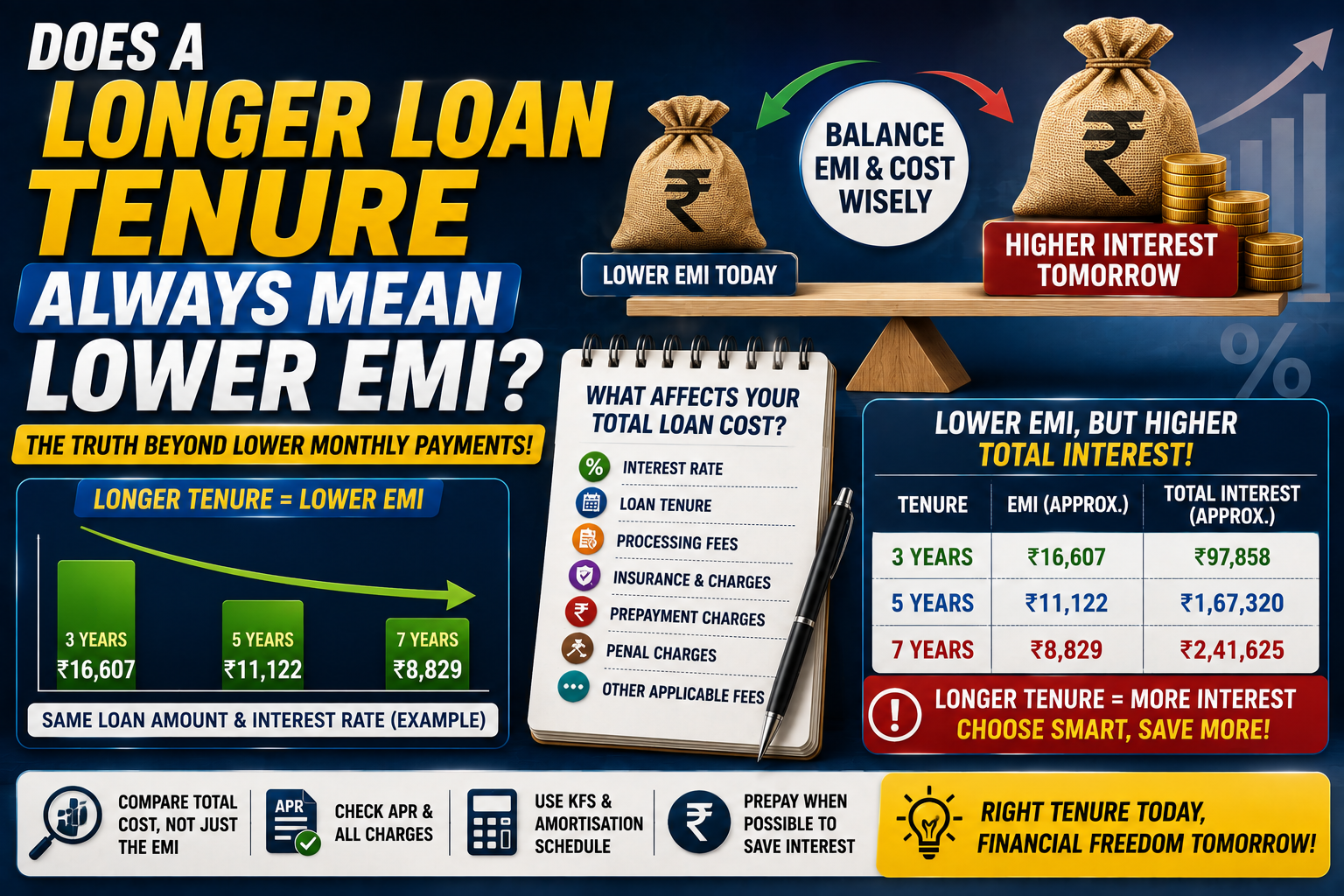
Does a longer loan tenure always mean lower EMI? Learn how loan tenure affects EMI, total interest, repayment cost, and how to choose the right tenure.
Table of Contents
Targeted Keyword: Longer Loan Tenure
Secondary Keywords: Loan Tenure and EMI, longer loan tenure lower EMI, loan tenure impact on EMI, longer tenure higher interest, how loan tenure affects loan cost, EMI calculation, total loan repayment
When borrowers compare loan offers, one of the first things they usually consider is the EMI.
A lower EMI can make a loan appear more affordable. This is why borrowers often choose a longer repayment period. If a five-year loan has a higher EMI than a seven-year loan, the seven-year option may initially look more comfortable.
But there is an important catch:
A lower EMI does not necessarily mean a cheaper loan.
In many standard amortising loans, extending the repayment period reduces the monthly instalment because the principal is spread over more payments. However, the borrower may pay interest for a longer period, which can significantly increase the total cost of the loan.
The Reserve Bank of India (RBI) explicitly explains that a longer loan tenure generally results in a lower monthly EMI, while shorter tenures create a higher EMI burden but repay the loan faster. RBI also notes that longer tenures can result in greater interest payments and make a loan more expensive overall.
Therefore, the answer to the question “Does a longer loan tenure always mean lower EMI?” is:
Usually, for a standard loan with the same principal and interest rate, a longer tenure lowers the EMI—but not always under every loan structure. More importantly, the lower EMI comes with a potential trade-off: higher total interest.
Let’s understand how this works.
What Is Loan Tenure?
Loan tenure is the period over which you are required to repay a loan.
For example:
- 1-year loan = 12 months
- 3-year loan = 36 months
- 5-year loan = 60 months
- 10-year loan = 120 months
- 20-year loan = 240 months
The tenure directly affects how your loan repayment is distributed.
Generally, if the loan amount and interest rate remain the same:
Longer tenure → lower EMI
Shorter tenure → higher EMI
But there is another relationship:
Longer tenure → more time paying interest
Shorter tenure → less time paying interest
This is the central trade-off borrowers need to understand.
Why Does a Longer Loan Tenure Usually Reduce EMI?
In a standard reducing-balance loan, the EMI is calculated using the principal, interest rate and number of instalments.
The basic EMI formula is:
EMI = P × r × (1+r)^n ÷ [(1+r)^n − 1]
Where:
- P = Principal amount
- r = Periodic interest rate
- n = Number of instalments
When the number of instalments increases, the repayment is distributed over a longer period.
As a result, the monthly payment generally decreases.
For example, suppose you borrow:
₹5 lakh
at an illustrative:
12% annual interest rate
Consider three different tenures.
3-year tenure
Approximate EMI: ₹16,607
5-year tenure
Approximate EMI: ₹11,122
7-year tenure
Approximate EMI: ₹8,829
The longer tenure clearly reduces the monthly payment.
But now comes the important question:
How much total interest do you pay?
Longer Tenure Can Mean Higher Total Interest
Let’s use the same hypothetical ₹5 lakh loan at 12% reducing interest.
| Tenure | Approx. EMI | Approx. Total Interest |
|---|---|---|
| 3 years | ₹16,607 | ₹97,858 |
| 5 years | ₹11,122 | ₹1,67,320 |
| 7 years | ₹8,829 | ₹2,41,625 |
These figures are illustrative and assume a standard monthly reducing-balance structure with no additional fees.
Notice what happens.
Going from:
3 years → 5 years
reduces the EMI substantially.
But total interest increases.
Going from:
5 years → 7 years
reduces the EMI further.
But total interest increases again.
This demonstrates the fundamental trade-off:
Lower monthly payment can mean higher lifetime borrowing cost.
Does Longer Loan Tenure Always Mean Lower EMI?
For a standard amortising loan where the:
- Principal is the same
- Interest rate is the same
- Repayment frequency is the same
- EMI structure is the same
a longer tenure generally produces a lower EMI.
However, the word “always” needs caution.
Not every loan uses a conventional fixed-EMI structure.
Some products may use:
- Step-up EMIs
- Step-down EMIs
- Balloon payments
- Interest-only periods
- Flexible repayment structures
- Floating rates
- Variable repayment arrangements
RBI itself notes that some banks offer flexible repayment structures such as step-up and step-down loans, where EMIs can increase or decrease over time.
Therefore, don’t assume that simply increasing the tenure will automatically reduce every payment in every loan product.
Check the actual repayment schedule.
The Real Cost of Choosing a Longer Tenure
The biggest mistake borrowers make is focusing only on EMI.
Suppose you are offered two options:
Option A
EMI: ₹15,000
Tenure: 4 years
Option B
EMI: ₹11,000
Tenure: 6 years
Option B looks more affordable.
But ask:
How many total payments will I make?
Option A:
₹15,000 × 48
= ₹7,20,000
Option B:
₹11,000 × 72
= ₹7,92,000
The second option has a lower monthly EMI but requires ₹72,000 more in total payments in this simplified example.
This is why borrowers should never evaluate a loan using EMI alone.
Lower EMI Does Not Mean Lower Loan Cost
This is perhaps the most important lesson in understanding Longer Loan Tenure.
Imagine two loans:
Loan A: ₹12,000 EMI
Loan B: ₹9,000 EMI
You might think Loan B is cheaper.
But what if:
Loan A = 5 years
Loan B = 8 years
Loan B may require substantially more interest payments because you remain indebted for three additional years.
Therefore:
EMI measures monthly affordability.
Total repayment measures overall cost.
They answer two different questions.
Longer Loan Tenure Can Be Useful
It would be wrong to say that longer tenure is always a bad choice.
A longer tenure can be useful when the shorter tenure creates an EMI that is too high for your income.
For example, suppose your monthly income is:
₹60,000
A loan with a:
₹25,000 EMI
may put considerable pressure on your monthly budget.
A longer tenure might reduce the EMI to:
₹18,000
That could make repayment more manageable.
In this situation, paying somewhat more total interest may be a reasonable trade-off for maintaining financial stability.
The objective isn’t necessarily to choose the shortest possible tenure.
It is to choose a tenure that balances:
Affordability + Total Cost + Financial Safety
When Should You Choose a Longer Tenure?
A longer tenure may make sense when:
Your Monthly Cash Flow Is Limited
If a shorter tenure would consume too much of your income, extending the tenure can reduce immediate financial pressure.
You Need More Financial Flexibility
A lower EMI leaves more monthly cash available for emergencies, investments and other obligations.
You Expect Income to Increase
Someone early in their career may prefer a manageable EMI today with the intention of making prepayments later, provided the loan terms permit and the strategy makes financial sense.
You Are Taking a Large Loan
For large loans such as home loans, a very short tenure may create an extremely high EMI.
However, borrowers should still calculate the additional interest created by a longer tenure.
When Should You Choose a Shorter Tenure?
A shorter tenure may make sense when:
You Can Comfortably Afford the EMI
If your income can comfortably support a higher EMI, reducing the tenure can save interest.
You Want to Become Debt-Free Faster
A shorter tenure gets rid of the loan sooner.
You Want to Minimize Total Interest
Generally, paying the principal faster reduces the period over which interest is charged.
You Have Stable Income
If your income is predictable and you maintain an emergency fund, a shorter tenure may be more manageable.
Longer Loan Tenure and Home Loans
The effect of tenure becomes particularly significant with home loans because the borrowed amount can be large and the repayment period can extend over many years.
For example, consider a hypothetical:
₹50 lakh home loan
Even a small difference in the repayment period can materially change the total interest.
A:
15-year loan
may have a much higher EMI than a:
25-year loan
But the 25-year loan can result in substantially greater total interest.
This creates a common dilemma:
Should I choose a lower EMI or save interest?
The answer depends on your income, cash flow, financial goals and ability to make additional principal repayments.
RBI consumer guidance also advises borrowers to examine loan tenure, interest rate, reset clauses and repayment terms carefully before accepting a home loan.
Longer Loan Tenure and Personal Loans
Personal loans are another area where tenure can significantly affect borrowing cost.
Suppose you borrow:
₹5 lakh
at a hypothetical reducing interest rate.
A 3-year tenure may have a relatively high EMI.
A 5-year tenure may make the EMI much more manageable.
However, because personal loans can carry relatively high interest rates, extending the tenure can significantly increase total interest.
Therefore, don’t automatically choose the maximum tenure offered by the lender.
Ask:
“How much additional interest will I pay if I extend the tenure by two years?”
That number can change your decision.
Longer Loan Tenure and Vehicle Loans
Vehicle loans also demonstrate the EMI-versus-total-cost trade-off.
Suppose you finance a car over:
3 years
versus:
7 years
The seven-year loan may make the monthly EMI significantly lower.
But you could remain in debt for much longer while paying interest.
There’s another problem with very long vehicle loans:
The vehicle depreciates while the loan remains outstanding.
This can potentially create a situation where the outstanding loan balance remains high relative to the vehicle’s market value.
Therefore, choosing a longer tenure for a depreciating asset requires additional caution.
Floating Interest Rates Can Change the Calculation
The relationship between tenure and EMI becomes more complicated when the loan has a floating interest rate.
Suppose your loan starts at:
8.5%
and later the applicable rate rises.
Your lender may adjust:
- EMI
- Tenure
- Or both
depending on the loan structure and applicable policy.
RBI’s rules for EMI-based floating-rate personal loans require lenders to communicate the possible impact of benchmark changes and provide borrowers with specified options when rates reset. These can include increasing EMI, extending the tenure, a combination of both, switching to a fixed rate under the lender’s policy, or prepaying the loan.
This means a borrower should not assume:
“My EMI will remain exactly the same for the next 20 years.”
If the loan is floating-rate, understand the reset mechanism.
Can a Longer Tenure Increase Instead of Reduce EMI?
Under normal circumstances, if all other variables remain unchanged, extending tenure generally reduces the EMI.
But if the interest rate changes at the same time, the outcome can be different.
For example:
Old tenure = 5 years
Old rate = 10%
You extend the tenure to:
7 years
But the new interest rate becomes:
14%
The EMI may not fall by as much as expected.
This is why comparing tenure without considering the interest rate can produce misleading conclusions.
Loan Tenure and Total Interest: The Hidden Trade-Off
Think of loan repayment as a balance between two objectives.
Objective 1: Lower Monthly EMI
Choose a longer tenure.
Objective 2: Lower Total Interest
Choose a shorter tenure, if affordable.
You cannot always maximize both.
A shorter tenure generally means:
Higher monthly payment + lower total interest
A longer tenure generally means:
Lower monthly payment + higher total interest
The best choice depends on your financial situation.
Should You Always Choose the Shortest Loan Tenure?
No.
This is another oversimplification.
A very short tenure can create a high EMI that leaves you with insufficient money for:
- Rent
- Food
- Emergency expenses
- Investments
- Insurance
- Existing debt
- Family responsibilities
If your EMI becomes too high, you could increase the risk of missing payments.
A slightly longer tenure with a comfortable EMI may be financially safer.
The goal is not:
“Finish the loan as quickly as possible at any cost.”
The goal is:
“Repay the loan efficiently without damaging your monthly financial stability.”
How to Choose the Right Loan Tenure
Consider these five factors.
1. Monthly Income
How much do you reliably earn every month?
2. Existing EMIs
Don’t evaluate the new loan in isolation.
Add your existing debt obligations.
3. Emergency Fund
You should have enough liquidity to handle unexpected expenses.
4. Total Interest
Calculate the difference between shorter and longer tenures.
5. Future Financial Goals
Consider investments, education, home purchase, business plans and other major expenses.
A loan that looks affordable today may become difficult if your financial obligations increase later.
Don’t Use Your Maximum EMI Capacity
A common mistake is to ask:
“What is the maximum EMI I can afford?”
A better question is:
“What EMI can I comfortably afford even if something goes wrong?”
Suppose your income is:
₹80,000 per month
and you technically have enough cash flow to pay:
₹30,000 EMI
That doesn’t necessarily mean you should take a loan requiring a ₹30,000 EMI.
Income can change.
Expenses can rise.
Unexpected events can occur.
Leaving some financial breathing room is often more sensible than stretching your budget to the maximum.
How to Compare Two Tenures
Suppose you are considering a:
₹10 lakh loan
and the lender offers:
Option A
5-year tenure
EMI: ₹22,000
Option B
8-year tenure
EMI: ₹16,000
Option B gives you:
₹6,000 more monthly cash flow.
But you need to calculate:
Total payments under Option A
versus:
Total payments under Option B
If Option B costs substantially more overall, ask yourself:
“Is the ₹6,000 monthly saving worth the additional interest?”
That is the correct financial question.
Use an Amortisation Schedule
An amortisation schedule shows how your loan balance changes over time.
It generally provides information about:
- EMI
- Principal component
- Interest component
- Outstanding balance
- Number of instalments
RBI describes an amortisation schedule as a table showing periodic principal and interest payments and the outstanding amount at different points in the loan.
For applicable loans, the RBI’s Key Facts Statement framework also requires an amortisation schedule to be provided.
You can use this schedule to compare:
5-year loan vs 7-year loan
and see exactly how much additional interest the longer tenure creates.
What Is the Best Tenure for a Loan?
There is no universal “best” tenure.
The appropriate tenure depends on:
- Loan amount
- Interest rate
- Income
- Existing debt
- Age
- Financial goals
- Emergency savings
- Expected income growth
- Loan type
For example:
A young salaried borrower with strong income growth may choose a different tenure from someone approaching retirement.
Similarly, a ₹2 lakh personal loan should not be evaluated in exactly the same way as a ₹50 lakh home loan.
Can You Take a Longer Tenure and Prepay Later?
This can be a practical strategy in some circumstances.
For example, you could choose:
7-year tenure
instead of:
5-year tenure
to keep the required EMI manageable.
If your income later increases, you could make additional principal payments, subject to the loan’s terms and applicable regulations.
This gives you flexibility.
However, don’t assume prepayment is always free.
Check:
- Prepayment charges
- Minimum prepayment amount
- Lock-in period
- Applicable lender policies
- Regulatory restrictions
RBI’s floating-rate EMI personal-loan framework provides borrowers with options around part or full prepayment when applicable, subject to the relevant rules and terms.
The Risk of Choosing a Very Long Tenure
A very long tenure can create several problems.
Higher Total Interest
You pay interest for a longer period.
Longer Debt Commitment
Your income remains committed to debt for more years.
Reduced Financial Flexibility
Future loans may become harder to manage.
Risk During Income Changes
If your income falls, a long-term obligation can become burdensome.
Delayed Financial Goals
Large long-term EMIs can affect your ability to invest or save for other goals.
Therefore, don’t choose a long tenure simply because the EMI looks attractive.
The Risk of Choosing a Very Short Tenure
The opposite extreme also has risks.
High EMI
Your monthly cash flow becomes tighter.
Less Emergency Flexibility
A large portion of income goes toward debt.
Greater Default Risk
If your income is unstable, a high EMI can become difficult to maintain.
Less Money for Other Goals
You may have less money available for savings and investments.
Therefore, the shortest tenure isn’t automatically the best choice either.
Longer Loan Tenure vs Shorter Loan Tenure
Here’s a simple comparison:
| Factor | Longer Tenure | Shorter Tenure |
|---|---|---|
| Monthly EMI | Usually lower | Usually higher |
| Total interest | Usually higher | Usually lower |
| Repayment period | Longer | Shorter |
| Monthly cash flow | More comfortable | More demanding |
| Debt-free date | Later | Earlier |
| Financial flexibility | Higher monthly flexibility | Lower monthly flexibility |
| Overall borrowing cost | Usually higher | Usually lower |
This table summarizes the central trade-off.
How Interest Rate Changes Affect Tenure
Suppose you have a floating-rate loan.
If interest rates increase, your lender may adjust the EMI, tenure or both depending on the applicable terms.
RBI specifically requires lenders covered by its EMI-based floating-rate personal-loan framework to communicate the impact of benchmark changes and provide borrowers with options for dealing with increased repayment burdens.
Therefore, when choosing a loan, ask:
“What happens to my EMI if the interest rate increases by 1%?”
This question is especially important for long-tenure loans.
Don’t Forget the APR and Total Cost
Tenure isn’t the only factor determining loan cost.
Also compare:
- Interest rate
- APR
- Processing fees
- Insurance
- Documentation charges
- Other applicable fees
- Prepayment conditions
- Penal charges
RBI’s KFS framework defines APR as the annual cost of credit that includes the interest rate and other charges associated with the credit facility.
Therefore, when comparing two loan offers, don’t simply choose the one with the lowest EMI.
Look at the complete cost.
A Simple Rule for Borrowers
You can use this simple decision framework:
If the shorter tenure EMI is comfortably affordable:
Consider the shorter tenure.
You may save substantial interest.
If the shorter tenure EMI strains your budget:
Consider a longer tenure.
Financial stability is more important than aggressively minimizing interest.
If you choose a longer tenure:
Check whether you can make future prepayments.
This can potentially give you flexibility while reducing future interest, subject to applicable terms and charges.
Frequently Asked Questions
Does a longer loan tenure always mean a lower EMI?
For a standard amortising loan with the same principal, interest rate and repayment structure, a longer tenure generally produces a lower EMI. However, unusual repayment structures or changes in interest rates can affect the result.
Does longer tenure increase interest?
Generally, yes. A longer tenure means you remain indebted for more time, so you typically pay more total interest.
Is a lower EMI better?
Not necessarily. A lower EMI improves monthly affordability but may increase the total cost of the loan.
Should I choose the shortest possible tenure?
Only if you can comfortably afford the higher EMI while maintaining adequate financial reserves.
Why does longer tenure reduce EMI?
The principal and interest repayment is spread across a larger number of instalments, which generally reduces the required monthly payment.
Can I choose a longer tenure and prepay later?
Potentially, yes. But check the loan agreement and applicable prepayment rules before relying on this strategy.
Does loan tenure affect home-loan interest?
Yes. A longer home-loan tenure generally lowers EMI but can substantially increase the total interest paid over the life of the loan.
Does loan tenure affect personal-loan EMI?
Yes. For a standard amortising personal loan, increasing the tenure generally reduces the EMI, assuming the interest rate and principal remain unchanged.
Can a floating interest rate change my EMI?
Yes. Depending on the loan structure, a change in the benchmark can affect the EMI, tenure or both. RBI requires covered lenders to communicate the impact of such changes and provide specified borrower options.
What is more important: EMI or total repayment?
Both matter, but they answer different questions. EMI measures monthly affordability, while total repayment shows the overall amount you will pay over the loan.
Final Takeaway
So, does a longer loan tenure always mean lower EMI?
For a conventional amortising loan, generally yes—if the loan amount, interest rate and repayment structure remain unchanged, extending the tenure usually reduces the monthly EMI.
But there is a major catch:
Lower EMI does not mean lower total cost.
A longer tenure generally means you pay interest for a longer period.
For example, in our hypothetical ₹5 lakh loan at 12% reducing interest:
- 3 years: approximately ₹16,607 EMI and ₹97,858 interest
- 5 years: approximately ₹11,122 EMI and ₹1,67,320 interest
- 7 years: approximately ₹8,829 EMI and ₹2,41,625 interest
The 7-year loan has the most comfortable EMI, but it also carries the highest total interest cost.
Therefore, the right loan tenure is not necessarily the shortest or longest one.
The better approach is to find the point where:
EMI is comfortably affordable + total interest is reasonable + repayment period fits your financial goals.
Before borrowing, compare:
Loan Amount
Interest Rate
Loan Tenure
EMI
Total Interest
APR
Processing Fees
Other Charges
Prepayment Terms
Total Repayment
For applicable loans, carefully review the Key Facts Statement (KFS) and amortisation schedule. RBI’s framework requires standardized loan information and APR disclosures for covered loans, helping borrowers understand the overall cost of credit.
And if you’re considering a floating-rate loan, don’t ignore the possibility of future rate changes. RBI’s framework specifically requires lenders to explain the potential impact of benchmark changes on EMI and/or tenure for covered EMI-based floating-rate personal loans.
The biggest mistake is choosing a loan simply because the EMI looks small.
The smarter question is:
“How much will I pay in total, and can I comfortably afford the repayment throughout the loan?”
A longer tenure can provide valuable monthly breathing room.
But that convenience comes at a price.
Lower EMI today can mean higher interest tomorrow.
Choose your loan tenure based on your complete financial situation—not just the EMI displayed on the loan calculator.
Useful Outbound Resources
- Reserve Bank of India – Consumer FAQ on Home Loans and Loan Tenure — Explains how tenure affects EMI, total interest, amortisation schedules and different repayment structures.
- RBI – Reset of Floating Interest Rate on EMI-Based Personal Loans — Official RBI directions covering changes in EMI/tenure when floating interest rates reset.
- RBI – FAQs on Floating Interest Rate and EMI-Based Personal Loans — Explains borrower options when interest rates rise.
- RBI – Key Facts Statement (KFS) Framework — Official RBI framework for standardized loan disclosures and borrower cost information.
- RBI – Master Directions on KFS and APR — Explains APR, equated periodic instalments and the standardized Key Facts Statement.
Learn how to calculate the Total Cost of a Loan before borrowing. Understand interest, EMI, processing fees, APR, insurance, penalties and other loan charges
