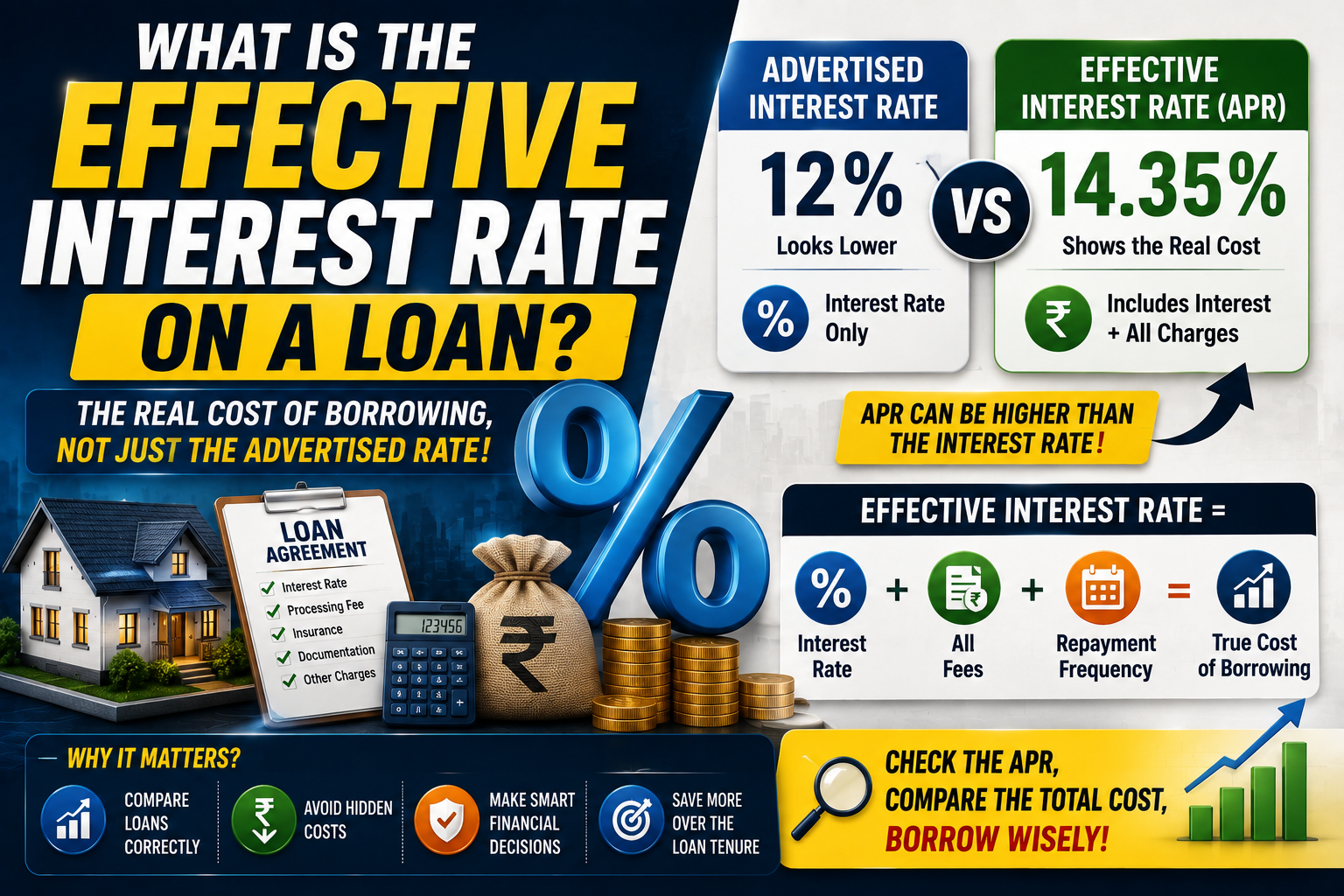
Learn what the Effective Interest Rate on a loan means, how it differs from the advertised rate and APR, how fees affect borrowing costs, and how to compare loan offers.
Table of Contents
When people compare loans, one of the first things they usually look at is the Interest Rate.
A lender may advertise a personal loan at 12%, another at 13%, and another at 14%. At first glance, it seems obvious that the 12% loan is the cheapest.
But that assumption can be misleading.
The advertised Interest Rate does not always tell you the complete cost of borrowing. Processing fees, insurance charges, documentation fees, repayment frequency, compounding and other applicable costs can change the actual cost of a loan.
This is where the concept of the Effective Interest Rate becomes important.
An Effective Interest Rate helps borrowers understand the economic cost of borrowing more accurately than simply looking at the headline rate.
However, there is an important distinction to understand:
Effective annual interest rate (EAR) generally refers to the annualized rate after taking compounding into account, while Annual Percentage Rate (APR) is a broader measure of the annual cost of credit that can include interest and applicable charges.
For Indian retail borrowers, RBI’s Key Facts Statement (KFS) framework defines APR as the annual cost of credit to the borrower, including the interest rate and all other charges associated with the credit facility.
Therefore, when comparing loan offers, don’t ask only:
“Which lender has the lowest Interest Rate?”
A better question is:
“Which loan has the lowest overall cost after considering the interest rate, fees and repayment structure?”
Let’s understand the Effective Interest Rate in detail.
What Is the Effective Interest Rate?
The Effective Interest Rate is an annualized way of expressing the actual cost or yield of borrowing or lending after taking relevant compounding effects into account.
In simple terms, it answers a question that the nominal rate may not fully answer:
“What rate am I effectively paying when the interest is actually applied at its stated frequency?”
For example, suppose a loan or financial product has a nominal annual rate of 12%, but interest is compounded monthly.
The effective annual rate is slightly higher than 12% because interest is being applied throughout the year.
The basic relationship is:
Effective Annual Rate = (1 + nominal rate / number of compounding periods) ^ number of periods − 1
For a 12% nominal rate compounded monthly:
EAR = (1 + 0.12/12)^12 − 1
This produces an effective annual rate of approximately:
12.68%
So:
12% nominal rate ≠ 12% effective annual rate
This distinction becomes important when comparing financial products with different compounding frequencies.
However, when discussing loans in India, borrowers should not confuse this mathematical effective annual rate with the APR disclosed in the KFS.
APR is broader because it incorporates the interest rate and applicable charges associated with the credit facility.
Effective Interest Rate vs Nominal Interest Rate
The nominal Interest Rate is the rate advertised or stated by the lender before considering the effect of compounding.
The Effective Interest Rate accounts for the effect of compounding.
Consider a simple example.
Suppose:
Nominal Interest Rate = 12% per year
If interest is compounded annually:
Effective rate = 12%
But if it is compounded monthly:
Effective rate ≈ 12.68%
The difference exists because interest is being applied more frequently.
However, many retail loans use an amortizing EMI structure rather than simply adding compound interest to a lump-sum balance. Therefore, you should not use the EAR formula alone to determine the total cost of an EMI loan.
For an actual loan comparison, the repayment schedule and APR are more useful.
Effective Interest Rate vs APR: What Is the Difference?
This is one of the most important distinctions in this topic.
Effective Annual Rate (EAR)
EAR primarily captures the effect of compounding frequency.
Annual Percentage Rate (APR)
APR is designed to represent the annual cost of credit, including the applicable interest rate and other charges associated with the credit facility.
RBI’s KFS framework specifically defines APR as the annual cost of credit to the borrower that includes the interest rate and all other charges associated with the credit facility.
Therefore:
EAR → focuses on compounding
APR → focuses on the broader annual cost of credit
For a consumer comparing two loans, APR is often the more useful figure when the objective is to understand the all-in borrowing cost.
Why the Advertised Interest Rate Can Be Misleading
Suppose two lenders offer you:
Lender A
Interest Rate: 11%
Processing Fee: ₹5,000
Lender B
Interest Rate: 12%
Processing Fee: ₹500
At first glance:
11% < 12%
So Lender A looks cheaper.
But imagine the loan is small and the processing fee represents a significant percentage of the amount actually received.
The difference in fees could reduce or even eliminate the apparent advantage of the lower Interest Rate.
This is why borrowers should look beyond the advertised rate.
RBI has emphasized the use of APR and standardized borrower disclosures to help customers compare the cost of borrowing across products and lenders.
Example: Why Fees Affect the Effective Cost
Suppose you borrow:
₹1,00,000
The lender advertises:
Interest Rate = 12%
But charges:
Processing fee = ₹3,000
If the fee is deducted upfront, you may receive only:
₹97,000
even though your contractual loan principal is:
₹1,00,000
You are therefore paying interest and repaying the loan based on ₹1,00,000 while receiving only ₹97,000 in usable funds.
This means your actual cost relative to the money you received is higher than the headline 12%.
This is one reason APR is valuable.
Why APR Matters for Loan Comparison
RBI’s KFS framework requires applicable lenders to provide borrowers with a standardized Key Facts Statement containing important information about the loan.
The framework defines APR as the annual cost of credit, including the interest rate and associated charges.
For borrowers, this can make comparisons much easier.
Instead of comparing:
Loan A = 12%
Loan B = 13%
you can look at the broader cost information.
For example:
| Loan | Advertised Rate | APR |
|---|---|---|
| Loan A | 12% | 14.2% |
| Loan B | 13% | 13.8% |
Loan A has the lower advertised Interest Rate, but Loan B has the lower APR in this hypothetical example.
That doesn’t automatically mean Loan B is right for you, because you should also examine tenure, EMI, prepayment terms and other conditions.
But it demonstrates why the headline rate alone is insufficient.
What Factors Can Increase the Effective Cost of a Loan?
Several factors can increase the actual cost of borrowing.
1. Interest Rate
The most obvious factor is the contractual interest rate.
A higher rate generally increases the interest component of your repayment.
2. Processing Fees
A processing fee increases the cost of obtaining the loan.
3. Documentation Charges
Some lenders may charge applicable documentation or administrative fees.
4. Insurance or Third-Party Charges
Depending on the product, certain charges may be associated with insurance or third-party services.
5. Loan Tenure
A longer tenure can reduce the EMI but may increase total interest paid.
6. Repayment Structure
A reducing-balance loan and a flat-rate loan can produce very different total costs even if their advertised rates appear similar.
7. Compounding or Interest Calculation
The method and frequency of interest calculation affect the effective rate in relevant financial products.
8. Other Applicable Charges
Penal charges, conversion charges and other costs can affect the total cost when they arise under the loan terms.
Effective Interest Rate and EMI
Many borrowers believe that the EMI tells them how expensive a loan is.
It doesn’t tell the whole story.
Suppose:
Loan A EMI = ₹15,000
Loan B EMI = ₹13,500
Loan B looks cheaper.
But what if:
Loan A tenure = 5 years
and:
Loan B tenure = 7 years?
You could pay less every month with Loan B while paying significantly more in total interest.
Therefore, always compare:
EMI + tenure + total interest + fees
rather than EMI alone.
Effective Interest Rate and Loan Tenure
Tenure can have a huge impact on the total borrowing cost.
Imagine you borrow:
₹5 lakh
at the same Interest Rate.
A three-year loan may have a much higher EMI but substantially lower total interest than a seven-year loan.
The seven-year loan may look attractive because the EMI is lower.
But the borrower is paying interest for four additional years.
Therefore, a lower EMI does not necessarily mean a cheaper loan.
This is particularly important when comparing personal loans and vehicle loans.
Effective Interest Rate for Reducing-Balance Loans
Many amortizing loans calculate interest on the outstanding principal.
Suppose you borrow:
₹5 lakh
At the beginning:
Outstanding principal = ₹5 lakh
After several repayments:
Outstanding principal = ₹4 lakh
Later:
Outstanding principal = ₹3 lakh
Interest is generally calculated on the outstanding balance according to the loan’s repayment structure.
Therefore, the interest component changes as the principal is repaid.
This is different from a flat-rate structure where interest may be calculated on the original principal throughout the stated tenure.
This distinction can make two loans with apparently similar Interest Rates have very different total costs.
Effective Interest Rate vs Flat Interest Rate
Suppose:
Loan A
10% flat
Loan B
12% reducing
It is tempting to choose Loan A because:
10% < 12%
But that is not an apples-to-apples comparison.
A flat Interest Rate is calculated differently from a reducing-balance Interest Rate.
With a flat-rate structure, interest is generally calculated against the original principal for the agreed period.
With a reducing-balance structure, interest is calculated against the outstanding principal.
Therefore, the 10% flat loan could potentially have a higher effective borrowing cost than the 12% reducing loan.
The correct approach is to compare the actual repayment schedule, total interest, APR and fees.
Effective Interest Rate Example
Let’s consider a hypothetical loan.
Loan amount: ₹2,00,000
Nominal rate: 12%
Tenure: 2 years
Processing fee: ₹5,000
Suppose the loan is amortized through monthly instalments.
The borrower should not look only at:
12% Interest Rate
Instead, the borrower should examine:
- EMI
- Total interest
- Processing fee
- Amount actually received
- Total repayment
- APR
- Prepayment terms
- Penal charges
- Other applicable fees
The actual economic cost is therefore broader than the 12% headline figure.
How Is Effective Interest Rate Calculated?
There are several different concepts that can be called an effective Interest Rate, depending on the context.
For Compounding
A standard effective annual rate can be calculated as:
EAR = (1 + r/n)^n − 1
where:
- r = nominal annual rate
- n = number of compounding periods per year
For a Loan With Fees
The true economic cost can be derived by comparing the net amount received by the borrower with the timing and amount of repayments.
This is conceptually closer to an internal rate of return calculation.
For Consumer Loan Comparison
The most practical number may be the lender’s disclosed APR, particularly where RBI’s KFS framework applies.
Therefore, borrowers should avoid using one formula for every type of loan.
Why the Effective Interest Rate Is Important
Understanding the effective Interest Rate can help you:
Compare Different Loan Offers
It allows you to look beyond the headline percentage.
Identify Expensive Fees
A low advertised rate may come with high charges.
Understand the Impact of Compounding
A nominal rate may not reflect the effective annual rate when interest compounds more frequently.
Evaluate Different Repayment Structures
Flat-rate and reducing-rate loans can have very different economics.
Make Better Financial Decisions
The objective is to minimize the total cost of borrowing while choosing a repayment structure you can comfortably manage.
Effective Interest Rate on Personal Loans
Personal loans often have relatively short tenures and can carry higher rates than some secured loans.
This makes it particularly important to compare the complete cost.
Suppose:
Lender A = 12%
Lender B = 13%
Don’t immediately reject Lender B.
Ask for:
- APR
- Processing fee
- EMI
- Total interest
- Total repayment
- Prepayment charges
- Penal charges
- Other applicable fees
You may discover that the 13% loan has a lower overall cost because its fees are significantly lower.
Effective Interest Rate on Home Loans
Home loans usually have long repayment periods.
Because of the size and duration of the borrowing, even a relatively small difference in pricing can have a significant impact on total interest.
For home loans, borrowers should additionally check:
- Fixed or floating rate
- Benchmark
- Spread
- Reset frequency
- Processing fees
- Legal/technical charges
- Prepayment conditions
- Loan tenure
RBI’s consumer guidance specifically encourages home-loan borrowers to ask about the Interest Rate, APR, benchmark, reset mechanism and spread/mark-up.
Effective Interest Rate on Digital Loans
The concept is particularly important for digital lending.
A digital loan may advertise:
“Get a loan at only 1% per month.”
That sounds inexpensive.
But:
1% per month is not simply 12% in every effective-cost sense.
You also need to understand:
- Processing fee
- GST or applicable taxes
- Other charges
- Repayment frequency
- Penal charges
- Net amount received
- Total amount payable
- APR
RBI’s digital-lending framework requires the APR of applicable digital loans to be disclosed upfront and included in the KFS.
This is especially useful because digital loan advertisements can otherwise make short-term borrowing appear cheaper than it actually is.
What Is a Key Facts Statement?
A Key Facts Statement (KFS) is a standardized document designed to give borrowers important information about a loan in a simple format.
For applicable loans, the KFS includes information such as:
- Loan amount
- Tenure
- Interest rate
- APR
- Repayment schedule
- Applicable charges
- Other key terms
RBI describes APR in the KFS framework as the annual cost of credit to the borrower, including the interest rate and all other charges associated with the credit facility.
The KFS can therefore be one of the most useful documents to review before accepting a loan.
How to Compare Two Loans Using APR and Effective Cost
Suppose you have two offers.
Loan A
Interest Rate: 11%
APR: 13.5%
Processing fee: ₹8,000
Loan B
Interest Rate: 12%
APR: 12.8%
Processing fee: ₹2,000
The first loan has the lower Interest Rate.
But the second has the lower APR in this hypothetical example.
This tells you something important:
The advertised Interest Rate isn’t the complete cost of the loan.
However, you should still inspect the detailed KFS and loan agreement before deciding.
Does a Higher Effective Interest Rate Always Mean a Bad Loan?
Not necessarily.
A higher rate may sometimes be justified by:
- Higher risk
- Unsecured borrowing
- Longer tenure
- Greater flexibility
- Different repayment terms
The objective isn’t simply to find the lowest number.
You should find a loan that offers:
Reasonable total cost + suitable terms + manageable repayment
A loan with a slightly higher cost but flexible prepayment and a repayment schedule that fits your finances could potentially be preferable to a cheaper loan that you struggle to repay.
Common Mistakes Borrowers Make
Mistake 1: Looking Only at the Interest Rate
The headline rate isn’t the complete cost.
Mistake 2: Ignoring APR
APR can provide a broader measure of borrowing cost for applicable loans.
Mistake 3: Comparing Flat and Reducing Rates Directly
They use different interest-calculation methods.
Mistake 4: Comparing EMI Only
A longer tenure can create a lower EMI but higher total interest.
Mistake 5: Ignoring Processing Fees
Fees can materially affect the effective cost, particularly for smaller loans.
Mistake 6: Ignoring the Amount Actually Received
An upfront fee can mean you receive less cash than the contractual principal.
Mistake 7: Not Reading the KFS
The KFS can reveal important costs before you commit.
Mistake 8: Assuming “Zero Cost” Means Free
A loan advertised with a low or zero interest rate may still have applicable charges or conditions.
Always examine the complete cost.
8 Questions to Ask Your Lender
Before accepting a loan, ask:
1. What is the Interest Rate?
Is it fixed or floating?
2. What is the APR?
Ask for the annualized all-in cost where applicable.
3. What is the processing fee?
Find out whether taxes apply.
4. How much money will I actually receive?
This matters if fees are deducted upfront.
5. What is the total repayment?
Don’t focus only on EMI.
6. What is the total interest payable?
Ask for the repayment schedule.
7. Are there prepayment or foreclosure charges?
Check the applicable rules and agreement.
8. What happens if I miss an EMI?
Ask about penal charges and other default-related costs.
How to Reduce Your Effective Borrowing Cost
There are several legitimate ways to reduce your overall loan cost.
Compare Multiple Lenders
Don’t accept the first offer.
Negotiate the Interest Rate
A strong credit profile can sometimes improve pricing.
Negotiate Processing Fees
Some lenders may have flexibility within their policies.
Choose an Appropriate Tenure
Don’t automatically choose the longest possible tenure.
Make Part-Prepayments Where Appropriate
Reducing principal can reduce future interest, subject to your loan terms and applicable rules.
Avoid Missed Payments
Late payments can create additional charges and potentially affect your credit history.
Read the KFS Before Signing
Understand the all-in cost before committing.
Effective Interest Rate: What Borrowers Should Remember
The most important lesson is:
The advertised Interest Rate is not always the same as the actual cost of borrowing.
You need to understand three related but different concepts:
Nominal Interest Rate
The stated rate before considering compounding effects and broader charges.
Effective Annual Rate
The annualized rate after accounting for the effect of compounding.
APR
A broader annualized measure of the cost of credit that includes the Interest Rate and applicable charges.
For Indian borrowers, the APR disclosed through the KFS is particularly useful when comparing applicable loan products. RBI’s KFS framework is specifically designed to give borrowers standardized information about the cost and important terms of credit.
Frequently Asked Questions
What is an Effective Interest Rate?
An Effective Interest Rate is an annualized measure that can reflect the actual effect of interest calculation and compounding. In loan comparisons, the broader cost of credit can also be assessed through APR.
Is Effective Interest Rate the same as APR?
No. EAR primarily reflects the effect of compounding, while APR is a broader measure of annual credit cost that includes interest and applicable charges.
Why is the Effective Interest Rate higher than the nominal rate?
When interest compounds more than once a year, interest earned or charged during one period can itself affect subsequent calculations. This can make the effective annual rate higher than the nominal rate.
Does the Effective Interest Rate include processing fees?
Not necessarily. A mathematical EAR based only on compounding does not automatically include loan fees. APR, where applicable, is designed to include the interest rate and associated charges.
Why should I check APR before taking a loan?
APR can help you compare the broader annual cost of credit rather than relying only on the advertised Interest Rate. RBI’s KFS framework requires APR disclosure for applicable loans.
Is a lower Interest Rate always better?
No. A lower headline rate can be accompanied by higher processing fees, a longer tenure or other costs. Compare total repayment and APR.
Does loan tenure affect the Effective Interest Rate?
The mathematical effective annual rate and the total interest payable are different concepts. Tenure has a major effect on the total amount of interest you pay even when the Interest Rate remains unchanged.
How can I reduce my effective borrowing cost?
Compare lenders, negotiate rates and fees, choose an appropriate tenure, avoid missed payments and consider prepayments where financially appropriate and permitted.
Where can I find the APR of my loan?
For applicable regulated loans, check your Key Facts Statement and loan agreement. RBI requires APR to be disclosed in the KFS for loans covered by its framework.
Final Takeaway
Understanding the Effective Interest Rate is essential because the number advertised by a lender doesn’t always tell you the complete cost of borrowing.
A loan advertised at:
12% Interest Rate
doesn’t automatically mean that your true annualized cost is exactly 12%.
The actual cost can be affected by:
- Compounding
- Processing fees
- Other applicable charges
- Repayment frequency
- Loan tenure
- Interest-calculation method
- Other contractual costs
At the same time, borrowers should avoid treating Effective Annual Rate (EAR) and APR as identical concepts.
EAR primarily captures the effect of compounding.
APR is a broader measure of the annual cost of credit that includes the interest rate and applicable charges.
For applicable loans in India, the RBI’s Key Facts Statement framework makes APR an especially important number to check before accepting a loan. RBI defines APR as the annual cost of credit to the borrower, including the interest rate and all other charges associated with the credit facility.
So, instead of asking:
“Which lender has the lowest Interest Rate?”
ask:
“How much will this loan actually cost me from the day I receive the money until the day I make the final repayment?”
Then compare:
Interest Rate → APR → Processing Fee → Total Interest → EMI → Tenure → Total Repayment → Other Charges
This approach gives you a much clearer picture of the true cost of borrowing.
The biggest mistake is to choose a loan based on a single percentage printed in an advertisement.
The smarter approach is to understand the complete cost of credit before signing the agreement.
A low Interest Rate can be attractive.
A low total borrowing cost is what actually matters.
Useful Outbound Resources
- Reserve Bank of India – Key Facts Statement (KFS) for Loans & Advances — Official RBI framework covering standardized loan disclosures and APR.
- Reserve Bank of India – KFS and APR Guidance — RBI regulatory material defining APR as the annual cost of credit, including interest and associated charges.
- Reserve Bank of India – Home Loan FAQ — RBI consumer guidance on Interest Rates, APR, benchmarks, floating rates and loan terms.
- Reserve Bank of India – Floating Interest Rate FAQs — RBI guidance on annualized rates, APR, KFS and the impact of floating-rate resets on applicable personal loans.
- Reserve Bank of India – Digital Lending Guidelines — RBI guidance requiring applicable digital loans to disclose APR upfront and include it in the KFS.
Understand Flat Interest Rate vs Reducing Interest Rate with examples. Learn how interest is calculated, compare EMI and total cost, and choose the right loan.
