Understand Flat Interest Rate vs Reducing Interest Rate with examples. Learn how interest is calculated, compare EMI and total cost, and choose the right loan.
Table of Contents
When comparing loans, borrowers often focus on the interest rate advertised by the lender.
For example, one lender may offer a loan at 10% flat interest, while another offers 12% reducing interest.
At first glance, the 10% loan appears cheaper.
But that conclusion can be completely wrong.
The reason is simple: flat-rate interest and reducing-balance interest are calculated differently.
With a flat interest rate, interest is calculated on the original loan principal throughout the agreed tenure, even though you gradually repay the principal through EMIs.
With a reducing interest rate, interest is calculated on the outstanding principal. As you repay the loan, the outstanding balance falls, and the interest component generally falls with it.
This difference can make a loan advertised at a seemingly low flat rate considerably more expensive than a loan carrying a higher reducing rate.
That is why understanding Flat Interest Rate vs Reducing Interest Rate is essential before taking a personal loan, vehicle loan, consumer loan or other type of credit where these pricing methods may be offered.
What Is a Flat Interest Rate?
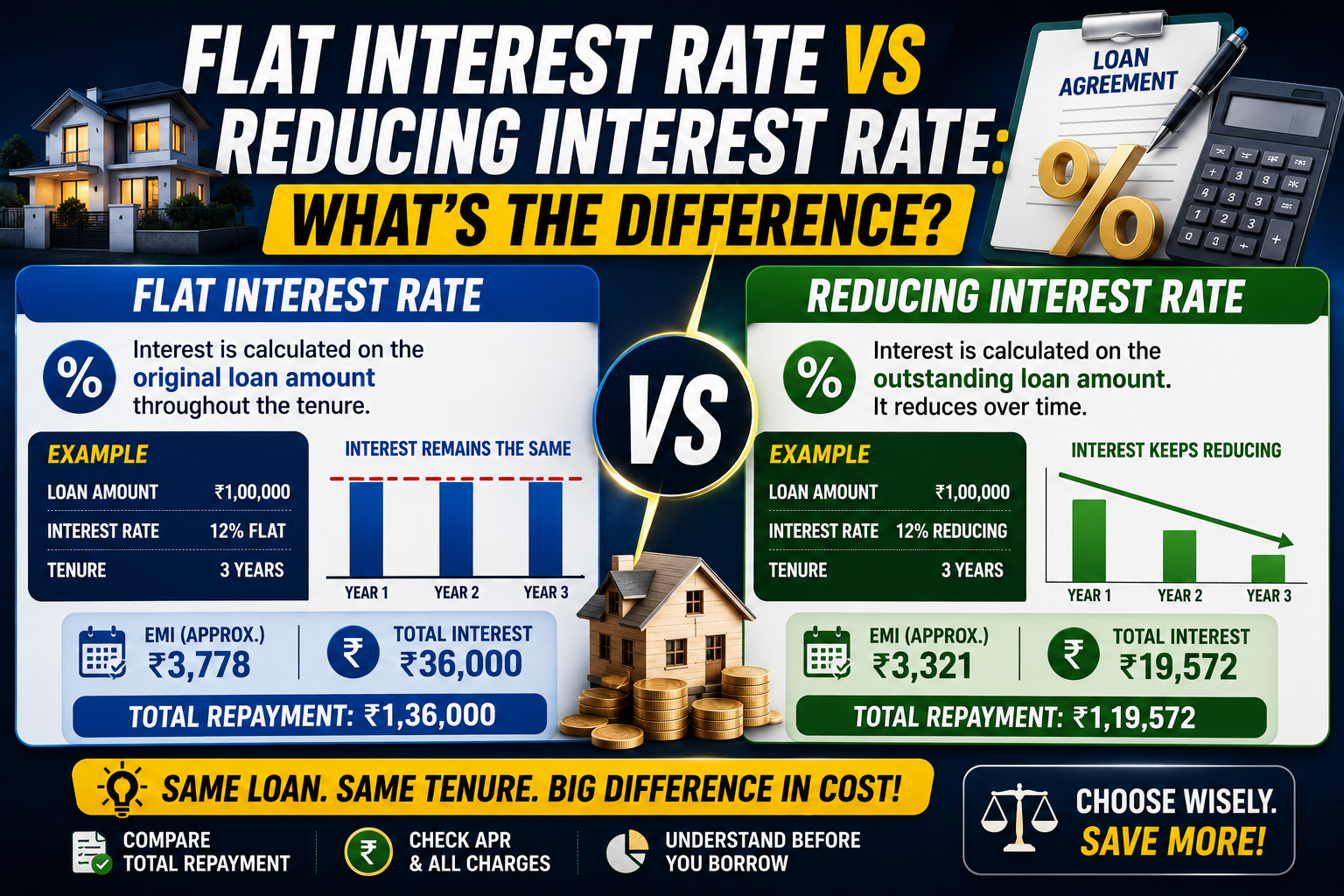
A flat interest rate is a method of calculating interest where the lender calculates interest on the original principal amount for the entire loan tenure.
The outstanding principal decreases as you make repayments, but the interest calculation continues to be based on the original principal under the flat-rate method.
Simple Example
Suppose you borrow:
Loan amount = ₹1,00,000
Flat interest rate = 12% per year
Tenure = 3 years
The annual interest is calculated as:
₹1,00,000 × 12% = ₹12,000
For three years:
₹12,000 × 3 = ₹36,000
Therefore:
Principal = ₹1,00,000
Total interest = ₹36,000
Total repayment = ₹1,36,000
If repayments are divided equally over 36 months:
₹1,36,000 ÷ 36 = approximately ₹3,778 per month
This is the basic principle behind flat-rate interest.
The important point is that the lender is calculating the interest using the original ₹1 lakh rather than recalculating interest on the declining outstanding balance.
What Is a Reducing Interest Rate?
A reducing interest rate, also called a reducing-balance or diminishing-balance rate, calculates interest on the outstanding principal.
As you repay your loan, the principal outstanding decreases.
Therefore, the amount on which interest is calculated also decreases.
Suppose you borrow:
₹1,00,000
at:
12% reducing interest
for:
3 years
Your EMI is approximately:
₹3,321
The total repayment over 36 months would be approximately:
₹1,19,572
So the total interest is approximately:
₹19,572
Compare this with the flat-rate example:
Flat-rate interest = ₹36,000
Reducing-balance interest ≈ ₹19,572
The difference is significant.
This is why simply comparing:
“12% flat”
with:
“12% reducing”
is misleading.
They are not economically equivalent rates.
Flat Interest Rate vs Reducing Interest Rate: Key Difference
The fundamental difference is the principal amount used to calculate interest.
Flat Interest Rate
Interest is calculated on the original loan amount.
Reducing Interest Rate
Interest is calculated on the outstanding principal.
As the outstanding principal falls, the interest calculation generally falls as well.
This creates a substantial difference in the total cost of the loan.
Flat Interest Rate vs Reducing Interest Rate: Example
Let’s compare the two methods using the same hypothetical loan.
Loan Amount
₹1,00,000
Tenure
3 years
Advertised Rate
12%
Flat Rate Calculation
Interest:
₹1,00,000 × 12% × 3
= ₹36,000
Total repayment:
₹1,00,000 + ₹36,000
= ₹1,36,000
Approximate monthly payment:
₹1,36,000 ÷ 36
= ₹3,778
Reducing Rate Calculation
At 12% annual interest with monthly reducing-balance calculation:
Approximate EMI:
₹3,321
Total repayment:
Approximately ₹1,19,572
Total interest:
Approximately ₹19,572
Comparison
| Feature | Flat Rate | Reducing Rate |
|---|---|---|
| Loan amount | ₹1,00,000 | ₹1,00,000 |
| Advertised rate | 12% | 12% |
| Tenure | 3 years | 3 years |
| Interest calculation | Original principal | Outstanding principal |
| Approx. EMI | ₹3,778 | ₹3,321 |
| Approx. total interest | ₹36,000 | ₹19,572 |
| Approx. total repayment | ₹1,36,000 | ₹1,19,572 |
The example demonstrates why the same advertised percentage can produce very different borrowing costs.
Why Does Reducing Interest Become Lower Over Time?
Let’s simplify the concept.
Imagine you borrow:
₹1,00,000
At the beginning, your outstanding principal is ₹1,00,000.
If the applicable monthly interest rate is 1%, interest for that month is approximately:
₹1,000
After you make a principal repayment, suppose the outstanding balance becomes:
₹98,000
Now the next month’s interest calculation is based on approximately ₹98,000 rather than ₹1,00,000.
The following month, the outstanding balance might become:
₹96,000
Interest is then calculated on approximately ₹96,000.
And so on.
This means that under a reducing-balance structure:
Outstanding principal ↓
Interest calculation ↓
This is why the interest component of an amortising loan generally declines over time while the principal component increases.
RBI’s published loan repayment examples demonstrate this structure by showing the outstanding principal, principal component, interest component and instalment separately across repayment periods.
Why Can a Flat Rate Look Cheaper?
This is where borrowers can get confused.
Imagine two lenders advertise:
Lender A
10% flat
Lender B
12% reducing
A borrower may immediately choose Lender A because:
10% < 12%
But that comparison is incomplete.
The 10% flat rate is being applied to the original principal throughout the tenure.
The 12% reducing rate is applied to the declining outstanding balance.
Therefore, the effective cost of the two loans can be very different.
This is why borrowers should compare:
Total interest + fees + other charges
rather than simply comparing the advertised percentage.
Is a Flat Rate the Same as APR?
No.
This is an important distinction.
The Annual Percentage Rate (APR) is intended to reflect the annualised cost of credit and can incorporate interest and applicable charges according to the relevant regulatory framework.
For regulated entities covered by RBI’s KFS framework, the Key Facts Statement includes the APR and a computation sheet, along with an amortisation schedule.
Therefore, if a lender tells you:
“Our loan is only 10% flat,”
don’t stop there.
Ask:
“What is the APR?”
Also ask for the:
- Total interest payable
- Processing fee
- Insurance or third-party charges
- Other applicable fees
- Total repayment amount
- Repayment schedule
These figures provide a much better picture of the actual cost.
How to Convert a Flat Rate Into an Approximate Reducing Rate
There is no single universal conversion formula that works perfectly for every loan.
The equivalent reducing rate depends on:
- Loan amount
- Tenure
- EMI frequency
- Repayment schedule
- Processing fees
- Other charges
- Exact calculation methodology
However, borrowers can use an approximate comparison.
For example, a 12% flat rate over three years in our ₹1 lakh example results in ₹36,000 of interest.
That is substantially higher than the approximately ₹19,572 interest generated by a 12% reducing-balance loan over the same period.
The approximate equivalent annual reducing rate for a given flat-rate loan must therefore be calculated based on its actual EMI and repayment schedule rather than simply saying:
“12% flat = 12% reducing.”
It isn’t.
For an accurate comparison, calculate the internal rate of return or compare the loan’s APR and amortisation schedule.
Flat Rate vs Reducing Rate: Why Tenure Matters
The difference between the two methods can become increasingly important as the loan tenure increases.
Suppose a lender charges:
10% flat
for:
5 years
Interest under a simple flat calculation would be:
10% × 5 = 50% of the original principal
So a ₹2 lakh loan could generate:
₹1 lakh interest
before considering other charges.
Under a reducing-balance structure, the borrower would be paying interest on the declining outstanding balance instead.
This means the total interest can be substantially lower.
Therefore, borrowers should be particularly cautious about long-tenure flat-rate loans.
Flat Interest Rate vs Reducing Interest Rate for Personal Loans
Personal loans are one area where borrowers may encounter different ways of presenting loan pricing.
Suppose two lenders offer:
Lender A
11% flat
Lender B
15% reducing
It would be a mistake to automatically choose the 11% loan.
You need to compare:
- EMI
- Total interest
- Processing fee
- Insurance
- Other charges
- APR
- Total repayment
- Prepayment terms
A 15% reducing-balance loan could potentially cost less than an 11% flat-rate loan depending on the loan structure.
The numbers must be calculated before deciding.
Flat Interest Rate vs Reducing Interest Rate for Vehicle Loans
Vehicle financing can also be advertised using different pricing methods.
Suppose:
Vehicle loan = ₹8 lakh
A lender advertises:
8% flat
Another offers:
11% reducing
The first offer appears cheaper.
But the actual repayment cost could tell a different story.
Before accepting either offer, ask the lender to provide:
Total amount payable over the entire tenure.
Then compare that figure.
This removes much of the confusion surrounding the advertised interest rate.
Flat Rate and EMI
One advantage of the flat-rate method is that the calculation can be relatively simple.
For a basic flat-rate structure:
Total Interest = Principal × Rate × Tenure
Then:
Total Repayment = Principal + Total Interest
And:
Periodic Payment = Total Repayment ÷ Number of Payments
However, actual loan products can include additional fees, different repayment schedules or other contractual terms.
Therefore, the simple formula is useful for understanding the concept but shouldn’t automatically be assumed to represent every lender’s exact calculation.
Reducing Rate and EMI Calculation
Reducing-balance loans typically use an amortisation formula.
For a monthly EMI:
EMI = P × r × (1+r)^n / [(1+r)^n − 1]
Where:
- P = Principal
- r = Monthly interest rate
- n = Number of monthly instalments
The EMI includes both principal and interest.
In the early stages, the interest component is generally larger.
As the outstanding principal falls, the interest component reduces and the principal component becomes larger.
This is why an amortisation schedule is useful.
Why the First EMIs Contain More Interest
Suppose you borrow:
₹5 lakh
At the beginning of the loan, you owe the entire ₹5 lakh.
Therefore, interest is calculated on a large principal balance.
After several years, you may owe only:
₹3 lakh
Now the interest calculation is based on a much smaller balance.
This doesn’t mean the lender is “charging extra interest” in the early months.
It is simply the mathematical result of calculating interest on the outstanding balance.
This is one reason borrowers who prepay early can potentially reduce future interest significantly.
Does Reducing Interest Mean the EMI Always Falls Every Month?
Not necessarily.
In a typical fixed-rate amortising loan, the EMI can remain constant while the composition changes.
For example:
Month 1
Interest: ₹5,000
Principal: ₹2,000
EMI: ₹7,000
Later:
Month 30
Interest: ₹3,000
Principal: ₹4,000
EMI: ₹7,000
The EMI stays the same, but more of it goes toward principal repayment.
The exact schedule depends on the loan’s interest rate, repayment frequency and structure.
Flat Rate vs Reducing Rate: Which Is Cheaper?
In many comparable loan scenarios, a reducing-balance loan can result in a lower total interest cost than a flat-rate loan carrying the same nominal percentage.
But don’t turn this into an absolute rule that every reducing-rate loan is cheaper.
Why?
Because the total cost also depends on:
- Interest rate
- Loan tenure
- Fees
- Insurance
- Processing charges
- Repayment frequency
- Prepayment conditions
- Other contractual costs
For example:
Reducing rate = 18%
could still be more expensive than:
Flat rate = 10%
depending on the specific loan structure.
Therefore, the correct comparison is not:
Flat vs reducing
alone.
It is:
Total cost of Loan A vs total cost of Loan B.
How to Compare Two Loans Correctly
Suppose you receive two loan offers.
Loan A
10% flat
3-year tenure
Loan B
14% reducing
3-year tenure
Don’t immediately choose Loan A.
Ask both lenders for:
- Loan amount
- Interest rate
- Interest calculation method
- EMI
- Total interest
- Processing fee
- Insurance charges
- Documentation charges
- Other fees
- Total amount payable
- APR
- Prepayment terms
- Penal charges
Then compare the total cost.
The Importance of APR
The Annual Percentage Rate is particularly useful because it can provide a broader view of the cost of credit than the headline interest rate alone.
RBI’s KFS framework requires applicable regulated entities to provide borrowers with a KFS containing the APR calculation and amortisation schedule for covered loans. It also requires applicable charges to be disclosed.
This gives borrowers a much better basis for comparing offers.
For example:
Loan A
Advertised rate: 10% flat
APR: 18%
Loan B
Advertised rate: 14% reducing
APR: 15%
Suddenly, the “cheaper” loan doesn’t look so cheap.
The exact figures above are illustrative, but the principle is extremely important.
What Is the Difference Between Interest Rate and APR?
The interest rate is the rate used to calculate interest under the loan’s pricing structure.
APR is a broader annualised measure of the cost of credit that can include applicable charges.
Therefore:
Interest rate ≠ total cost
and:
Interest rate ≠ necessarily APR
This is why borrowers should ask for the APR and repayment schedule before accepting a loan.
Can Flat-Rate Loans Be Beneficial?
Flat-rate financing isn’t automatically bad.
It can be useful in some circumstances if:
- The rate is genuinely competitive
- The tenure is short
- Fees are low
- The total repayment is attractive
- The borrower understands the calculation
- The lender provides transparent disclosures
The problem arises when borrowers compare a flat rate directly with a reducing rate without adjusting for the different calculation methods.
The issue is therefore not simply:
“Flat rate = bad.”
It is:
“Flat rate must be evaluated using the actual total cost.”
Advantages of a Flat Interest Rate
Simple Calculation
The interest calculation can be easier to understand.
Predictable Payment
The repayment amount can be straightforward when the structure uses equal instalments.
Easy Comparison Within Similar Flat-Rate Products
If all competing lenders use the same method and have similar fees, comparing total repayment can be simple.
However, this advantage disappears if you compare a flat rate directly with a reducing rate without accounting for the calculation difference.
Disadvantages of a Flat Interest Rate
Interest Is Based on Original Principal
You continue to be charged interest based on the original principal under the flat-rate method.
Can Look Cheaper Than It Really Is
A low headline percentage can create a misleading impression.
Direct Comparison With Reducing Rates Is Difficult
10% flat and 10% reducing are not equivalent.
Longer Tenures Can Increase the Cost
Because interest continues to be calculated on the original principal, total interest can become substantial.
Advantages of a Reducing Interest Rate
Interest Is Based on Outstanding Principal
As you repay principal, the interest calculation reduces.
More Economically Transparent
The relationship between outstanding debt and interest is easier to understand.
Can Reduce Total Interest
For comparable nominal rates and terms, reducing-balance calculations can produce lower total interest than flat-rate calculations.
Useful for Long-Term Borrowing
The declining principal becomes particularly important over longer repayment periods.
Disadvantages of a Reducing Interest Rate
EMI Calculation Can Be More Complex
The mathematical formula is less intuitive than simple flat-rate calculation.
Rate Changes Can Affect EMI or Tenure
If the loan is floating-rate, future rate changes can affect repayment.
Higher Advertised Rate Can Look Expensive
A reducing rate may appear higher than a flat rate even when the total cost is lower.
Which Loans Usually Use Reducing-Balance Interest?
Reducing-balance calculations are commonly associated with amortising loans such as:
- Home loans
- Many personal loans
- Vehicle loans
- Business loans
- Consumer loans
However, the exact calculation method depends on the lender and product.
Never assume the calculation method from the loan category alone.
Ask the lender directly:
“Is this interest calculated on a flat-rate basis or on a reducing-balance basis?”
How to Identify a Flat-Rate Loan
Look for phrases such as:
- Flat interest rate
- Flat rate
- Flat interest calculation
- Interest calculated on original principal
But don’t rely solely on marketing language.
Ask for the:
Amortisation schedule
and:
Total interest payable
If the lender cannot clearly explain how the interest is calculated, that’s a reason to slow down before signing.
How to Identify a Reducing-Rate Loan
Look for:
- Reducing balance
- Diminishing balance
- Monthly reducing balance
- Interest calculated on outstanding principal
Again, confirm the actual method in the loan documentation.
For regulated lenders, borrowers should receive clear information about the loan’s pricing and applicable charges through the required disclosures. RBI’s KFS framework is designed to help borrowers make informed comparisons.
What Should You Ask the Lender?
Before taking a loan, ask these questions:
1. What is the interest calculation method?
Flat or reducing?
2. What is the actual APR?
Don’t settle for only the advertised rate.
3. What is the total interest payable?
Ask for the exact amount.
4. What is the total repayment?
This is one of the most useful comparison figures.
5. What fees are included?
Check processing, insurance, documentation and other charges.
6. Is the interest rate fixed or floating?
A reducing rate can still be fixed or floating.
7. What happens if I prepay?
Check the applicable rules and charges.
8. What happens if I miss an EMI?
Ask about penal charges and payment-return charges.
9. Can I get the amortisation schedule?
You should understand how each payment is allocated between principal and interest.
Flat Interest Rate vs Reducing Interest Rate: Common Mistakes
Mistake 1: Choosing the Lowest Percentage
A 9% flat rate isn’t automatically cheaper than a 12% reducing rate.
Mistake 2: Ignoring APR
The headline rate doesn’t tell you the complete cost.
Mistake 3: Ignoring Processing Fees
A low interest rate can be offset by high fees.
Mistake 4: Comparing EMI Only
A lower EMI can result from a longer tenure.
Mistake 5: Ignoring Total Repayment
Always calculate how much money leaves your pocket in total.
Mistake 6: Not Checking the Calculation Method
Ask whether the lender uses flat or reducing balance.
Mistake 7: Ignoring the Amortisation Schedule
The schedule shows how much of each payment goes toward principal and interest.
Flat Interest Rate vs Reducing Interest Rate: Which Is Better?
For most borrowers comparing otherwise similar loan offers, a reducing-balance structure is generally easier to evaluate economically because interest is calculated on the outstanding principal.
However, saying that reducing is always better would be too simplistic.
The actual answer depends on the complete loan package.
A flat-rate loan can potentially be competitive if its total repayment, fees and other terms are genuinely better.
Therefore, the right decision-making process is:
Don’t ask: “Which interest rate is lower?”
Ask:
“Which loan requires me to repay less money overall?”
That’s the number that matters.
Frequently Asked Questions
What is a flat interest rate?
A flat interest rate calculates interest based on the original principal amount for the agreed period, even as the borrower repays the principal.
What is a reducing interest rate?
A reducing interest rate calculates interest based on the outstanding principal. As the principal decreases, the amount used to calculate interest generally decreases.
Is 10% flat better than 12% reducing?
Not necessarily. The two percentages are calculated differently. You must compare total interest, APR, fees and total repayment.
Is reducing interest better than flat interest?
A reducing-balance method can be cheaper for comparable nominal rates and terms because interest is calculated on the declining principal. But the complete loan cost must be compared.
How do I calculate flat-rate interest?
A basic flat-rate calculation is:
Interest = Principal × Rate × Tenure
For example, ₹1 lakh at 10% for 3 years produces ₹30,000 of interest under a simple flat-rate calculation.
How is reducing interest calculated?
Interest is calculated periodically on the outstanding principal. As principal is repaid, the interest component generally declines.
Does a flat-rate loan have an EMI?
Yes. The total principal and flat-rate interest can be divided across the scheduled instalments, depending on the loan structure.
Is APR more important than the advertised interest rate?
For comparing the overall cost of covered loans, APR can be more informative because it incorporates interest and applicable charges under the relevant framework. RBI’s KFS framework requires APR disclosure for applicable loans.
Can I convert a flat-rate loan into a reducing-rate loan?
Usually, this depends on the lender and product. You may instead need to refinance or take a different loan. Check the lender’s terms before assuming conversion is available.
Where can I find the interest calculation method?
Check the sanction letter, loan agreement, KFS and repayment/amortisation schedule. If it isn’t clear, ask the lender before signing.
Final Takeaway
Understanding Flat Interest Rate vs Reducing Interest Rate can save borrowers from making a costly mistake.
The biggest misconception is that:
10% flat is automatically cheaper than 12% reducing.
It isn’t.
A flat-rate loan calculates interest on the original principal throughout the agreed tenure.
A reducing-balance loan calculates interest on the outstanding principal, which declines as you repay the loan.
Our ₹1 lakh, three-year example demonstrates the difference:
12% flat → ₹36,000 total interest
versus approximately:
12% reducing → ₹19,572 total interest
The exact numbers will vary depending on the loan structure, repayment frequency and lender terms, but the principle remains the same.
Therefore, never compare loan offers based only on the advertised interest percentage.
Instead, compare:
Interest calculation method
APR
Total interest
EMI
Processing fees
Other charges
Total repayment
Prepayment terms
Penal charges
Loan tenure
For applicable regulated loans, RBI’s Key Facts Statement framework is particularly useful because it requires relevant lenders to provide standardized information including APR and an amortisation schedule.
The most important question to ask a lender is:
“How much will I actually repay from start to finish?”
Once you know that number, the difference between a seemingly cheap flat-rate loan and a potentially more economical reducing-rate loan becomes much easier to understand.
Useful Outbound Resources
- Reserve Bank of India – Key Facts Statement and APR Framework — RBI information on standardized loan disclosures, APR and borrower-facing cost information.
- Reserve Bank of India – Master Directions — RBI regulatory material containing examples of repayment schedules and reducing-balance calculations.
- RBI – Handbook on Regulations at a Glance — Overview of RBI requirements around loan pricing, charges and transparent disclosures.
- RBI – EMI-Based Personal Loans and Rate Reset FAQs — RBI information on interest-rate resets, EMI/tenure changes and borrower disclosures.
What is Penal Interest on a loan? Learn how penal charges work, when lenders can charge them, RBI rules, late EMI penalties, calculation, and how to avoid extra loan costs.
