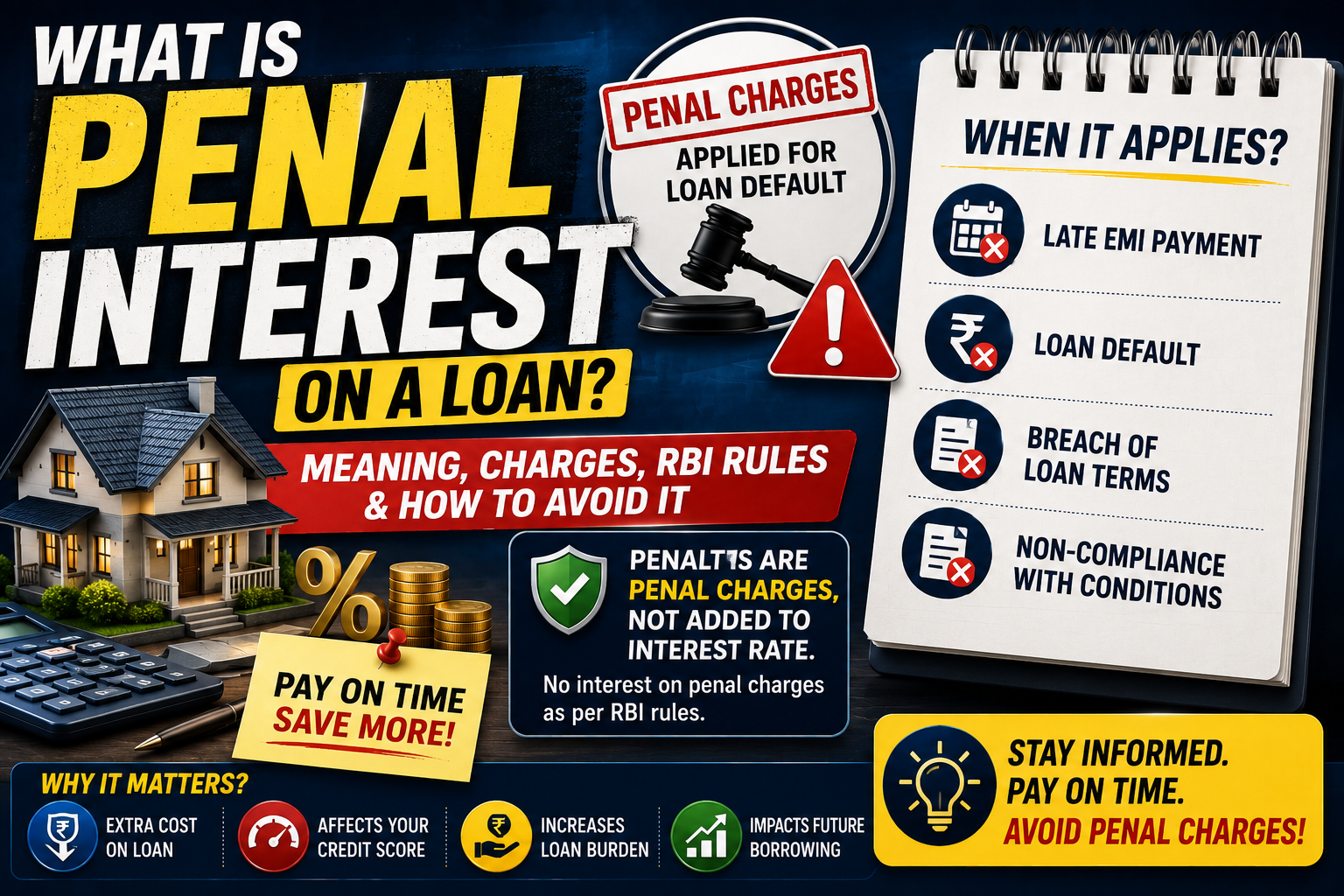
What is Penal Interest on a loan? Learn how penal charges work, when lenders can charge them, RBI rules, late EMI penalties, calculation, and how to avoid extra loan costs.
Table of Contents
Taking a loan creates a financial obligation that continues until the borrowed amount is fully repaid. One of the most important responsibilities of a borrower is making EMI or other scheduled payments on time.
But what happens when you miss a payment?
Apart from the regular interest applicable to the loan, you may face an additional financial consequence for the default or breach of the loan terms.
This additional cost is commonly referred to by borrowers as Penal Interest.
However, there is an important regulatory distinction that borrowers should understand.
Under the Reserve Bank of India’s current framework for regulated entities, penalties imposed for non-compliance with material terms and conditions of a loan are generally required to be treated as penal charges, rather than being added to the interest rate as “penal interest.” RBI also says that such penal charges should not be capitalised, meaning the lender should not calculate further interest on the penal charges themselves.
So, although people commonly search for the term Penal Interest, the current regulatory concept is better understood as penal charges on loans.
Let’s understand what this means, when it can apply, how it differs from normal interest, and what borrowers should do if they are charged a penalty.
What Is Penal Interest?
In everyday lending terminology, Penal Interest refers to an additional amount charged when a borrower fails to comply with certain loan terms, particularly repayment obligations.
For example, suppose your monthly EMI is due on the 5th of every month.
If you fail to make the required payment on time, the lender may impose a permitted penalty according to the loan agreement and its applicable policy.
Historically, banks could structure such penalties as an additional interest rate over the normal rate.
However, RBI changed this framework.
Under the RBI’s Fair Lending Practice – Penal Charges in Loan Accounts directions, penalties for non-compliance with material terms and conditions are to be treated as penal charges and not as an additional component added to the interest rate.
The RBI’s stated objective is that these charges should promote credit discipline and should not be used primarily as a revenue-enhancement tool.
Penal Interest vs Penal Charges: What’s the Difference?
This distinction is extremely important for borrowers.
Penal Interest
Traditionally, a lender could charge an additional rate over the contracted interest rate.
For example:
Normal interest rate = 10%
Penal interest = additional 2%
The effective rate could become 12% during the applicable default period.
Penal Charges
Under the RBI framework applicable to regulated entities covered by the directions, the penalty should instead be structured as a separate penal charge.
It should not be added to the contracted interest rate.
There should also be no further interest calculated on the penal charge itself.
Therefore, while consumers may continue using the phrase Penal Interest, the regulatory treatment has changed.
Why Do Lenders Charge Penal Charges?
The purpose is primarily to encourage borrowers to comply with the terms of the loan agreement.
For example, a lender expects:
- EMI payments on time
- Required documents to be submitted
- Financial information to be provided where contractually required
- Other material conditions to be followed
If the borrower doesn’t comply with a material condition, a permitted penal charge may apply.
RBI specifically states that the purpose of penal interest/charges is essentially to promote credit discipline and that such charges are not meant to be used as a revenue-enhancement tool.
This distinction matters.
A penalty should be connected to the borrower’s non-compliance rather than functioning as another source of excessive interest income.
When Can Penal Charges Apply?
The exact circumstances depend on the loan agreement and the lender’s Board-approved policy.
RBI’s framework refers to non-compliance with material terms and conditions of the loan contract. What constitutes a material term can vary by loan category and lender.
Examples may include:
- Failure to repay an EMI on time
- Default in repayment
- Failure to submit required financial information
- Breach of another material contractual condition
For an ordinary borrower, the most common situation is likely to be:
Late or missed repayment.
However, don’t assume every small administrative mistake automatically results in a penal charge.
The lender’s policy and loan agreement matter.
How Does Penal Interest Work When You Miss an EMI?
Consider a hypothetical example.
Your monthly EMI is:
₹20,000
You fail to pay the EMI by the due date.
Your lender’s applicable policy may provide for a penal charge for the default.
The exact amount depends on the lender’s terms and applicable regulatory requirements.
The important distinction is:
Regular interest on the loan continues according to the loan contract.
A separate penal charge may apply because of the default.
RBI has clarified that interest can continue to be charged at the contracted rate on unpaid interest or unpaid EMI according to normal interest-compounding procedures. That is different from charging an additional penal rate of interest.
Is Penal Interest the Same as Regular Loan Interest?
No.
This is one of the most common misconceptions.
Regular Interest
This is the cost of borrowing money.
For example:
Loan interest rate = 9% per year
You pay interest according to the loan’s repayment schedule.
Penal Charge
This is an additional charge arising from specified non-compliance with the loan agreement.
For example:
Late EMI → applicable penal charge
Therefore:
Regular interest = cost of borrowing
Penal charge = consequence of specified non-compliance
They serve different purposes.
Can Penal Charges Be Added to the Principal?
Under RBI’s framework for regulated entities, penal charges should not be capitalised.
This means the lender should not calculate further interest on the penal charge itself.
For example, suppose:
Outstanding loan = ₹1,00,000
Penal charge = ₹500
The lender should not treat that ₹500 penal charge as new principal on which another layer of interest is calculated.
This is an important borrower protection.
However, don’t confuse this with normal interest that may continue to accrue on the unpaid loan amount under the contracted terms.
Can a Lender Charge Penal Interest on Unpaid EMI?
A default in repayment can be treated as non-compliance with the material repayment terms of a loan contract.
RBI’s FAQ clarifies that where a borrower defaults in repayment, any penalty charged should be levied in the form of penal charges, rather than penal interest. Such charges should be reasonable and applied to the amount under default in a non-discriminatory manner according to the lender’s Board-approved policy.
This means borrowers should look carefully at the lender’s:
- Loan agreement
- KFS, where applicable
- Schedule of charges
- Penal-charge policy
Are Penal Charges Allowed on All Loans?
The RBI directions apply to specified regulated entities, including banks, NBFCs, HFCs, certain cooperative banks and All India Financial Institutions, subject to the scope and exclusions of the applicable directions.
There are also specific exclusions and separate regulatory frameworks for certain types of credit.
For example, RBI’s FAQ notes that the penal-charge instructions do not apply to products covered by the RBI’s framework on External Commercial Borrowings, Trade Credits and Structured Obligations, and separate rules can apply.
Therefore, the safest approach is:
Check which lender and loan product you are dealing with before assuming a particular RBI rule applies.
RBI Rules on Penal Charges
The RBI introduced its revised framework to improve fairness and transparency in loan-related penalties.
Some important principles include:
1. Penal Charges Instead of Penal Interest
Penalties for non-compliance with material loan terms should be treated as penal charges rather than being added to the interest rate.
2. No Capitalisation
No further interest should be calculated on the penal charges themselves.
3. Reasonable Amount
Penal charges should be reasonable and proportionate to the non-compliance.
4. No Discrimination Within a Product Category
Charges should not be discriminatory within the same loan/product category.
5. Clear Disclosure
The quantum and reason for penal charges should be clearly disclosed in the loan agreement and applicable KFS/most-important-terms documents, and displayed through the lender’s website under relevant interest/service-charge information.
6. Communication After Default
When reminders are sent regarding non-compliance, the applicable penal charges should also be communicated.
Can Banks Charge Penal Interest on a Loan?
Borrowers often ask this because older financial content still uses the phrase penal interest.
The current RBI framework says that for covered regulated entities, a penalty for non-compliance with material terms should be treated as a penal charge, not as an additional rate of interest.
Therefore, an article saying:
“Banks can simply add 2% or 3% penal interest to your loan rate”
is potentially outdated or oversimplified.
The applicable penalty should follow the lender’s Board-approved policy and RBI requirements.
Can NBFCs Charge Penal Interest?
NBFCs are also covered by the RBI’s penal-charge framework, subject to the scope of the directions.
RBI specifically included NBFCs, including Housing Finance Companies, within the 2023 directions.
This is particularly relevant for borrowers taking:
- Personal loans
- Home loans
- Vehicle loans
- Consumer loans
- Business loans
from NBFCs.
For applicable NBFC loans, the penal charge and the reason for the charge should be transparently communicated.
RBI’s directions also specifically require applicable NBFCs to mention penalties for late repayment prominently in the loan agreement.
What Is the Difference Between Late Payment Fee and Penal Charge?
The terminology used by lenders can vary.
You might see terms such as:
- Penal charges
- Late-payment charges
- Default charges
- Bounce charges
- Return charges
These are not necessarily identical.
A penal charge relates to the penalty for non-compliance with material terms.
A payment-return or bounce charge may relate to a failed payment transaction, such as a failed auto-debit.
Therefore, don’t assume:
“Every fee after a missed EMI is the same thing.”
Check the lender’s fee schedule and loan agreement.
Is Penal Charge the Same as a Loan Bounce Charge?
Not necessarily.
Suppose your EMI is scheduled through an automatic bank debit.
The debit fails because there isn’t enough balance.
Two separate consequences could potentially arise:
- A charge connected with the failed payment/return
- A penal charge related to the repayment default
Whether both apply depends on the lender’s terms and applicable rules.
If you see multiple charges after one missed EMI, ask the lender for a written explanation of each charge.
Example of Penal Charges
Suppose you have:
Personal loan outstanding = ₹3,00,000
EMI = ₹10,000
You miss an EMI.
Assume, purely for illustration, that the lender’s disclosed policy provides for a:
₹500 penal charge
The borrower would need to deal with:
- The overdue EMI
- Normal interest applicable under the loan terms
- The ₹500 penal charge, if validly imposed
The ₹500 should not itself become a new interest-bearing principal amount under the RBI framework applicable to the lender.
This example is only illustrative.
Actual charges vary by lender and loan product.
What If You Miss Multiple EMIs?
This is where a small payment problem can become a much larger financial problem.
Suppose you miss:
1 EMI
Then another.
Then another.
The problem is no longer simply the penal charge.
You could also face:
- Growing overdue amounts
- Continuing contractual interest
- Collection activity
- Credit-report consequences
- Potential classification issues if the account remains overdue
- Greater difficulty managing future borrowing
The penal charge is therefore only one part of the financial consequences of default.
The bigger concern is getting the account back into regular repayment.
Does Penal Interest Affect Your CIBIL Score?
The penal charge itself is not the same thing as a credit score.
However, the underlying missed or delayed repayment can have consequences for your credit history.
Credit reporting depends on the lender’s reporting obligations and the applicable credit-information framework.
Therefore, borrowers should not think:
“I can pay the penalty later, so missing the EMI doesn’t matter.”
Missing an EMI can have consequences beyond the penalty amount.
The best protection is simple:
Pay your EMI on time.
What Happens If the Default Is Due to a Genuine Problem?
Sometimes borrowers miss payments because of genuine financial difficulties.
For example:
- Salary delay
- Temporary business slowdown
- Unexpected expense
- Banking problem
- Medical emergency
- Technical payment failure
If you realize you cannot make the payment, don’t simply ignore the lender.
Contact the lender as soon as possible.
Ask:
- What amount is currently overdue?
- What charges have been applied?
- Can I regularise the account?
- What payment options are available?
- Is any restructuring or other relief available under the lender’s policy?
The earlier you communicate, the more options you may have.
Can You Dispute a Penal Charge?
Yes, if you believe a charge has been incorrectly imposed or is inconsistent with the applicable terms.
Start by checking:
1. Loan Agreement
Find the relevant clause.
2. KFS or Most Important Terms
Check whether the charge was disclosed.
3. Lender’s Website
Look for the applicable schedule of interest rates and service charges.
4. Loan Statement
Confirm when and why the charge was applied.
5. Customer Support
Ask for a written explanation.
If the issue remains unresolved, use the lender’s formal grievance-redressal process.
For regulated entities, RBI’s framework requires transparency around penal charges and their communication to borrowers.
What If the Lender Charges Penal Interest on Penal Charges?
This is a particularly important point.
For regulated entities covered by RBI’s framework, penal charges should not be capitalised, meaning no further interest should be computed on the penal charges themselves.
If you believe a lender is calculating additional interest on the penal charge itself, ask for a detailed statement showing:
- Principal outstanding
- Regular interest
- Overdue interest, if applicable
- Penal charge
- Other fees
- Calculation method
Then compare it with the loan agreement and applicable RBI requirements.
Don’t rely on a verbal explanation alone.
How Can You Avoid Penal Charges?
The easiest way is obvious:
Pay your EMIs on time.
But there are practical steps that can reduce the risk.
1. Keep Sufficient Bank Balance
If your EMI is automatically debited, maintain enough funds before the due date.
2. Set a Reminder
Create a reminder several days before your EMI date.
3. Use Auto-Debit Carefully
Make sure your mandate is active and your bank account has sufficient funds.
4. Monitor Your Loan Account
Check whether payments have actually been credited.
5. Update Your Contact Details
Make sure your lender can reach you.
6. Read the Loan Agreement
Know exactly what happens if you miss a payment.
7. Maintain an Emergency Fund
Unexpected expenses can otherwise cause EMI defaults.
Don’t Confuse Penal Charges With Normal Interest
This is worth repeating.
Imagine:
Loan principal = ₹5 lakh
Normal interest = 10%
You miss an EMI.
The lender may continue charging normal interest according to the loan contract on the outstanding amount.
A separate penal charge may apply for the default.
The RBI framework does not mean that regular interest stops simply because penal charges are regulated. RBI’s FAQ specifically explains that normal procedures for compounding interest in the loan account continue, including interest on unpaid interest at the contracted rate where applicable.
Therefore:
No penal interest ≠ no interest after default.
That distinction is critical.
Are Penal Charges Always a Fixed Amount?
Not necessarily.
The structure can vary according to the lender’s Board-approved policy and loan product.
A lender may use a fixed amount or another reasonable structure, provided it complies with applicable regulatory requirements.
The important requirement is that the charge should be:
- Reasonable
- Proportionate
- Transparent
- Properly disclosed
- Applied consistently within the relevant product category
RBI specifically requires the quantum of penal charges to be reasonable and commensurate with the non-compliance.
What Should You Check Before Taking a Loan?
Don’t wait until you miss an EMI.
Before accepting a loan, check:
Interest Rate
What is the regular borrowing rate?
EMI
What is your monthly payment?
Due Date
When must you pay?
Penal Charges
What happens if you miss the due date?
Payment Return Charges
What happens if an auto-debit fails?
Prepayment
Can you repay early?
Other Fees
What other charges can apply?
For digital and other covered loans, check the Key Facts Statement (KFS) and loan agreement.
Understanding these terms before borrowing is much easier than disputing unexpected charges later.
Penal Interest and the Key Facts Statement
The Key Facts Statement is particularly important for many retail and other covered loans.
It provides borrowers with standardized information about the loan, including applicable charges.
RBI’s framework requires relevant charges to be clearly disclosed, and the penal-charge directions specifically require the quantum and reason for penal charges to be disclosed in the loan agreement and applicable KFS/most-important-terms documentation.
So before accepting a loan:
Don’t just check the EMI.
Look for:
Regular interest + APR + processing fee + penal charges + other applicable fees.
What If You Are Charged a Very High Penal Amount?
Don’t immediately assume that any penalty is illegal.
First determine:
- What caused the charge?
- What does your loan agreement say?
- Was the charge disclosed?
- Is the lender regulated by RBI?
- Is the charge reasonable and proportionate?
- Is the lender calculating additional interest on the penal charge?
- Does the charge comply with the lender’s Board-approved policy?
If something appears inconsistent, raise a formal complaint.
RBI’s directions specifically emphasize reasonableness, transparency and non-discriminatory application of penal charges.
Penal Interest on Home Loans
Home-loan borrowers can also face consequences for repayment defaults.
For example, if your EMI is:
₹35,000
and you miss the payment, the lender may impose applicable charges according to its terms.
However, home-loan borrowers should distinguish between:
- Normal interest
- Penal charges
- Payment-return charges
- Prepayment/foreclosure charges
These are separate concepts.
Also, don’t confuse penal charges for late payment with prepayment charges.
Prepayment charges relate to repaying a loan early.
Penal charges relate to non-compliance or default.
Penal Interest on Personal Loans
Personal loans are generally unsecured, so lenders pay close attention to repayment behavior.
If you miss an EMI, the lender may apply applicable penal charges according to its policy.
Because personal loans can have relatively short tenures and higher interest rates than some secured loans, repeated defaults can quickly become financially stressful.
If you’re struggling to pay a personal-loan EMI, contact the lender early rather than allowing several instalments to become overdue.
Penal Interest on Digital Loans
Digital lending has made borrowing easier, but it has also increased the importance of transparent fee disclosures.
For regulated digital lending, borrowers should be able to identify:
- Actual lender
- Loan amount
- Interest rate
- APR
- EMI
- Penal charges
- Other fees
- Repayment schedule
- Grievance mechanism
If a digital loan app suddenly demands a penalty through a personal UPI account or an unrelated bank account, do not pay automatically.
Verify the payment request with the actual regulated lender.
Common Myths About Penal Interest
Myth 1: Penal Interest Is Just Extra Interest
Not necessarily.
Under the current RBI framework for covered regulated entities, the penalty should generally be treated as a separate penal charge rather than an additional rate of interest.
Myth 2: Lenders Can Charge Any Penalty They Want
No.
RBI requires applicable penal charges to be reasonable and proportionate to the non-compliance.
Myth 3: Penal Charges Can Keep Accumulating Interest
For covered regulated entities, penal charges cannot be capitalised, meaning further interest should not be calculated on the penal charges themselves.
Myth 4: Missing One EMI Doesn’t Matter
It can matter.
You may face charges and potential credit-report consequences.
Myth 5: Penal Charges Replace Normal Interest
No.
Normal contractual interest can continue to apply according to the loan terms.
Frequently Asked Questions
What is Penal Interest on a loan?
Penal Interest traditionally referred to an additional interest amount charged when a borrower defaulted or violated loan terms. Under the current RBI framework for covered regulated entities, such penalties are generally required to be treated as penal charges, not as an additional interest rate.
Why is Penal Interest charged?
A lender may impose a penal charge when a borrower fails to comply with material terms and conditions of the loan, including repayment obligations.
Can banks charge Penal Interest?
For loans covered by RBI’s current penal-charge framework, penalties for non-compliance should be levied as penal charges rather than as an additional rate of interest.
Can Penal Charges be capitalised?
No. Under the RBI framework applicable to covered regulated entities, penal charges should not be capitalised, meaning no further interest should be calculated on those charges.
Does normal interest continue after an EMI default?
Yes. RBI’s FAQ clarifies that the normal contracted interest mechanism can continue to apply to unpaid amounts; this is separate from the penal-charge regime.
Are Penal Charges disclosed in the loan agreement?
For covered regulated entities, the quantum and reason for penal charges must be clearly disclosed in the loan agreement and applicable KFS/most-important-terms documentation.
Can I dispute a Penal Charge?
Yes. If you believe a charge is incorrect or inconsistent with the loan terms or applicable RBI requirements, ask the lender for a written explanation and use its grievance-redressal process if necessary.
How can I avoid Penal Charges?
Pay your EMI on time, maintain sufficient funds for automatic payments, monitor your loan account and contact the lender early if you anticipate difficulty making a payment.
Final Takeaway
Penal Interest is a term that many borrowers use for the additional cost associated with a loan default or breach of loan terms.
But India’s regulatory framework has evolved.
For regulated entities covered by the RBI’s Fair Lending Practice – Penal Charges in Loan Accounts directions, penalties for non-compliance with material loan terms should generally be treated as penal charges, rather than as an additional interest rate. These charges should be reasonable, proportionate and clearly disclosed. They also cannot be capitalised, meaning the lender should not calculate further interest on the penal charges themselves.
The most important distinction for borrowers is:
Regular interest is the cost of borrowing money.
Penal charges are a consequence of specified non-compliance with the loan agreement.
And these two should not be confused.
If you miss an EMI, don’t simply focus on the penalty amount. The bigger concern is getting your account back into regular repayment.
If you notice an unexpected charge, check:
Loan Agreement → KFS → Fee Schedule → Loan Statement → Lender’s Explanation
If the charge appears unreasonable, undisclosed or inconsistent with the applicable rules, raise the issue formally with the lender.
Ultimately, the best way to avoid Penal Interest or penal charges is straightforward:
Pay your EMIs on time, understand your loan terms before borrowing, keep enough funds available for scheduled payments, and contact your lender early if you are facing repayment difficulties.
A missed EMI can cost more than the immediate penalty. It can create a chain of overdue payments, additional financial stress and potential credit-history consequences.
So don’t treat the penalty as the main problem.
The real goal should be avoiding the default in the first place.
Useful Outbound Resources
- Reserve Bank of India – FAQs on Fair Lending Practice: Penal Charges in Loan Accounts — RBI’s official FAQ explaining how penal charges work, including treatment of defaults and non-capitalisation.
- Reserve Bank of India – Fair Lending Practice: Penal Charges in Loan Accounts — RBI’s 2023 framework covering penal charges, disclosure, reasonableness and treatment of default-related penalties.
- Reserve Bank of India – Key Facts Statement Framework — RBI information on standardized loan disclosures and borrower-facing cost information.
- Reserve Bank of India – Financial Education Resources — RBI’s consumer-focused financial information and FAQs on loans and banking.
Fixed vs Floating Home Loan explained in detail. Compare interest-rate stability, EMI changes, prepayment, risks, savings and RBI rules to choose the right home loan.
