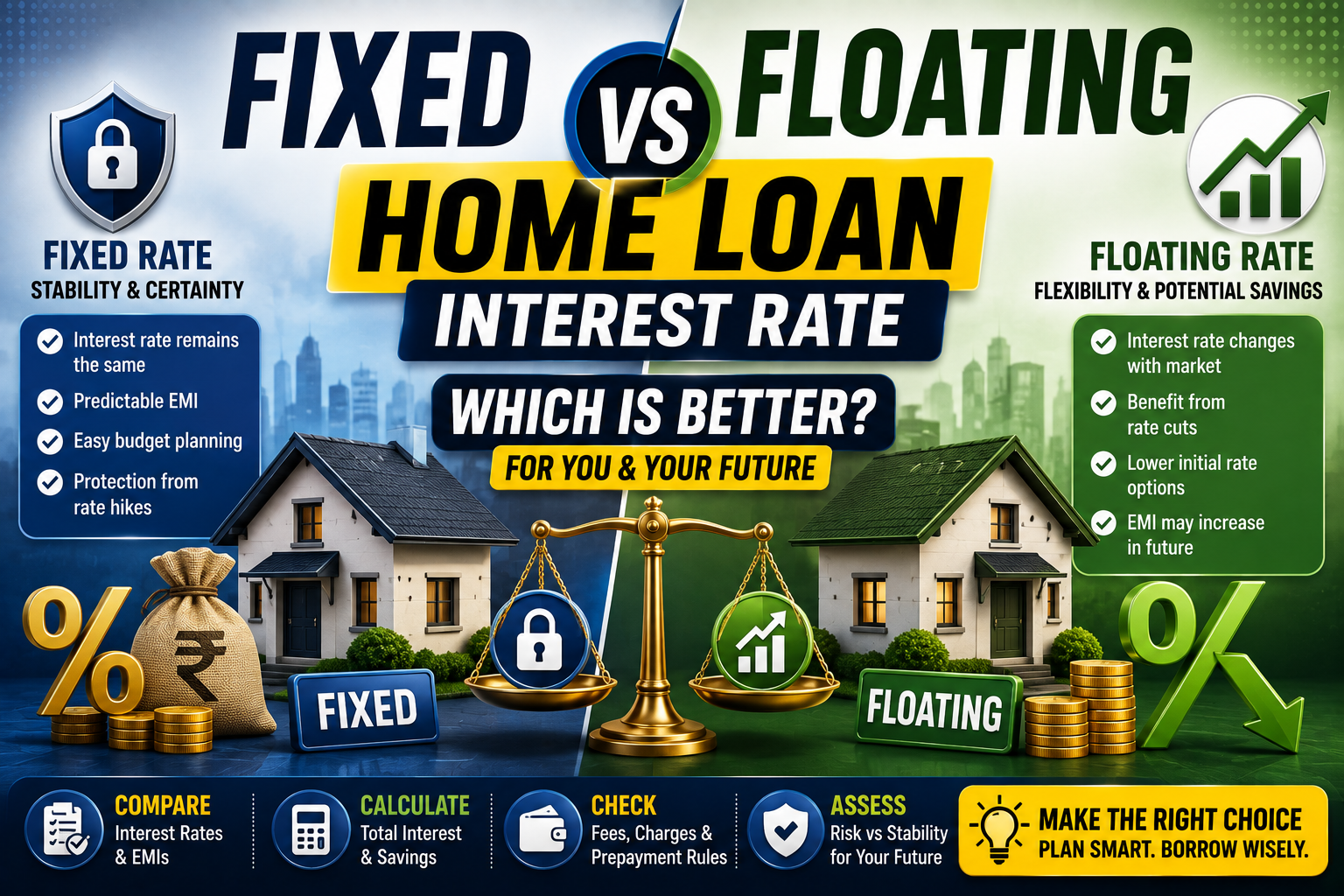
Fixed vs Floating Home Loan explained in detail. Compare interest-rate stability, EMI changes, prepayment, risks, savings and RBI rules to choose the right home loan.
Table of Contents
Choosing the right home loan is not only about finding the lowest advertised interest rate.
One of the most important decisions you will make is whether to choose a fixed interest rate or a floating interest rate.
This decision can affect your EMI, total interest cost, financial planning and ability to benefit when market interest rates change.
The debate around Fixed vs Floating Home Loan is often presented too simply:
Fixed = safe
Floating = risky
But the reality is more complicated.
A fixed-rate home loan provides greater certainty because the interest rate is fixed for the agreed period. A floating-rate home loan can move up or down based on the applicable benchmark and the lender’s spread, meaning your EMI, tenure or both may change when rates reset.
The Reserve Bank of India (RBI) allows banks to offer loans on fixed or floating interest rates, subject to the applicable regulatory framework. RBI also advises home-loan borrowers to understand the benchmark, reset mechanism and terms before choosing a floating-rate loan.
So which one should you choose?
The answer depends on your income stability, risk tolerance, expected interest-rate environment, loan tenure and ability to handle a higher EMI.
Let’s compare both options in detail.
What Is a Fixed-Rate Home Loan?
A fixed-rate home loan is a loan where the interest rate remains fixed for the period specified in the loan agreement.
With a pure fixed-rate loan, the interest rate remains unchanged throughout the agreed loan tenure.
For example:
Loan amount: ₹50 lakh
Interest rate: 8.5% fixed
Tenure: 20 years
If the loan is genuinely fixed for the entire tenure, changes in market interest rates generally won’t change your contracted interest rate.
This gives you greater predictability.
However, borrowers should be careful about the word “fixed.”
Some lenders offer loans where the interest rate is fixed only for an initial period and then changes to a floating rate.
RBI specifically advises borrowers to check the reset clause where the rate is fixed only for part of the loan tenure.
Therefore, always ask:
“Is this rate fixed for the entire tenure or only for a specific period?”
What Is a Floating-Rate Home Loan?
A floating-rate home loan has an interest rate that can change over time based on the applicable benchmark and the lender’s spread or margin.
For bank retail loans, floating rates are generally linked to an external benchmark under the applicable RBI framework. RBI’s current regulatory handbook notes that banks are required to link floating-rate loans to retail borrowers to external benchmark lending rates, with specified benchmarks including the RBI policy repo rate and certain government Treasury Bill yields published by FBIL.
For example, imagine your loan is priced at:
Benchmark + lender spread
If the benchmark changes, the interest rate on your loan may also change, subject to the loan’s terms and reset mechanism.
That can affect your:
- EMI
- Loan tenure
- Total interest payable
or a combination of these.
This is the fundamental difference between Fixed vs Floating Home Loan.
Fixed vs Floating Home Loan: Quick Comparison
| Feature | Fixed-Rate Home Loan | Floating-Rate Home Loan |
|---|---|---|
| Interest rate | Fixed for agreed period | Can change |
| EMI predictability | High | Lower |
| Benefit from rate cuts | Usually limited | Generally benefits |
| Risk from rate increases | Lower | Higher |
| Budget planning | Easier | Requires flexibility |
| Long-term certainty | Higher | Lower |
| Potential savings during falling rates | Lower | Higher |
| Potential cost during rising rates | More predictable | Can increase |
| Benchmark impact | Generally limited during fixed period | Important |
| Best suited for | Borrowers prioritising certainty | Borrowers comfortable with rate changes |
But this table alone shouldn’t determine your decision.
The actual loan agreement matters.
How Does a Floating Interest Rate Affect Your EMI?
Suppose you take:
Home loan = ₹50 lakh
Tenure = 20 years
Your initial floating interest rate is:
8.5%
Later, the applicable benchmark rises and your loan rate increases to:
9.5%
The lender may adjust the EMI, the remaining tenure, or both according to the loan agreement and applicable rules.
This can increase your overall borrowing cost.
RBI’s framework for EMI-based floating-rate loans requires regulated entities to communicate the possible impact of benchmark changes and provide borrowers with applicable options when rates reset.
This is important because a floating-rate loan isn’t simply:
“EMI changes every month.”
The actual reset mechanism depends on the lender and loan contract.
What Happens When Interest Rates Fall?
This is where floating-rate loans can become attractive.
Suppose your initial rate is:
8.5%
and the applicable benchmark falls.
Your loan rate may decline according to the lender’s pricing formula.
This can potentially result in:
- Lower EMI
- Shorter tenure
- Lower total interest
- A combination of these benefits
However, borrowers should not assume that every market-rate cut will immediately produce an identical reduction in their home-loan rate.
The applicable benchmark, spread, reset frequency and contractual terms matter.
RBI advises borrowers to understand what index their floating-rate loan is linked to, how frequently the index is updated and whether the spread or margin is fixed or variable.
What Happens When Interest Rates Rise?
The opposite can happen.
Suppose:
Initial rate = 8.5%
Later:
New rate = 9.5%
Your repayment burden can increase.
Depending on the loan’s structure, the lender may:
- Increase EMI
- Extend the tenure
- Use a combination of both
RBI’s framework for floating-rate EMI-based loans requires lenders to communicate the impact of rate resets and provide borrowers with applicable choices regarding EMI, tenure and prepayment.
This is why borrowers choosing floating rates need some financial headroom.
Fixed vs Floating Home Loan: Which Has Lower Interest?
There is no permanent winner.
The answer depends on how interest rates move during your loan tenure.
Imagine:
Fixed rate
8.75%
Floating rate
8.25% initially
The floating loan starts cheaper.
If rates remain stable or decline, the floating loan could potentially save money.
But if rates rise significantly, the floating loan could eventually become more expensive.
A fixed-rate borrower pays for certainty.
A floating-rate borrower accepts uncertainty in exchange for the possibility of benefiting from falling rates.
Fixed Rate Gives You Certainty
One of the biggest advantages of a fixed-rate home loan is predictability.
Suppose your monthly EMI is:
₹43,000
and your rate is genuinely fixed for the applicable period.
You can build your monthly budget around that figure without worrying about benchmark-driven increases during that fixed period.
This can be particularly valuable for:
- First-time homebuyers
- Households with tight monthly budgets
- Borrowers with limited emergency savings
- People whose income is relatively stable but not highly flexible
- Borrowers who dislike financial uncertainty
The value of certainty should not be underestimated.
Floating Rate Gives You Flexibility With Falling Rates
Floating rates can be advantageous when interest rates decline.
For example, if a borrower takes a floating-rate loan during a relatively high-rate period and rates subsequently fall, the borrower may benefit without having to refinance the entire loan.
A fixed-rate borrower may need to negotiate a rate conversion or refinance, depending on the loan terms.
This makes floating rates attractive to borrowers who:
- Have stable income
- Can absorb EMI changes
- Expect to hold the loan for a long time
- Want the possibility of benefiting from rate cuts
- Are comfortable monitoring their loan
Fixed vs Floating Home Loan for a 20-Year Loan
Long-tenure loans require special consideration.
A 20-year loan can experience several economic cycles.
Interest rates may rise, fall and remain stable at different times.
Therefore, predicting today’s interest-rate environment for the next 20 years is unrealistic.
This makes the choice less about:
“Will rates rise next year?”
and more about:
“Can I comfortably handle the loan if rates rise?”
If your answer is yes, floating rates may be manageable.
If a moderate rate increase would seriously damage your household budget, a fixed-rate structure may provide valuable protection—provided the fixed rate is genuinely fixed for the period you care about.
Don’t Assume “Fixed” Means Fixed Forever
This is one of the biggest traps in the Fixed vs Floating Home Loan comparison.
A lender may advertise:
“Fixed Home Loan – 8.5%”
But the fine print could state:
Fixed for the first 2 years, floating thereafter.
That is not equivalent to a pure fixed-rate loan for 20 years.
RBI’s consumer guidance specifically tells borrowers to check the reset clause where a home loan is fixed only for part of its tenure.
Before choosing a fixed-rate product, ask:
- How long is the rate fixed?
- When can it reset?
- What rate applies after the fixed period?
- How is the new rate calculated?
- Is there a cap on the reset?
- Can I switch to floating?
- What charges apply to switching?
Never choose based only on the word “fixed.”
What Is a Hybrid or Dual-Rate Home Loan?
Some products combine fixed and floating-rate periods.
For example:
Years 1–3: Fixed
Years 4–20: Floating
This can provide initial payment certainty but still expose you to future interest-rate movements.
The important point is:
Hybrid loan ≠ pure fixed loan.
RBI has previously clarified that dual-rate or special-rate home loans cannot simply be treated as fixed-rate loans for regulatory purposes once they become floating.
Therefore, understand exactly what happens after the fixed period ends.
Prepayment: An Important Difference
If you expect to make large prepayments, you should compare the prepayment terms carefully.
For bank home loans, RBI has long prohibited banks from charging foreclosure/prepayment penalties on floating-rate home loans.
However, borrowers should not assume that every fixed-rate loan or every lender category has identical treatment.
The applicable prepayment rules depend on factors such as:
- Fixed or floating rate
- Type of lender
- Borrower category
- Loan type
- Applicable regulatory framework
- Loan agreement
RBI’s 2025 regulatory framework also includes specific prepayment-charge directions, so borrowers should check the current rules and their lender’s terms before relying on older generalizations.
The practical lesson is simple:
Check the prepayment clause before signing the loan.
Fixed vs Floating Home Loan and Loan Tenure
Tenure can significantly change the economics of your decision.
Suppose you take:
₹50 lakh for 20 years
A small interest-rate difference can have a large effect because the loan remains outstanding for a long time.
With a floating loan, the final cost depends on how the rate behaves over the years.
With a fixed loan, the interest rate provides greater certainty for the fixed period.
Therefore, the longer the tenure, the more important it becomes to evaluate your ability to tolerate changing interest rates.
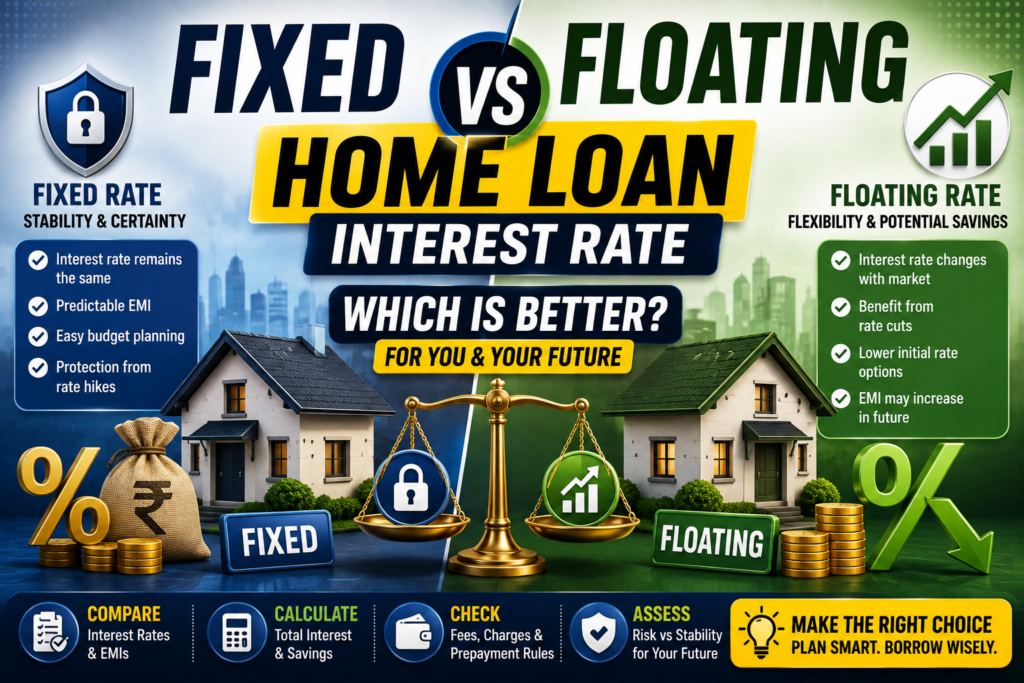
Fixed vs Floating Home Loan: A Numerical Illustration
Consider a hypothetical loan:
Loan amount: ₹50 lakh
Tenure: 20 years
Option A: Fixed
Interest rate:
8.75%
Option B: Floating
Starting interest rate:
8.25%
The floating loan begins at a lower rate.
But imagine rates rise over time and the floating rate averages:
9.25%
The floating loan could become more expensive than the fixed loan.
Now imagine rates instead decline and the floating rate averages:
7.50%
The floating loan could produce substantial savings.
This illustrates an important point:
You cannot determine which option is cheaper simply by comparing the starting rates.
The future path of the floating rate matters.
Who Should Choose a Fixed Home Loan?
A fixed-rate loan may be more suitable if:
You Want Predictable EMIs
You don’t want your monthly repayment to fluctuate during the fixed period.
Your Budget Is Tight
A significant EMI increase could create financial stress.
Your Income Is Stable but Limited
You prefer certainty over potential savings.
You Expect Rates to Rise
You believe locking in a reasonable rate provides valuable protection.
You Value Simplicity
You don’t want to monitor benchmark movements and reset dates.
However, make sure the product is actually fixed for the period you need.
Who Should Choose a Floating Home Loan?
A floating-rate loan may suit you if:
You Have Strong Repayment Capacity
You can absorb an increase in EMI.
You Have Emergency Savings
A rate increase won’t immediately destabilize your finances.
You Expect Rates to Fall or Stay Moderate
You want the possibility of benefiting from lower rates.
You Have a Long-Term Horizon
You are comfortable with market cycles.
You Plan to Prepay
Floating-rate loans can be attractive where applicable prepayment protections make early repayment easier.
But again, verify the specific rules applying to your loan.
Fixed vs Floating Home Loan for Salaried Borrowers
A salaried borrower with predictable income may be able to handle either option.
But consider your income growth.
Suppose your salary is expected to rise steadily.
A floating-rate increase of ₹3,000–₹5,000 per month may become manageable after several years.
On the other hand, if your salary is unlikely to grow significantly, rate volatility could be more difficult.
Therefore, don’t choose based only on your current EMI.
Ask:
“What happens if my EMI increases by 10%, 15% or 20%?”
If the answer is:
“I can still comfortably afford it,”
floating may be reasonable.
If the answer is:
“That would destroy my monthly budget,”
rate certainty becomes more valuable.
Fixed vs Floating Home Loan for Self-Employed Borrowers
Self-employed borrowers may have variable income.
For such borrowers, predictable repayments can sometimes be valuable.
For example:
A business owner may earn:
₹2 lakh in one month
but:
₹1 lakh the next month.
A sudden EMI increase during a weak business period could create stress.
However, if the business has strong cash reserves and income growth potential, a floating loan can still be suitable.
The decision should be based on cash-flow resilience, not simply employment category.
What About Interest Rates in the Economy?
Floating-rate loans are influenced by the broader interest-rate environment.
When monetary policy becomes tighter and benchmark rates rise, borrowing costs can increase.
When the rate environment becomes easier, floating rates can potentially decline.
But borrowers should avoid trying to perfectly predict the next RBI policy decision.
Nobody can reliably predict the entire interest-rate cycle over a 15- or 20-year home loan.
A better approach is:
Choose a loan structure that remains affordable across multiple scenarios.
The Stress Test Every Borrower Should Do
Before selecting a floating-rate loan, perform a simple stress test.
Suppose your expected EMI is:
₹40,000
Now imagine the EMI becomes:
₹44,000
Then:
₹48,000
Then:
₹52,000
Ask yourself:
Can I still pay comfortably?
Also consider other obligations:
- School fees
- Car loan
- Personal loan
- Insurance
- Household expenses
- Investments
- Emergency savings
A home loan shouldn’t consume so much of your monthly cash flow that a moderate interest-rate increase creates a crisis.
Don’t Choose Floating Simply Because It Is Cheaper Today
This is an important reality check.
Suppose:
Fixed = 8.75%
Floating = 8.25%
It is tempting to say:
“Floating is obviously better.”
Not necessarily.
You are receiving a lower starting rate because you are accepting future uncertainty.
The correct comparison is:
Expected total cost + risk of payment increases
versus
Higher fixed cost + certainty
This is essentially a trade-off between price and interest-rate risk.
Don’t Choose Fixed Simply Because It Feels Safer
The opposite mistake is also common.
A fixed rate may feel safer, but you could potentially pay more if market rates decline significantly.
Suppose:
Fixed = 9%
and floating rates later decline to:
7.5%
A fixed-rate borrower may continue paying the higher contracted rate unless the loan provides a suitable conversion option.
Therefore, certainty has a cost.
The question is whether that cost is worth paying.
How to Compare Fixed vs Floating Home Loan Offers
When comparing two offers, create a simple table:
| Factor | Fixed | Floating |
|---|---|---|
| Starting interest rate | ___% | ___% |
| Rate fixed for | ___ years | N/A |
| Benchmark | N/A | ___ |
| Reset frequency | ___ | ___ |
| Current EMI | ₹___ | ₹___ |
| Maximum possible EMI | Check terms | Scenario-based |
| Prepayment charges | Check | Check |
| Switch option | Check | Check |
| Processing fee | ₹___ | ₹___ |
| Total cost estimate | ₹___ | Scenario-based |
| Rate risk | Lower | Higher |
This forces you to look beyond the headline rate.
Questions to Ask Your Lender
Before signing, ask:
For a Fixed Loan
- Is the rate fixed for the entire tenure?
- If not, when does it reset?
- How is the post-fixed rate calculated?
- Can I switch to floating?
- What is the switching fee?
- What are the prepayment rules?
For a Floating Loan
- What benchmark is used?
- What is the spread?
- Is the spread fixed?
- How often does the rate reset?
- How quickly does the rate change after the benchmark changes?
- Can EMI increase?
- Can tenure increase?
- What happens if rates rise substantially?
- Can I switch to fixed?
- What charges apply to switching?
RBI’s consumer guidance specifically recommends asking lenders about the benchmark, rate variation, reset frequency, internal/external benchmark and spread/mark-up.
Common Mistakes Borrowers Make
Mistake 1: Looking Only at the Interest Rate
The cheapest starting rate isn’t necessarily the cheapest long-term option.
Mistake 2: Assuming Fixed Means Fixed Forever
Always check the reset clause.
Mistake 3: Ignoring the Benchmark
Floating borrowers need to know what their rate is linked to.
Mistake 4: Ignoring the Spread
A benchmark can fall while your lender’s spread remains unchanged.
Mistake 5: Choosing a Loan Based Only on EMI
A lower EMI can result from a longer tenure.
Mistake 6: Ignoring Prepayment Rules
This can matter significantly if you plan to repay early.
Mistake 7: Underestimating Rate Risk
A floating rate can increase.
Mistake 8: Trying to Predict 20 Years of Interest Rates
You can’t reliably do that.
Instead, stress-test your finances.
Frequently Asked Questions
Is fixed or floating home loan better?
Neither is universally better. A fixed loan prioritizes repayment certainty, while a floating loan provides the possibility of benefiting from falling rates but exposes the borrower to increases.
Is floating interest rate risky?
It carries interest-rate risk because the applicable rate can change. Borrowers should ensure they have enough financial headroom to handle higher EMIs or longer tenure.
Can floating home-loan rates decrease?
Yes, depending on movements in the applicable benchmark and the lender’s pricing mechanism.
Can a fixed home-loan rate increase?
If it is a genuine fixed-rate loan for the entire applicable period, the contracted rate does not change during that fixed period. However, hybrid or special-rate products may reset after the fixed period, so borrowers must read the agreement carefully.
What is better for a 20-year home loan?
There is no universal answer. For a long tenure, borrowers should focus on affordability under different interest-rate scenarios rather than trying to predict the exact future rate cycle.
Can I switch from floating to fixed?
Some regulated lenders may provide a switch option subject to their Board-approved policy and applicable charges. RBI’s framework for EMI-based floating-rate loans requires regulated entities to provide applicable switch options and transparently disclose related charges where the framework applies.
Can I prepay a floating-rate home loan without penalty?
Banks cannot charge foreclosure/prepayment penalties on floating-rate home loans in the applicable circumstances, and RBI has extended similar protections to certain floating-rate term loans for individual borrowers. However, the exact applicability depends on the loan and lender.
Is a fixed home loan always more expensive?
Not necessarily. Its cost depends on the fixed rate offered and how floating rates behave over the loan period.
Final Verdict: Fixed vs Floating Home Loan — Which Is Better?
The Fixed vs Floating Home Loan decision is ultimately a decision about risk.
A fixed-rate loan asks you to pay a premium for greater certainty.
A floating-rate loan gives you the possibility of benefiting when rates decline, but you accept the possibility that your borrowing cost can increase.
Therefore, there is no universal answer.
A fixed-rate home loan may be better if:
- You strongly value EMI stability.
- Your monthly budget has limited flexibility.
- You want predictable long-term payments during the fixed period.
- You are uncomfortable with interest-rate fluctuations.
- The fixed rate is reasonable compared with the floating alternative.
A floating-rate home loan may be better if:
- You have strong repayment capacity.
- You have adequate emergency savings.
- You can tolerate EMI increases.
- You want to benefit if interest rates decline.
- You expect to make significant prepayments.
- The floating rate is meaningfully cheaper and the loan terms are transparent.
But here’s the most important reality check:
Don’t try to predict whether interest rates will be higher or lower 15–20 years from now.
Instead, ask:
“Can I comfortably afford this loan even if interest rates move against me?”
If yes, floating may offer attractive flexibility.
If no, the certainty of a genuinely fixed rate may be worth the additional cost.
Also remember that a hybrid or dual-rate loan is not the same thing as a pure fixed-rate loan. If the lender fixes the rate for only two or three years and then moves you to floating, you are still exposed to future interest-rate changes.
Before signing, compare:
Interest rate → Benchmark → Spread → Reset frequency → EMI → Tenure → Prepayment rules → Switching charges → Total cost
And get the terms in writing.
RBI’s consumer guidance itself recommends that borrowers ask about the benchmark, reset frequency, spread/mark-up and whether the fixed rate remains fixed for the entire tenure or only a specified period.
The smartest choice isn’t necessarily the loan with the lowest starting rate.
It is the loan whose cost and risk you can comfortably manage throughout the period you expect to borrow.
Useful Outbound Resources
- Reserve Bank of India – Home Loan FAQ — RBI consumer guidance on fixed and floating home loans, reset clauses, benchmarks, spreads and APR.
- RBI – Reset of Floating Interest Rate on EMI-Based Loans — Official RBI framework covering communication of rate-reset impacts and borrower options for applicable EMI-based floating-rate loans.
- RBI – Handbook on Regulations at a Glance — RBI overview of current lending-rate and external-benchmark requirements.
- RBI – Floating-Rate Home Loan Prepayment Guidelines — RBI guidance on foreclosure/prepayment penalties for applicable floating-rate loans.
- RBI – Home Loans: Foreclosure Charges / Prepayment Penalty — RBI’s specific guidance on floating-rate home-loan prepayment penalties for banks.
Learn when a Home Loan Balance Transfer actually makes sense. Compare interest savings, processing fees, tenure, EMI, foreclosure costs and break-even before switching lenders.
